

Corporate political giving disclosure: Why transparency matters for investors
How Bailard’s NFI Capture framework evaluates political transparency in a post-Citizens United world
Historically, corporate political giving was a bi-partisan affair. But like many aspects of society in the past decade, it is becoming less so. Corporate political giving has also been supercharged by the Supreme Court’s decision in the Citizens United v Federal Elections Commission in 2010, which left Corporations unconstrained in how much they give to PACs and Super PACs. The decision immediately increased the influence of corporate political spending on elections (especially local and state elections) while at the same time making it more difficult to track this spending. In response to Citizens United, Bailard’s sustainable and responsible investment scoring framework for non-financial information (NFI Capture) has always included a factor measuring corporate political spending disclosure. The issue was relatively “under the radar” until the aftermath of January 6, 2021 when scrutiny on corporate political giving became a focus of responsible investing and shareholder engagement.
Why political spending disclosure matters to investors
We focus on the disclosure of political giving policies and procedures because, in a world of so-called “Dark Money”, it is so difficult to “follow-the-money” from an individual big donor or corporation to a candidate. The use of 501(c)(4)s, for example, has grown in prominence since Citizens United, and their donors are totally untraceable. This was not the court’s intention, but this is what has transpired.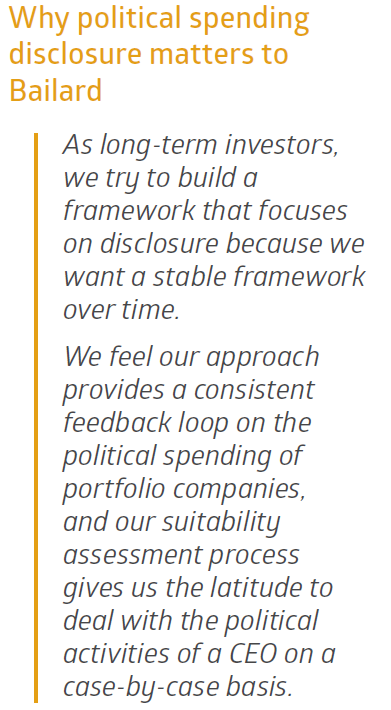
Opaqueness always makes the job of a sustainable and responsible investor more difficult. That is why transparency in corporate political spending has always been the focus of corporate engagement work—pressing for voluntary disclosure or advocating for the development of standardized ESG reporting and political spending disclosure standards. In order to “score” an activity or pattern of behavior, you need to be able to track data reliably, not just for a moment in time, but quarter after quarter, year after year. Corporate political giving in our current environment is not a category where this kind of consistent, comparable disclosure is possible.
NFI Capture political giving framework
Our proprietary NFI scoring framework’s Political Disclosure score can increase or decrease the overall NFI Capture score for a company. We believe this is a directional feedback loop to signal whether a company is moving in a positive direction towards transparency.
CEO political giving and shareholder risk
A related area of political spending that we view as a less reliable indicator is individual CEO political giving. Historically, shareholders and investors paid little attention to CEOs’ personal political contributions, which were generally understood to reflect individual beliefs, socio-economic interests, or personal relationships rather than the interests of the company or its shareholders. However, as political polarization has intensified and social media has amplified public scrutiny, CEOs have increasingly come to be viewed through a political lens, elevating the visibility and perceived significance of their personal political activities.
As a firm, we address exclusions of companies that fall into this category on a case-by-case basis through a suitability assessment process. For practical and philosophical reasons, this is why we focus on measuring a company’s level of political spending disclosure.
In our approach, evaluating the personal political giving of CEOs would only be appropriate if those actions were inextricably linked to the company, and there appears to be a deliberate risk associated with the behavior of the CEO (either reputational, legal, or ethical).
501(c)(4) political spending and disclosure standards
As mentioned previously, politically active nonprofits organized under Section 501(c)(4) of the Internal Revenue Code are another significant recipient of corporate political contributions. 501(c)(4)s may engage in unlimited spending and political campaigning as long as such activity is not their primary focus (although this definition is not concretely defined). Contributions to these organizations are subject only to voluntary political spending disclosure, and there is no way to confirm whether a company gives to a 501(c)(4) unless the company itself discloses that information. Additionally, there is limited oversight over how payments are ultimately deployed, leaving it virtually impossible to trace dark money contributions back to their source.
Some 501(c)(4)s maintain websites listing some or all of their supporters, but for the most part, those organizations are less likely to be involved in election-related spending than the more opaque 501(c)(4)s that dominate this space.
We look for companies with a clear political spending disclosure policy that either prohibits the tax-exempt groups they contribute to from using those payments for election-related purposes, or prohibits such contributions entirely. Full credit is awarded to companies that provide itemized political spending disclosures — naming the politically active tax-exempt groups they support and the amounts given to each. Partial credit is awarded to companies offering partial disclosure, and no credit is given to companies that do not disclose this corporate political spending or that report only a single aggregate figure.
Conclusion
In the post-Citizens United environment, making consistent, comparable analysis of direct political spending has become increasingly difficult. Our approach emphasizes the quality of corporate policies, governance, and disclosure—rather than attempting to track the relatively small political spending that takes place outside the opaque super-structure of 501(c)(4)s, PACs, and SuperPACs.
Like many issues, how an activity is viewed in society depends on multiple factors, and it changes over time. As long-term investors, we try to build a framework that focuses on disclosure because we want a stable framework over time. We feel our approach provides a consistent feedback loop on the political spending of portfolio companies, and our suitability assessment process gives us the latitude to deal with the political activities of a CEO on a case-by-case basis.
Download the full issue brief here.
Recent Insights
Keep Informed
Get the latest News & Insights from the Bailard team delivered to your inbox.