

Higher rates have made 2026 a hard year for bond investors, and the AI boom may be the next to feel them.
By Jon Manchester, CFA, CFP®, Senior Vice President, Chief Strategist, Wealth Management.
We might forgive bond investors for the dour mood. They had become rather accustomed to the comforting routine of collecting semi-annual interest payments, seldom bothered by rising interest rates or unexpected inflation amid a 40-year downtrend for long-term interest rates. In fact, over the half-century ending with 2025, the Bloomberg U.S. Aggregate Bond Index only produced negative total returns (accounting for both price changes and income) in five of those years. Only three such instances occurred before 2021-22, when the post-COVID inflation spike sent interest rates up and bond prices down. Magnitude matters as well: the Index posted a modest decline in 2021 before sinking a stunning 13% in 2022, while the U.S. registered inflation readings not seen since the early 1980s. With 2026 on track for another negative year for bonds, discontent has started to creep in, particularly for the considerable cohort of bond investors who simply want to generate drama-free income on an annual basis and ideally outpace inflation. On the road to riches, investing in bonds is taking the dirt road—aboard a tractor hauling a hay wagon—so tolerance for potholes is limited.
With the 2022 inflation shock still looming large in the bond market’s psyche, sensitivity is heightened to any upward moves in the broad level of prices. Crude oil traded at an average price of nearly $87 per barrel in the third quarter, approximately 32% higher year-over-year. Its ascent, largely a consequence of the Iran war, pushed the trailing 12-month change for the headline Consumer Price Index (CPI) above 4% earlier this year, before easing to a still uncomfortably high 3.4% rate in August. The bond market has adjusted accordingly, with the benchmark 10-year U.S. Treasury Note yield at 5.27% by quarter-end, its highest level since 2002 and up from 4.17% at the end of 2025. Part of that northward move reflects the anticipated impact of current inflation numbers on monetary policy, a higher rate for longer. But it also captures expectations for sustained strength in economic output and, in turn, corporate profit growth. In other words, tighter monetary policy may be required to restrain the economy from overheating. Toss in the longer-term concerns around the worsening U.S. fiscal situation, and you have a complicated decision tree for bond investors.
Interestingly, the higher yield does not reflect a change in long-term inflation expectations. According to the Federal Reserve Bank of St. Louis, the bond market expects inflation of roughly 2.4% annually over the next decade, only slightly higher than the so-called breakeven rate at the outset of 2026.1 If that inflation estimate proves to be in the right ballpark, buying a 10-year U.S. Treasury Note today would mean realizing a nearly 3% annual “real” or inflation-adjusted return. Considering that over the last 25 years CPI inflation averaged a 2.5% annual growth rate while the 10-year U.S. Treasury Note yield mostly languished below 4%, earning a potential 3% real return could encourage some capital to flow back into the bond market. It is also worth noting that for investors who buy and hold bonds until maturity, changes in market interest rates ultimately have no bearing on the return for bonds held to maturity: the return is set upon purchase. Inflation is the wildcard to worry about, in that case.
Dueling banjos
 Federal Reserve chair Kevin Warsh has the distinct pleasure of fighting inflation (and critics) while trying to avoid tipping the economy into recession. After vowing to deliver price stability upon taking the job, Warsh and the Federal Open Market Committee (FOMC) took an initial step past jawboning by announcing the first hike in the target Fed Funds rate since 2023. Warsh said the increase to a target range of 3.75% to 4.00% “removed a dose of accommodation.” The phrasing raised some eyebrows, given the Fed’s policy rate was already above the FOMC’s current estimate of the long-run neutral rate (where policy is neither accommodative nor restrictive) at 3.25%. Without going down the rabbit hole of this largely academic debate, the important takeaway is that the FOMC may need to raise the Fed Funds target rate further, which could slow economic growth and weigh on certain segments of both the bond and equity markets. As an example, the worst-performing S&P 500 Index industry groups during the third quarter included the yield-sensitive Utilities and Real Estate Investment Trusts (REITs), plus Consumer Services and Consumer Durables & Apparel, where higher borrowing costs could hurt.
At risk of a (very) dated reference, the 1972 film Deliverance starred Burt Reynolds and Jon Voight on a whitewater canoeing trip with two other businessmen from Atlanta in a remote area of northern Georgia. One iconic scene involved a musical duel between a country boy playing a banjo and one of the businessmen on guitar. The song is called “Dueling Banjos,” and it climbed as high as #2 on the Billboard Hot 100 list the following year. The back-and-forth exchange feels a little like the dueling narratives we hear each day in the markets. For the bulls, the AI buildout has plenty of room to run; equity valuations remain reasonable broadly speaking, and estimated S&P 500 earnings per share growth of 34% this year means the corporate profits party continues. Bears point to the FOMC moving more restrictive (“Don’t Fight the Fed”), while the economy tries to absorb higher costs, plus a concentrated U.S. equity market that is overly reliant on the AI theme for growth, among other issues. You’d have to say the bulls are leading the banjo duel: it’s hard to argue with the bottom line. However, both stocks and bonds could use a little debt-liverance, at least with respect to relief from higher rates.
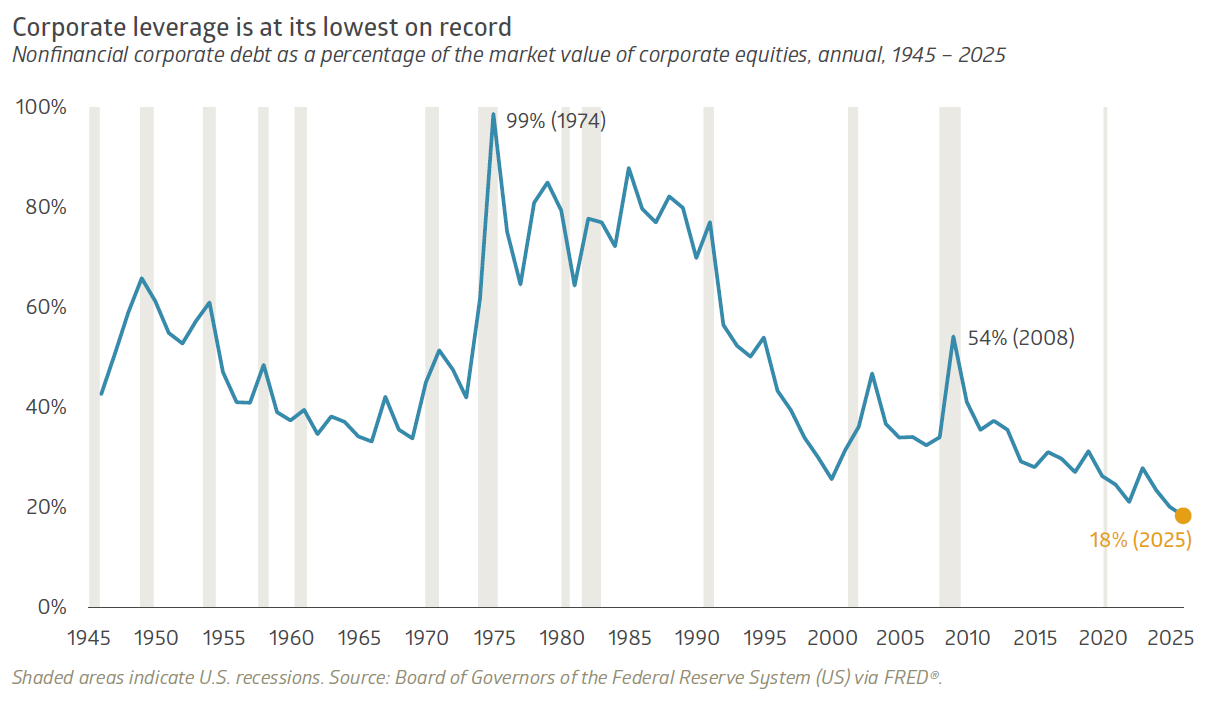
Corporate America has been unafraid to pony up to the borrowing bar. In August, U.S. investment-grade bond sales set a third straight monthly record high, as supply hit $145 billion for the month, easily above 2020’s total of $136 billion.2 With the AI buildout at full throttle, eight deals in 2026 have hit the market sized at $25 billion or higher, all issued by technology companies. Despite the glut of debt offerings, corporate balance sheets still look healthy. As shown below, debt as a percentage of market value for nonfinancial firms is at its lowest level since 1945.3 Admittedly, part of that is due to rising market values, but the current 18% level is nowhere near what we saw in past recessions, COVID-19 aside. A long period of low borrowing rates has also helped.
Kind of a big deal
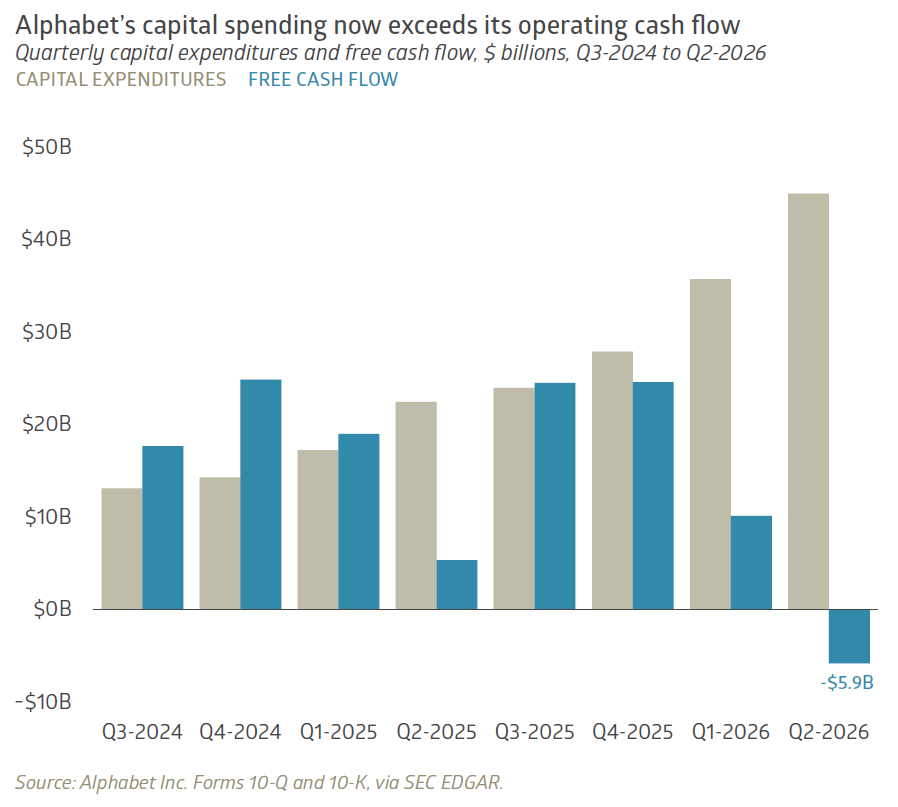
The gilded firms of AI royalty continue to apply all gas, no brakes. In late July, Alphabet reported Q2 revenues of nearly $120 billion – a 24% year-over-year increase and the twelfth straight quarter of double-digit topline growth. Expenses jumped as well, with capital expenditures (capex) of $45 billion, doubling from a year ago. Alphabet upped its capex guidance to $200 billion for the full year, which would be a 119% increase over 2025. The Wall Street consensus estimate for Alphabet’s 2027 capex spend is $300 billion! Investors were not overly enamored with the additional allowance. The stock declined 7% on the day following earnings, in part a reaction to the company’s negative Q2 free cash flow (FCF) of $5.9 billion. To be fair, Alphabet had still managed to generate $53 billion of FCF over the trailing 12 months.
These are staggering numbers, and Alphabet is certainly not alone in this high-stakes game. Nvidia, a beneficiary of the capex spend, is also increasingly financially intertwined with seemingly the entire AI ecosystem. In September, the company announced that the Board had approved a $150 billion increase to the share repurchase plan, taking the total authorization to $250 billion. Nvidia said it marked the largest share repurchase authorization increase in history, which no one doubted. Only 47 stocks in the S&P 500 currently carry a market capitalization above that $250 billion level. With Nvidia’s market cap at nearly $6 trillion, the buyback will amazingly only equate to around 4% of its shares. Like Alphabet and other megacap tech companies, Nvidia is growing impressively at scale. CFO Colette Kress said in late August that Nvidia expects to grow fiscal 2028 revenues by approximately 70%. She added, “This is a supply-constrained outlook,” meaning demand is even higher than the 70% growth rate implies.4
This powerful AI growth cycle now faces an additional challenge in the form of higher borrowing costs, both Fed- and market-determined. Irresistible force meets immovable object. A recent Wall Street Journal article cautions that, “Booms need continuous flows of fresh capital to perpetuate themselves. History shows they can start turning into busts the moment the window to raise new capital closes.”5 We’re not there yet, the article acknowledges, but if the capital spigot turns off, the momentum behind the AI trade could quickly reverse.
For now, the equity market appears to be sticking with risk-on mode. Equities did falter in September, however, historically the worst month of the year for stocks. The S&P 500 Index declined by a modest 0.4%, but the S&P 500 Equal Weighted Index fell 4.8%, a sign that the average stock is facing more hardships than those raking in AI cash. With interest rates now higher, some balance sheets could be stress-tested in the quarters ahead. Cue the banjo music, though. Baird Strategas points out that the estimated next 12-month S&P 500 operating margin is up to 21.5%.6 That is well above the Index’s 15% average over the last five years, indicative of an increasingly Tech-heavy market still in the fast lane.
# # #
1. “10-Year Breakeven Inflation Rate,” https://fred.stlouisfed.org, 10/5/2026.
2. “US High-Grade Bond Sales Set August Record in Year Full of Them,” www.bloomberg.com, 8/17/2026.
3. “Nonfinancial Corporate Business; Debt as a Percentage of the Market Value of Corporate Equities,” https://fred.stlouisfed.org, 9/11/2026.
4. “Q2 2027 Earnings Call,” https://investor.nvidia.com, 8/26/2026.
5. “How to Know When the AI Boom Is About to Go Bust,” www.wsj.com, 9/27/2026.
6. “Momentum Continues, With Caution.” www.bairdstrategas.com, 9/22/2026.
Past performance is no indication of future results. All investments involve the risk of loss. Please see the last page for important disclosures as well as index and category definitions.
Recent Insights
Keep Informed
Get the latest News & Insights from the Bailard team delivered to your inbox.