

Health care paperwork, a short money conversation, a first Roth IRA, and a beneficiary check: four items that are easier to take care of when the family is in one place.
By Alexandra Labagh, Portfolio Associate and Mikhail Saliba, CFP®, Estate and Financial Planning Associate
There’s a particular kind of magic to having everyone back under one roof for the holidays with school, work, and busy schedules on pause. It’s also one of the few times all year when a short, low-key financial conversation can actually happen and a practical task or two can get done.
Here are four things worth putting on the family checklist this year.
Celebrate adulthood with paperwork
The moment a child turns 18, even if it doesn’t feel like it as a parent or grandparent, they are legally an adult. A hospital may no longer be able to update a parent on their own child’s condition. A college may not be able to discuss a grade, a health issue, or a disciplinary matter with a parent, even in a real emergency. This applies just as much if you’re a grandparent who helps with tuition or is listed as an emergency contact. Without the right paperwork, you may have no legal standing to be informed or to act, no matter how involved you are. For kids away at school, the physical distance makes this an even bigger problem.
Fortunately, the fix is simple, and having the family together is the easiest time all year to handle it. Four documents cover most of what’s needed:
- Medical (Healthcare) Power of Attorney: lets a parent or another designated adult make medical decisions if the young adult can’t.
- HIPAA Release: grants medical providers permission to share health information and discuss treatments with the designated adult.
- FERPA Release: lets the college share academic or disciplinary information with the designated adult.
- Durable (Financial) Power of Attorney: lets a trusted adult step in on a bank account, lease, or tax matter if it’s ever necessary.
Sourcing this paperwork is also easier than you might think. The HIPAA and FERPA releases are short, standard forms that require little information beyond signatures. We recommend asking your child’s primary care physician for the HIPAA release, and their university for the FERPA release.
Medical and Financial Powers of Attorney take more thought. They are legal documents, and rules vary by state, so they are best drafted by an attorney. Bailard can give you access to an online platform where you can create them at no cost. Please contact your Investment Counselor for more information.
Have a short money conversation
No one wants to turn family dinner into a finance seminar, and you don’t have to. A few minutes of casual conversation can go a long way.
Budgeting basics. Your young adult doesn’t need a spreadsheet, just a general sense of what’s coming in versus what’s going out each month. Even that simple awareness tends to prevent a lot of financial stress down the road.
Building credit early. If they don’t already know, it’s worth explaining what a credit score is in plain terms: essentially a track record of how reliably someone repays what they borrow. Using a first credit card responsibly, small purchases paid off in full, is one of the easiest ways to start building that track record.
Common credit-card mistakes. Some quick warnings can save real money: carrying a balance (it costs interest and doesn’t build credit), missing a payment due date, or opening several new accounts at once just to “build credit faster.” Slow and steady wins here.
 Paying yourself first. Even a small automatic transfer into savings from every paycheck builds a habit that can last a lifetime. The amount matters far less than consistency, and a young adult has plenty of years ahead for that habit to compound.
Knowing where to ask questions. Perhaps most importantly, encourage them to ask before they act, whether that’s you, a grandparent, or a financial professional, rather than after a decision is already made.
If your student would rather hear some of this from someone other than Mom, Dad, Grandma, or Grandpa, we are always happy to have a short, no-pressure conversation directly with them.
Consider a Roth IRA for a working student
Here’s where the holidays can turn into something more than a good conversation: a genuine head start.
If your child earned income this year from a summer job, internship, or part-time work, they may be eligible to contribute to a Roth IRA. The contribution generally can’t exceed the student’s eligible earned income for the year, and it’s also subject to the annual IRA contribution limit in effect for that year. For 2026, the maximum is $7,500.
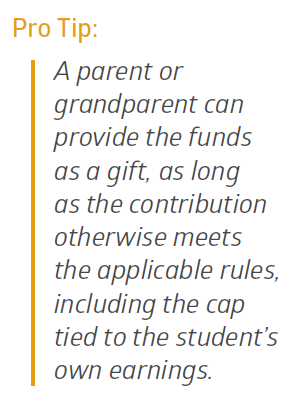 Why does starting this early matter? Money contributed now has decades to potentially grow, though investment values can also fall. Qualified withdrawals from a Roth IRA in retirement can generally be tax-free under current rules. Think of it as your young adult’s first real investing lesson — and for you, a meaningful gift that teaches a habit money can’t buy on its own.
The holidays are a convenient time to tackle this. You likely have easy access to pay stubs (a W-2 usually doesn’t arrive until January), and everyone is already in the same place to open the account together and talk through investing basics. The good news: you can generally contribute for 2026 until the tax filing deadline in April 2027, so there’s no need to rush the paperwork over pie. Just use the time together to get the conversation started.
If you’d like help figuring out whether a working student in your family may be eligible for a Roth IRA, or how to get one started, we’re happy to help.
The kids are not the only ones with work to do before the new year
The end of the year is also a great time for you and your family to make sure your beneficiary designations match your wishes. Relationships change, children (or grandchildren!) are born, and people pass away. It is easy to set your beneficiaries when you open an account and then never touch them again, but circumstances change. If you pass away with outdated beneficiaries on file, your heirs often have little they can do, even if they know what you wanted.
IRAs are the accounts most people think about when checking beneficiaries, but 401(k)s, life insurance policies, and taxable transfer-on-death (TOD) accounts have them too.
It’s also worth adding contingent, or backup, beneficiaries (alongside your primary ones) in case the primary beneficiary predeceases you or a catastrophe involves both of you. It may seem like a small thing, but the 20 minutes it takes could save the people you love days of bureaucratic headache.
A rare window worth using
Having the whole family together like this doesn’t happen often. A few honest conversations and a little planning now can make the years ahead easier for everyone.
# # #
The tax rates and rules described in this article reflect Federal law in effect as of the date of publication and are subject to change. This material is provided for educational purposes only. Neither Bailard nor any of its employees can provide tax or legal advice. Please consult your tax advisor regarding your particular situation.
Recent Insights
Keep Informed
Get the latest News & Insights from the Bailard team delivered to your inbox.