

Monday Macro with Dave
Weekly perspective on current developments, emerging risks, and potential implications for investors.
Parsing signals from noise in job reports and the labor market
Dave Harrison Smith, CFA
Chief Investment Officer
March 30, 2026
Markets are increasingly pricing in a more prolonged Middle East conflict and sustained pressure on energy prices. Our focus remains on how that transmits through to markets and portfolios. A key starting point is the condition of the U.S. economy heading into the conflict.
This week’s data, including retail sales, ISM manufacturing, and labor reports from ADP, Challenger, and the Bureau of Labor Statistics (BLS), should help establish that baseline.
Last month’s Nonfarm Payrolls report from the BLS missed expectations by a wide margin, showing a decline of 92,000 jobs versus forecasts for a modest gain of 55,000. The release raised concerns about labor market weakness heading into the Iran conflict and briefly reignited discussion around “stagflation.” It also ran counter to the prevailing view that the labor market was cooling, but not breaking.
Payroll miss likely reflects strikes and weather, not a trend break
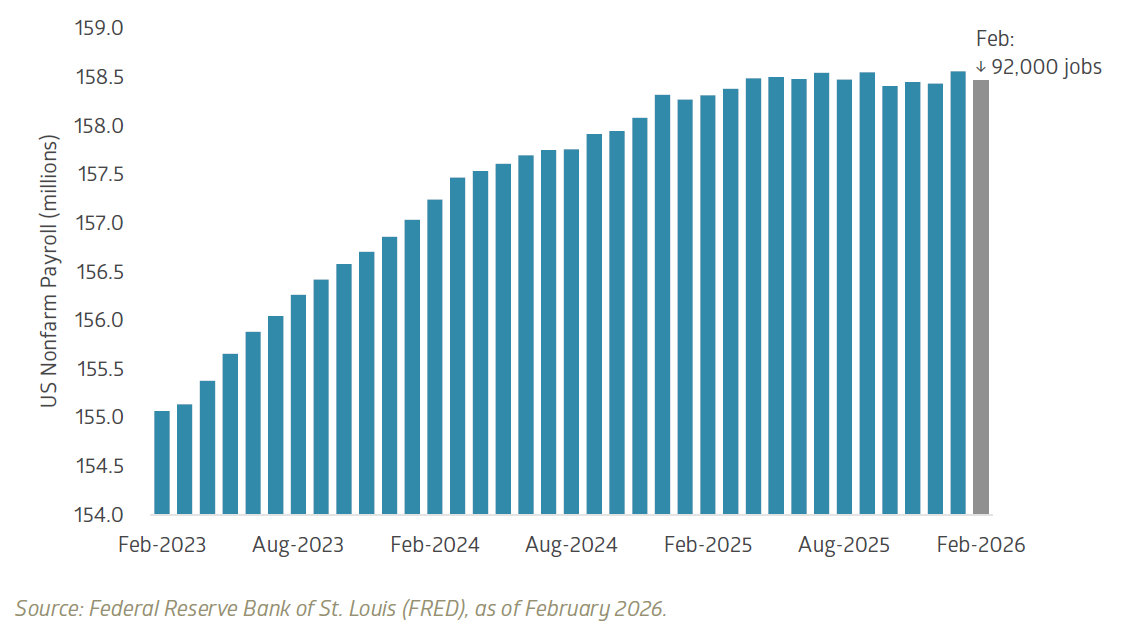
Importantly, the February BLS data included several one-time distortions, including labor strikes and severe weather. Other indicators, such as ADP data and unemployment claims, have shown more resilience in recent weeks. That said, layoffs have picked up at the margin, with announcements from UPS, Meta, and Amazon in the first quarter. The next BLS report, due Friday, will carry added weight.
Stagflation concerns in context
Concerns around stagflation have risen sharply in recent weeks. Defined as weak growth alongside elevated inflation, the concept remains anchored in the oil shocks of the 1970s.
Federal Reserve Chair Jerome Powell pushed back on that comparison following last week’s Federal Open Market Committee (FOMC) meeting, noting today’s backdrop of roughly 3% inflation and 4% to 4.5% unemployment stands in stark contrast to the double-digit levels seen in that era. As he put it, “I would reserve the term stagflation for a much more serious set of circumstances. That is not the situation we’re in.”
Still, the tension is real. The Fed’s dual mandate is being tested by an energy shock that could push inflation higher while weighing on growth. That dynamic has been enough to pressure equity valuations, even as earnings expectations remain strong. With valuations already elevated, there has been little room for error.
As Kenneth Rogoff noted in the Financial Times:
“Coming on top of the ongoing Ukraine and tariff wars, the Iran war is shaping up as the biggest stagflationary shock the world has seen in five decades.”
Rising deficits, rising yields, fewer hedges
Global bond yields have continued to trend higher since the onset of the Iran conflict. Last week saw the U.S. 10-year reach 4.44%, Germany’s bund rise to 3.10%, and Japan’s JGB to 2.34%, while the U.K. gilt was a modest exception, easing slightly to 4.92%.
Deficit concerns remain front and center. The U.S. was already projected to run deficits of 5% to 7% of GDP in the coming years. Add higher energy prices, geopolitical uncertainty, and policy constraints, and confidence in those projections has started to erode.
The result is a more challenging environment for diversification. Equities have faced valuation pressure, while bonds, typically viewed as a ballast, have also struggled as yields rise and prices fall. The Bloomberg Aggregate Index is down 2.49% month-to-date and 0.79% year-to-date. Modest in absolute terms, but notable given the volatility elsewhere.
# # #
Past performance is no indication of future results. All investments have the risk of loss.
The information in this publication is based primarily on data available as of its publication date and has been obtained from sources believed to be reliable, but its accuracy, completeness, and interpretation are not guaranteed. Bailard undertakes no duty to update any of the information contained herein, and such opinions are subject to change without notice. We do not think this publication should necessarily be relied upon as a sole source of information and opinion. This publication is not a recommendation of, or an offer to sell or solicitation of an offer to buy any particular security or investment product. It does not take into consideration the particular investment objectives, financial situations, or needs of individual clients.
Any indices or other financial benchmarks referenced are provided for illustrative purposes only. Indices are unmanaged, reflect reinvestment of income and dividends, and do not reflect the impact of advisory fees. Investors cannot invest directly in an index. Any individual securities referenced herein are for illustrative purposes only and not necessarily representative of investments that have been made or will be made in the future. Bailard, Inc. makes no recommendation to buy or sell securities discussed herein. Bailard clients may hold positions in the securities discussed and may buy or sell such securities at any time.
Certain information may constitute “forward-looking statements,” which can be identified by the use of forward-looking terminology such as “may,” “will,” “should,” “expect,” “anticipate,” “project,” “estimate,” “intend,” “continue,” or “believe,” or the negatives thereof or other variations thereon or comparable terminology. Due to various risks and uncertainties, actual events, results or actual performance may differ materially from those reflected or contemplated in such forward-looking statements.
Bailard, Inc. does not provide investment advice in jurisdictions where it is not authorized to do so.
Recent Insights
Keep Informed
Get the latest News & Insights from the Bailard team delivered to your inbox.