

The unintended consequence of Artificial Intelligence: Higher yields on U.S. government debt
Sustainable, Responsible and Impact Investing
September 29, 2026
Artificial Intelligence (AI) has become the dominant driver of U.S. economic growth, but its massive capital expenditure requirements are reshaping debt markets. While AI spending has kept the economy out of recession, the pivot toward debt financing is increasing supply of long-duration bonds, putting upward pressure on U.S. Treasury yields. This unintended consequence threatens to destabilize government finances, echoing past episodes of “Bond Vigilantes” but with far greater debt burdens today.
Understanding the neutral rate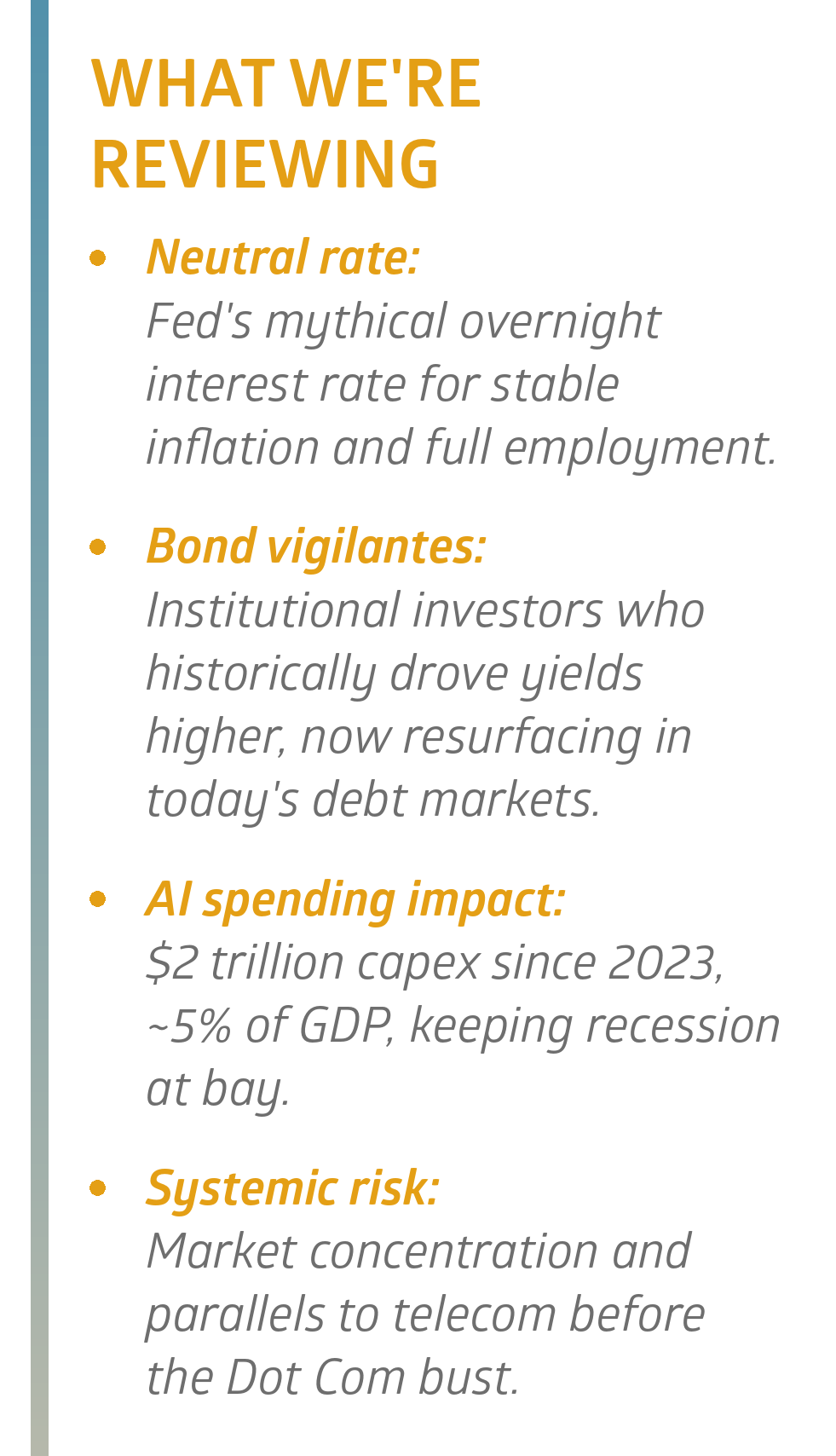
The “neutral rate” is the mythical overnight interest rate for an economy with stable inflation and full employment. The Federal Reserve Bank (Fed) sets the rate by committee. It is not a specific number. In fact, it is so fanciful a concept Wall Street analysts call this type of economic condition “Goldilocks”; not too hot and not too cold. Yields on the longer-dated U.S. bonds, are a different story. They aren’t set by committee. They are set by the bond market which is now being impacted by the artificial intelligence (AI) boom. That could ultimately mean higher rates and that is not good news for the U.S. Treasury Department.
Bond vigilantes: Past vs. present
Of course, the U.S. Treasury Department is no stranger to market forces driving up yields on its long-dated debt. When inflation spiked in the early 1980s, the “Bond Vigilantes” rode into town and started selling government securities driving up rates. While the moniker is worthy of an Ennio Morricone soundtrack, it was coined by economist Ed Yardeni. Who are they? The “Bond Vigilantes” are the large institutional investors who buy long-dated U.S. Treasury Bonds. These investors have long-term time horizons and as a result, are more concerned with the levels of national debt and budget deficits in Washington than the average stock investor. In 1981, selling by these “Bond Vigilantes” forced the U.S. long bond up to 15%. That would be catastrophic to the U.S. economy if something similar happened today.
This is where AI comes in — and not in a good way. AI is the driving force in the US economy today. AI is the 800-gigawatt gorilla. The elephant in every room. Yet, it is always a double-edged sword. Will AI cure cancer, or is it an existential threat to humanity? Will it solve the climate crisis, or use so much energy and water in the process it tips the planet to the point of no return? The AI-led tech sector’s cozy relationship with Washington is starting to cut both ways too. With overt support from the U.S. administration, AI spending has kept the US economy afloat and driven the stock market higher and higher. But it could soon do the same for yields on long-term treasuries which would have the opposite effect; it would hurt the stock market, slow the economy, and cripple the U.S. Government’s ability to balance its budget.
AI spending and U.S. GDP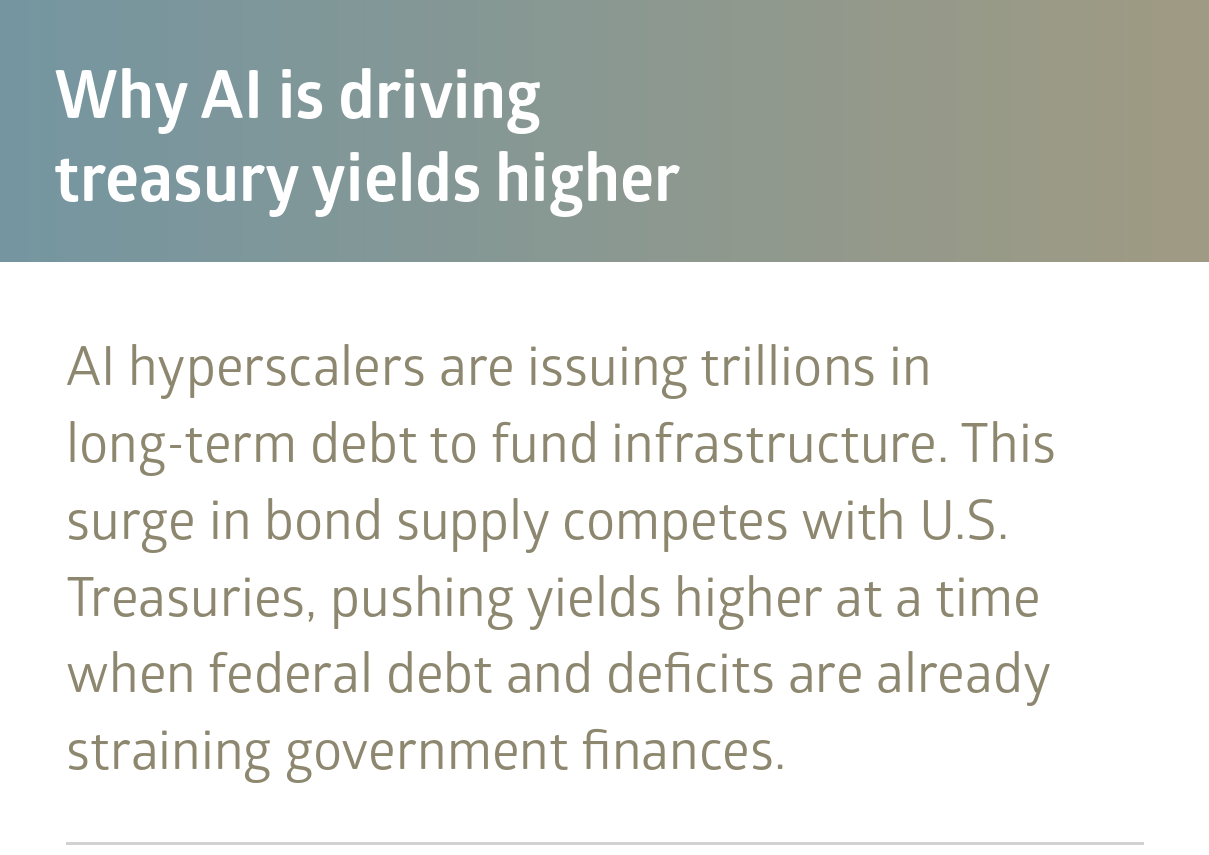
First, the good news: the $2 trillion of capex (capital expenditures) spent on the AI build-out since 2023 kept the U.S. out of recession.1 By some estimates the AI build-out now accounts for 5% of US GDP.2 Up to this point, the spending has come exclusively from the free cash flow of the tech behemoths behind the AI buildout. It has not forced the cost of capital higher in the general economy. Now, the bad news: these AI “hyperscalers” are now turning to the debt market to fund the estimated $5 trillion to be spent by 2030.3 That increases the supply of long-duration bonds on the market and puts additional upward pressure on long-term rates at the worst time possible.
While the US economy was in a precarious position when the “Bond Vigilantes” appeared in 1981, the U.S. balance sheet was in much better shape. In fact, the federal debt to GDP ratio in 1981 was 32% compared to 126% at the close of 2025.4 To put that into dollars owed, the U.S. national debt crossed $1 billion for the first time in 1981. In 2026, it crossed the $40 trillion level. The U.S. needs lower rates to keep the carrying costs of the national debt from choking off all other spending. Today, the U.S. already spends more on net interest expense than it does on defense.5
Treasury yields under pressure
This is what triggered Treasury Secretary Scott Bessent’s recent $6 billion Treasury Bond buy-back to force down the yields of the long bond.6 It didn’t work. To be clear, the U.S. balance sheet and deficit spending already place huge upward pressure on the yields of U.S. Treasuries. The 30-year bond was at 4.61% the day before the war on Iran began. It has moved to over 5.3% in the six months since. The U.S. ten-year bond has crossed the meaningful 5% level. But now, investors in long-dated bonds have more supply.
And it is happening fast. By the end of the 1980s, corporate bond maturities averaged 8-10 years. That drifted up to a average maturity of over 12 years during the long, zero-interest stretch following the great financial crisis. In 2026, despite the higher interest rates, the average maturity of corporate debt is over 15 years – including a rare “century bond” issued by Alphabet. In all, the five largest hyperscalers have already issued $500 billion in long-term debt over the past year to help finance the AI buildout.7 By most estimates, another trillion dollars will be financed in the next three years.8
The average debt rating of the five largest hyper-scalers is A to AA+. With current spreads between 60 and 100 basis points higher than equivalent U.S. government bonds9, this makes the longer-issued AI-linked debt attractive to the same pension fund and insurance buyers of long-term government debt. This puts upward pressure on the yields of U.S. government long-dated bonds.
Meanwhile, this race to fund the AI buildout is changing the composition of the investment grade debt market as well. In the first half of 2026, the largest hyper-scalers issued $165 billion in investment grade debt. They now account for 10% of the Bloomberg U.S. Corporate Index.10 11 Although not as extreme as the concentration of this cohort in the S&P500, growing concentration in fixed income indices raises the risk for the overall economy. While AI-linked bonds still represent only a small part of the overall investment grade and high yield markets, so did telecom bonds in 1995. By 1999, on the eve of the Dot Com bust, telecom represented over 20% of the index.12
It is happening in the high yield debt market too. While AI-linked credit comprises less than 2% of high yield indices today, it accounts for 41% of new issuances in the first half of 2026.13 The AI infrastructure buildout is also dominating the private credit world. By some estimates, private credit will be financing over one trillion of the AI infrastructure build-out in the next three years.14 In total, this represents a massive amount of counter-party risk throughout the financial system.
Systematic risk from AI debt
In our view, AI-related capital spending has kept the U.S. economy from getting cold enough to slide into recession but not hot enough to force a rate hike for over three years. AI spending also drove stock market returns higher. But now AI could create a headwind by forcing bond yields higher. This would create a real headache for a cash strapped U.S. Government. And the Fed, which is also contending with political pressure and inflation from tariffs and war, will have to thread a needle more than usual to find that “Goldilocks” neutral rate in a rapidly changing environment.
Download the full PDF here.
###
1 Yahoo Finance. 23 October 2025. AI is keeping the U.S. economy out of a recession.
2 Business Insider. 10 September 2026. An AI stock crash would spark a U.S. recession and global economic stagnation, Fitch warns.
3 Goldman Sachs. 12 June 2026. Private Markets Are Expected to Have a Growing Role in Data Center Financing.
4 Fiscal Data. 22 September 2026. What is the national debt?
5 Fortune. 7 September 2026. ‘Uncharted territory’: The $40 trillion U.S. national debt just got uglier as interest payments rise to $1.25 trillion a year.
6 U.S. Department of Treasury. 19 August 2026. Treasury Announces Increased Sizes of Nominal Long-End Liquidity Support Buybacks Beginning September 9.
7 Morningstar. 20 August 2026. Why Bond Yields Are Rising—and Might Keep Heading Higher.
8 MIT Technology Review. 15 September 2026. What’s at stake in AI’s trillion-dollar gamble.
9 Reuters. 10 September 2026. AI debt splurge is warping credit spreads.
10 Neuberger. 10 July 2026. How SpaceX and AI Spending Are Reshaping Investment Grade Credit.
11 Capital Group. 24 July 2026. Four charts that expose market concentration risk.
12 Penn Mutual. 6 August 2026. AI Infrastructure Bonds: A Full Picture of Spreads.
13 BNY. April 2026. Is High Yield At Less Risk From AI?
14 Goldman Sachs. 5 August 2026. How AI Debt Is Reshaping Credit Markets
The information in this publication is based primarily on data available as of September 2026 and has been obtained from sources believed to be reliable, but its accuracy, completeness, and interpretation are not guaranteed. We do not think it should necessarily be relied on as a sole source of information and opinion.
This publication has been distributed for informational purposes only and is not a recommendation of, or an offer to sell or solicitation of an offer to buy any particular security, strategy, or investment product. It does not take into account the particular investment objectives, financial situations, or needs of individual clients. Neither Bailard nor any employee of Bailard can give tax or legal advice. The contents of this document should not be construed as, and should not be relied upon for, tax or legal advice. Any references to specific securities are included solely as general market commentary and were selected based on criteria unrelated to Bailard’s portfolio recommendations or the past performance of any security held in any Bailard account. All investments have risks, including the risks that they can lose money and that the market value will fluctuate as the stock and bond markets fluctuate. There is no guarantee that any investment strategy will achieve its objectives. Past performance is no guarantee of future results. All investments have the risk of loss. This publication contains the current opinions of the authors and such opinions are subject to change without notice. Bailard cannot provide investment advice in any jurisdiction where it is prohibited from doing so. #NMREX
Recent Insights
Keep Informed
Get the latest News & Insights from the Bailard team delivered to your inbox.