

Morning Macro with Dave
Weekly perspective on current developments, emerging risks, and potential implications for investors.
The bond vigilantes are stirring
Dave Harrison Smith, CFA
Chief Investment Officer
September 2, 2026
Global yields are rising
The term “bond vigilantes” was coined by strategist Ed Yardeni in the early 1980s. Paul Volcker’s Federal Reserve (the “Fed”) had aggressively tightened monetary policy to combat double-digit inflation, and investors remained sensitive to any hint that policymakers could lose their resolve. Yardeni posited that even if fiscal and monetary policymakers were unwilling to maintain discipline, bond investors would impose discipline for them. By selling bonds and driving yields higher, markets would tighten financial conditions, slowing the economy and ultimately restraining inflation. “The economy will be run by vigilantes in the credit markets,” Yardeni wrote at the time.
We are far from the economic backdrop of the 1980s. We sit today with unemployment hovering near 4%, economic output firmly in expansion territory, and a Federal Funds target range between 3.50%-3.75%. Yet, bond markets are sending a warning.
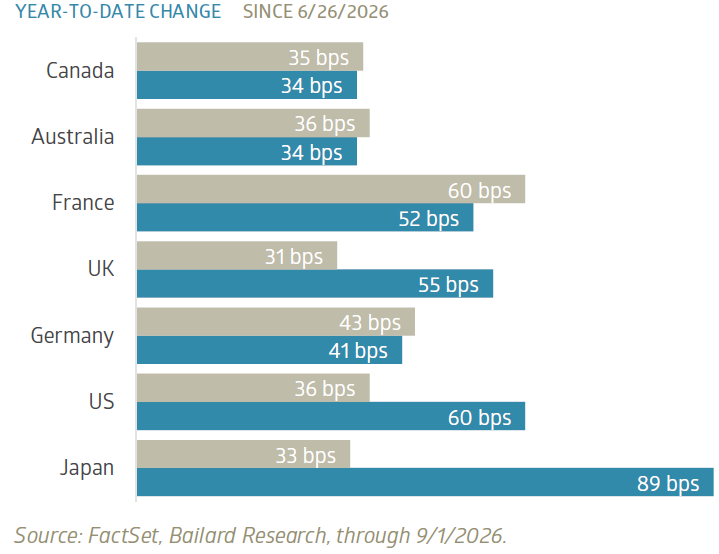
Government yields have risen sharply in recent weeks across the developed world. Looking at an equal-weight basket of 10-year government bonds from major bond markets, including the US, Japan, Germany, the UK, France, Australia, and Canada, yields have increased by 52 basis points (0.01%, “bp”) since the start of the year, and 39 bps since the end of June. Excluding Japan, which is navigating a relatively distinct policy normalization path, yields have still increased by 46 bps and 40 bps for the same time periods. The causes differ somewhat by country, but common drivers are familiar: significant fiscal deficits, persistent inflation, geopolitical turmoil, and pressure from energy input prices. Globally, the bond vigilantes are applying pressure.
Government yields rising sharply
Fed expectations are shifting
Importantly, the move in rates has not been constrained to the long end of the curve. The yield on the US two-year Treasury had increased to 4.35% on August 28, up from 4.08% at the end of June and 3.48% at the beginning of the year. The two-year is particularly sensitive to expectations of Fed policy, suggesting this move tells a different story. Bond investors are not just demanding higher yields to compensate for fiscal risk or inflation uncertainty; they are also rapidly repricing the anticipated path of monetary policy.
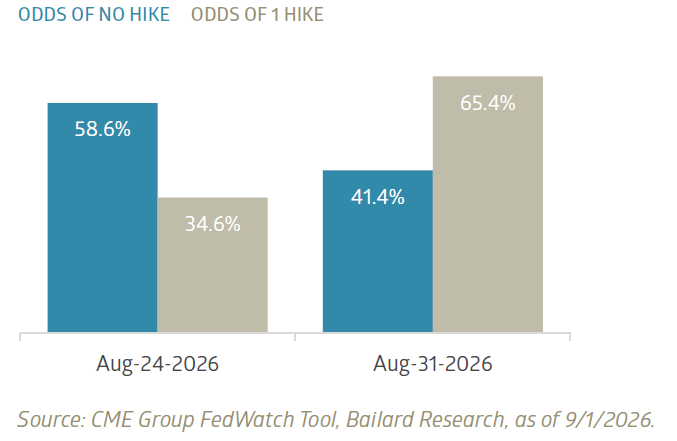
Further, Fed Chair Kevin Warsh gave markets a jolt at last week’s annual Jackson Hole conference. In his highly anticipated speech, the previously guarded Warsh indicated that he would be “hard pressed” to describe current financial conditions as restrictive and pointed to several inflation indicators that were running well above target. Odds of a hike at the September meeting jumped from less than 40% last week to over 65% as of writing, and the implied number of rate hikes in 2026 jumped to between one and two. It’s clear what the market is implying: rates are likely to head higher in the very near term.
Implied odds of Fed Rate hike, September meeting
Caution, not panic
The impact of rising rates and yields is far from isolated to global bond investors. Global governments risk falling into a negative feedback loop in which rising rates increase interest costs and pressure fiscal budgets. This worsens the fiscal outlook, forcing additional borrowing and causing investors to demand still more compensation for holding government debt.
Elevated rates also stress corporations by increasing the hurdle rate for investment and increasing refinancing costs. This is increasingly relevant to the AI infrastructure boom, which has reached extraordinary scale and has increasingly forced some of the largest technology companies to tap debt markets to finance new data centers. Consumers also feel the pressure from higher yields through mortgage rates, auto loans, and other forms of borrowing, potentially pressuring another pillar of support of the current economic expansion.
Investors have seen this movie before. The painful memories of the stock and bond crash of 2022 remain fresh in their minds. In response to surging inflation, the Fed moved aggressively to normalize rates, embarking on one of the most aggressive tightening cycles in decades. Rising yields punished both stock and bond investors, with the S&P 500 Index falling 18.1% for the year and the Bloomberg US Aggregate Bond Index down 13.0%. A simple 60/40 blended portfolio lost roughly 16%, one of the most painful years for diversified investors in modern history.
This does not mean 2026 is destined to follow the trajectory of 2022. Indeed, the starting backdrop is vastly different. But the experience is a useful reminder that a sufficiently sharp rise in rates can overwhelm otherwise healthy fundamentals.
This brings the discussion back to inflation. Warsh emphasized that inflation has been above target for 65 consecutive months and reiterated that responsibility for restoring price stability ultimately rests with the central bank. Further, the newly minted Chair of the Fed left little doubt as to his interpretation of the recent inflation data: “While this summer’s PCE and CPI readings were better than expected, they do not tell me that underlying trends have meaningfully improved.”
For now, the underlying economy remains strong. Labor markets appear cool but stable, business activity remains expansionary, and corporate earnings are posting stellar growth. Those conditions give the economy some room to absorb higher rates. But they also give the Fed little reason to tolerate persistent inflation.
If inflation remains sticky, global central banks may be forced to tighten more aggressively or keep rates higher for longer than markets anticipate. This tightening could compound the current growth headwinds we are seeing from higher energy prices, and pressure borrowing costs across governments and corporations. The risk is not simply rising yields, but cumulative tightening of financial conditions that begins to weigh more meaningfully on business activity.
The future is not yet etched in stone. Cooler inflation readings in upcoming weeks could instill confidence that progress toward price stability is underway. Warsh clearly outlined his discipline for changing course: “We must be confident that underlying inflation is moving to our objective, clearly and at sufficient speed. Otherwise, we have work to do.”
The expansion rests on a solid footing, and long-term investors should not panic. Yet there are increasing reasons for caution. Inflation remains a thorn, and the bond vigilantes are stirring. The question for investors is whether rising yields remain a manageable symptom of the current economic expansion, or whether mounting pressure eventually becomes significant enough to threaten the durability of growth.
# # #
Past performance is no indication of future results. All investments have the risk of loss.
The information in this publication is based primarily on data available as of its publication date and has been obtained from sources believed to be reliable. Still, its accuracy, completeness, and interpretation are not guaranteed. Bailard undertakes no duty to update any of the information contained herein, and such opinions are subject to change without notice. We do not think this publication should necessarily be relied upon as a sole source of information and opinion. This publication is not a recommendation of, or an offer to sell or solicitation of an offer to buy any particular security or investment product. It does not take into consideration the particular investment objectives, financial situations, or needs of individual clients.
Any indices or other financial benchmarks referenced are provided for illustrative purposes only. Indices are unmanaged, reflect reinvestment of income and dividends, and do not reflect the impact of advisory fees. Investors cannot invest directly in an index. Any individual securities referenced herein are for illustrative purposes only and not necessarily representative of investments that have been made or will be made in the future. Bailard, Inc. makes no recommendation to buy or sell securities discussed herein. Bailard clients may hold positions in the securities discussed and may buy or sell such securities at any time.
The S&P 500 Index measures large-cap U.S. equities; the Russell 1000 Index measures large-cap U.S. equities, with the Russell 1000 Growth and Russell 1000 Value indices measuring the growth and value segments, respectively; the Russell 2000 Index measures small-cap U.S. equities, with the Russell 2000 Growth and Russell 2000 Value indices measuring the growth and value segments, respectively; the S&P MicroCap Index and Russell Microcap Index measure micro-cap U.S. equities; the MSCI EAFE Index measures developed-market equities outside the U.S. and Canada; the MSCI Emerging Markets Index measures emerging-market equities; the Bloomberg U.S. Aggregate Bond Index measures the U.S. investment-grade taxable bond market; the Bloomberg U.S. Treasury Inflation-Linked Bond Index measures U.S. Treasury Inflation-Protected Securities, or TIPS; and the Bloomberg Municipal Bond Index measures the U.S. investment-grade tax-exempt municipal bond market. The U.S. CPI refers to the Consumer Price Index, a measure of inflation based on prices paid by consumers for a representative basket of goods and services.
Certain information may constitute “forward-looking statements,” which can be identified by the use of forward-looking terminology such as “may,” “will,” “should,” “expect,” “anticipate,” “project,” “estimate,” “intend,” “continue,” or “believe,” or the negatives thereof or other variations thereon or comparable terminology. Due to various risks and uncertainties, actual events, results, or actual performance may differ materially from those reflected or contemplated in such forward-looking statements.
Bailard, Inc. does not provide investment advice in jurisdictions where it is not authorized to do so.
Recent Insights
Keep Informed
Get the latest News & Insights from the Bailard team delivered to your inbox.