

Morning Macro with Dave
Weekly perspective on current developments, emerging risks, and potential implications for investors.
When an oil shock becomes an inflation problem
Dave Harrison Smith, CFA
Chief Investment Officer
July 29, 2026
Renewed clashes across the Middle East have disrupted a resilient stretch for U.S. equities. From the re-escalation of hostilities on July 7 through July 27, the S&P 500 declined 1.2%, while the technology-heavy Nasdaq 100 fell 3.9%. Energy markets have been volatile, with Brent crude oil briefly moving back above $100 per barrel as attacks have again disrupted key shipping routes. U.S. retail gasoline prices also jumped higher, from just under $3.50 per gallon to $4.10 by July 27, according to AAA.
Oil and gasoline prices have risen sharply
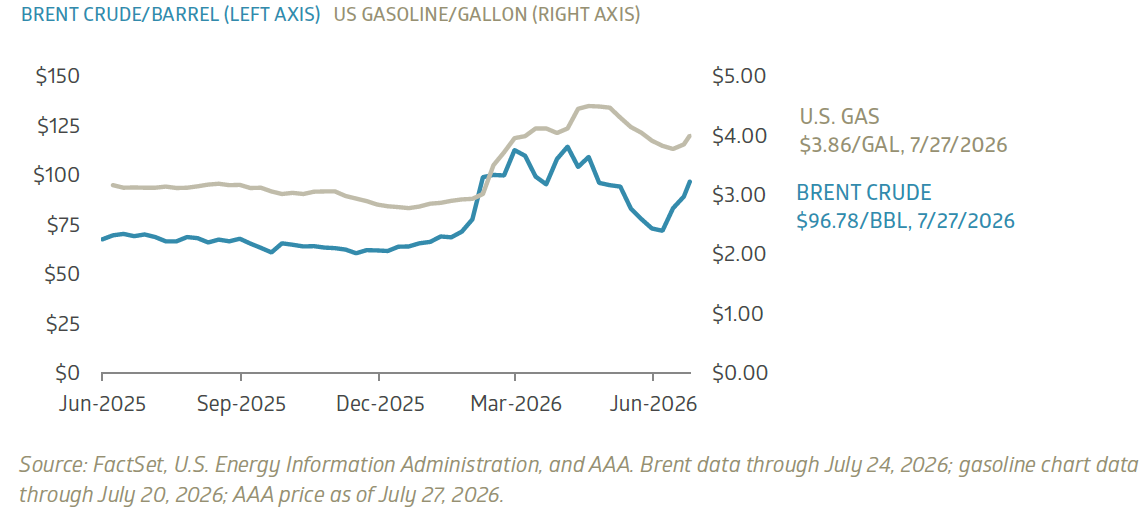
The sharp move in oil prices is reigniting fears of inflation. Thus far, the effects of the energy shocks have largely been confined to headline inflation. The pain felt by consumers and the associated reduction in household purchasing power are very real, but the pass-through to core inflation has been limited. We have yet to see second-order inflation effects, but the risk should not be underappreciated. The potential damage is less immediate but potentially more consequential as higher energy costs feed into freight and manufacturing costs, and eventually into the prices of goods in a more meaningful way.
Duration therefore remains the key risk. A brief spike in energy prices is likely to produce headline inflation but have only limited impact on underlying pricing behavior. A prolonged surge increases the risk that businesses pass higher energy costs on to customers, workers seek compensation increases to offset reduced purchasing power, and companies incorporate higher inflation expectations into their decision-making processes. This self-fulfilling feedback loop is how a temporary supply shock can foster a durable inflation problem.
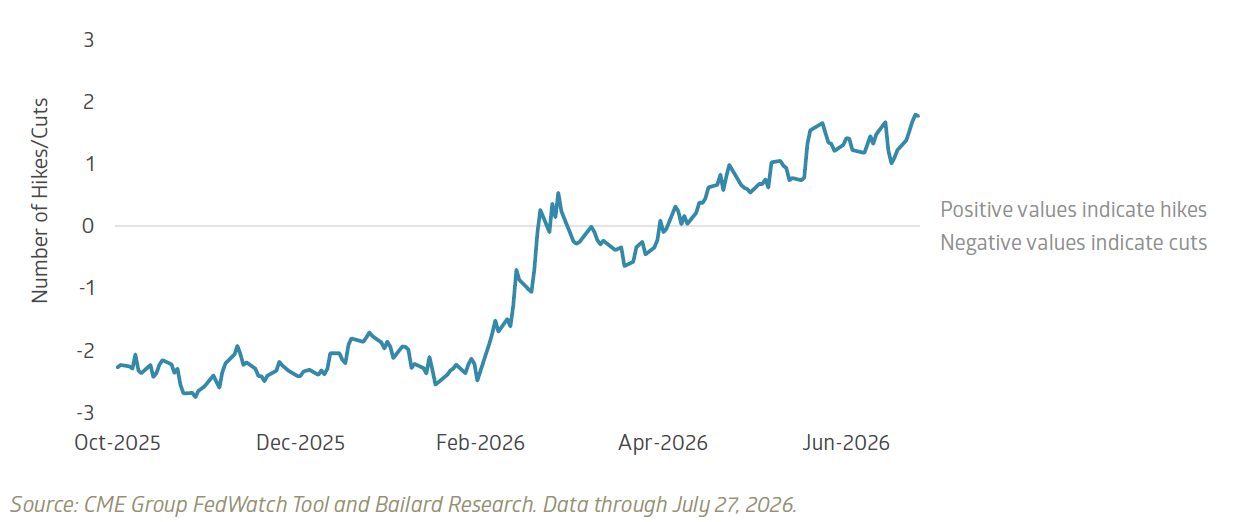
This creates a difficult situation for the Federal Reserve (the “Fed”). Higher interest rates cannot open a shipping lane, but the central bank may still need to act if inflation expectations begin to rise. In the days leading up to the Fed’s July Federal Open Market Committee (FOMC) meeting, futures markets had moved from pricing cuts to nearly two rate hikes by year-end.
Rate expectations have swung from cuts to hikes
Probability-weighted number of futures-implied 25-basis-point moves by year-end 2026
The policy outlook is also more uncertain than it was under prior leadership. New Fed Chair Kevin Warsh has shifted the Fed’s communication strategy away from explicit forward guidance, placing greater weight on market prices as an independent signal for policymakers. This approach has merit, but it also widens the range of outcomes investors must consider.
At the conclusion of its July meeting today, the Fed left the federal funds target range unchanged at 3.50% to 3.75%. The vote was not unanimous, with three officials dissenting in favor of an immediate hike, an unusually hawkish split after five straight meetings on hold. The decision gives policymakers more time to assess whether higher energy prices are beginning to affect underlying inflation.
Looking to September, we do expect a rate increase to re-establish credibility and help anchor inflation expectations. We are even hearing talk that the Fed may consider a 50 basis point interest rate increase, though that remains a tail risk scenario rather than base case. The Fed moving quickly to raise rates, perhaps even with a larger raise than consensus expectation, would serve to cement conviction that this central bank committee is dedicated to fighting inflation. However, it would also serve as a major shock to investors and the economy.
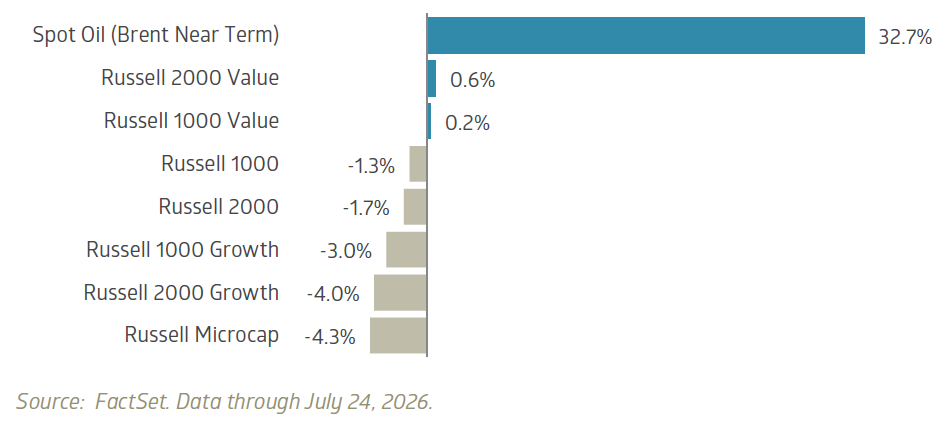
Markets have begun to reflect the tension among higher energy prices, higher inflation, and the increased likelihood of tighter monetary policy. Momentum stocks, most notably artificial intelligence infrastructure stocks, have suffered as investors have de-risked portfolios. Growth stocks, particularly those with rich valuations reliant on cash flows far into the future, have underperformed value stocks. The U.S. dollar, which remains a safe-haven asset, has strengthened against a basket of currencies, causing some pain for U.S.-based investors holding foreign assets.
Oil rallies as growth stocks slide
Selected commodities, July 7 through July 24, 2026
For investors, the outlook now relies on two related questions. The first is the duration of the Middle East conflict and associated energy crisis, and whether elevated prices remain in place long enough to become ingrained in consumer and business behavior and force an interest rate move. The second is the durability of the extraordinary artificial intelligence buildout, and whether it can be sustained as economic growth slows and companies face tighter budgets and financial conditions.
The market’s recent rotation deserves attention. Higher oil prices and the widening conflict support higher risk premiums, but geopolitical shocks can ease quickly, as last quarter demonstrated. Recent weakness may still prove temporary. For investors, the response is renewed attention to valuation and diversification, guided by a disciplined investment process.
# # #
Past performance is no indication of future results. All investments have the risk of loss.
The information in this publication is based primarily on data available as of its publication date and has been obtained from sources believed to be reliable. Still, its accuracy, completeness, and interpretation are not guaranteed. Bailard undertakes no duty to update any of the information contained herein, and such opinions are subject to change without notice. We do not think this publication should necessarily be relied upon as a sole source of information and opinion. This publication is not a recommendation of, or an offer to sell or solicitation of an offer to buy any particular security or investment product. It does not take into consideration the particular investment objectives, financial situations, or needs of individual clients.
Any indices or other financial benchmarks referenced are provided for illustrative purposes only. Indices are unmanaged, reflect reinvestment of income and dividends, and do not reflect the impact of advisory fees. Investors cannot invest directly in an index. Any individual securities referenced herein are for illustrative purposes only and not necessarily representative of investments that have been made or will be made in the future. Bailard, Inc. makes no recommendation to buy or sell securities discussed herein. Bailard clients may hold positions in the securities discussed and may buy or sell such securities at any time.
The S&P 500 Index measures large-cap U.S. equities; the Russell 1000 Index measures large-cap U.S. equities, with the Russell 1000 Growth and Russell 1000 Value indices measuring the growth and value segments, respectively; the Russell 2000 Index measures small-cap U.S. equities, with the Russell 2000 Growth and Russell 2000 Value indices measuring the growth and value segments, respectively; the S&P MicroCap Index and Russell Microcap Index measure micro-cap U.S. equities; the MSCI EAFE Index measures developed-market equities outside the U.S. and Canada; the MSCI Emerging Markets Index measures emerging-market equities; the Bloomberg U.S. Aggregate Bond Index measures the U.S. investment-grade taxable bond market; the Bloomberg U.S. Treasury Inflation-Linked Bond Index measures U.S. Treasury Inflation-Protected Securities, or TIPS; and the Bloomberg Municipal Bond Index measures the U.S. investment-grade tax-exempt municipal bond market. The U.S. CPI refers to the Consumer Price Index, a measure of inflation based on prices paid by consumers for a representative basket of goods and services.
Certain information may constitute “forward-looking statements,” which can be identified by the use of forward-looking terminology such as “may,” “will,” “should,” “expect,” “anticipate,” “project,” “estimate,” “intend,” “continue,” or “believe,” or the negatives thereof or other variations thereon or comparable terminology. Due to various risks and uncertainties, actual events, results, or actual performance may differ materially from those reflected or contemplated in such forward-looking statements.
Bailard, Inc. does not provide investment advice in jurisdictions where it is not authorized to do so.
Recent Insights
Keep Informed
Get the latest News & Insights from the Bailard team delivered to your inbox.