

Morning Macro with Dave
Weekly perspective on current developments, emerging risks, and potential implications for investors.
AI build-out reaches far beyond tech
Dave Harrison Smith, CFA
Chief Investment Officer
July 21, 2026
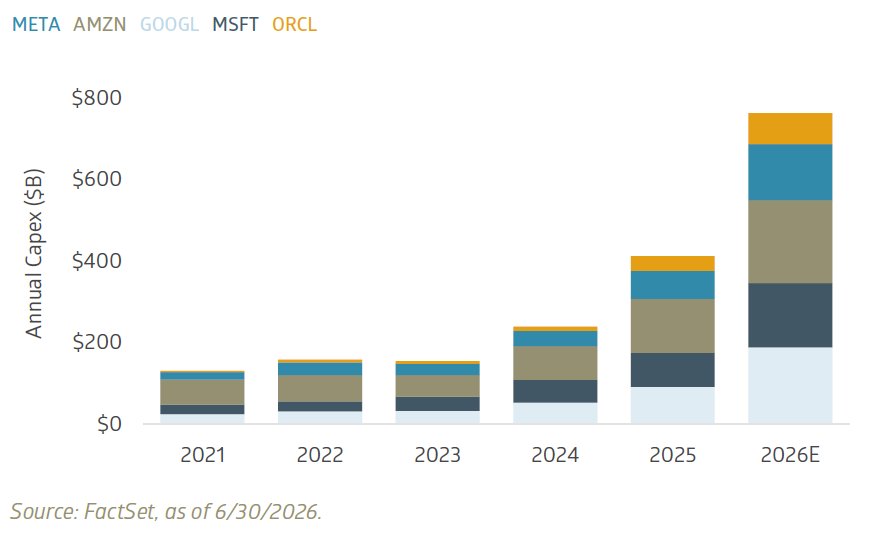
The scale of the artificial intelligence (AI) infrastructure build-out is hard to overstate. Pew Research estimated that there were more than 1,500 data center projects planned or under construction in the U.S. as of early 2026. For perspective, Synergy Research Group counted just 659 hyperscale data centers in operation worldwide as of 2021. Capital spending from major cloud and data center providers, including Google, Amazon, Meta, Microsoft, and Oracle, has soared from $130 billion in 2021 to an estimated $760 billion in 2026. That number is expected to increase again in 2027 to nearly $1 trillion.
Capital spending by major technology companies is accelerating
Actual and estimated annual capital expenditures, $billions
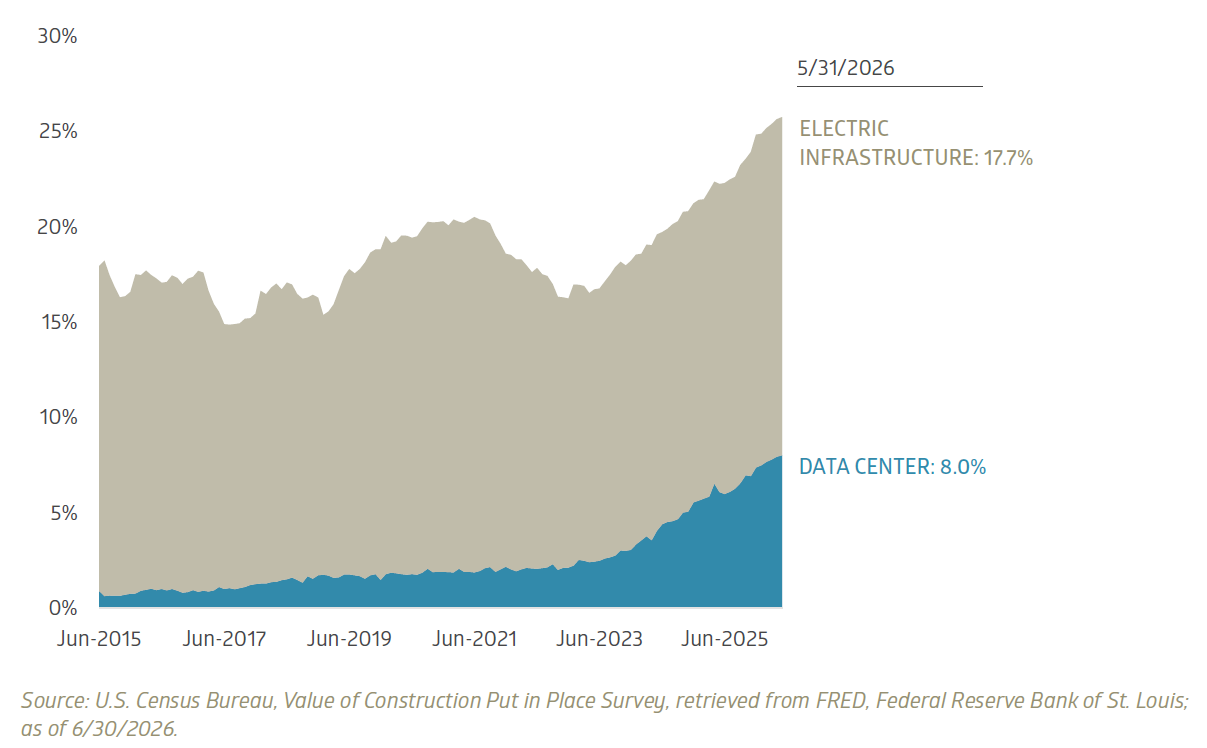
While media and investors rightfully focus on semiconductors and suppliers of critical components, the economic impact of this spending extends far beyond these suppliers. The Census Bureau’s Value of Construction Put in Place survey illustrates the breadth of this impact. Construction spending on Data Centers and Electric Infrastructure has risen to more than a quarter of private nonresidential construction spending, up from 17.3% in 2019. Excluding these categories, inflation-adjusted construction spending is up only 1% over the same period. Construction firms, industrial design firms, and a deeply intertwined supply chain of vendors and their employees are all highly levered to the AI infrastructure boom.
Data centers and electric infrastructure now represent more than a quarter of private nonresidential construction
Share of private nonresidential construction spending
Rapid revenue growth is supporting exceptional investment
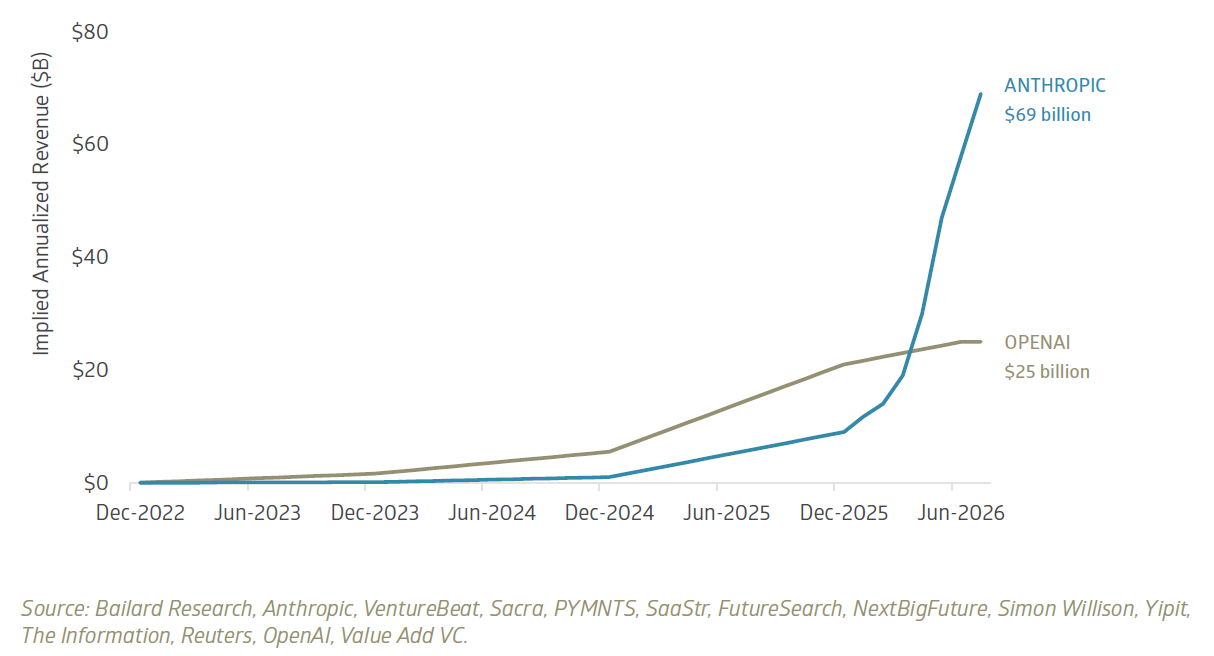
This increase in spending is unparalleled, and investors have rightfully questioned whether the underlying business models can sustain it. Critically, we are seeing exceptional revenue growth at most major AI laboratories. OpenAI is rumored to be targeting annualized revenue growth to $30 billion by year-end 2026, up an impressive 50% from levels at the end of 2025. This is dwarfed by Anthropic’s reported run rate of $69 billion as of mid-July, up from a rumored $9 billion at the end of 2025. For perspective, it took both Google and Facebook approximately twelve years from their founding to approach $30 billion in annual revenue.
AI lab revenue has accelerated sharply
Reported or estimated annualized revenue run rate, $ billions
For now, the rapid revenue growth provides meaningful support for the AI infrastructure build-out. The figures suggest that users are seeing value in AI and that many customers are willing to pay considerable sums to the leading AI labs. Usage, enterprise adoption, and revenue are all rising. Much therefore depends on continued growth across a narrow segment of the economy and a small group of companies.
Yet, disruption is the norm rather than the exception in the technology industry. Internally, we are spending considerable time understanding the impact of the rise of low-cost, open-source models, particularly those emerging from China. DeepSeek, Alibaba’s Qwen, Moonshot’s Kimi, and Zhipu’s GLM have all demonstrated considerable capabilities that may rival some leading AI lab models, at least in some use cases. The ability for corporations to utilize on-premise hardware for these models may help reduce data governance risks. Adoption and further progress here could threaten the economics and business models of the leading labs, pressure pricing, and eventually disrupt the capital-spending forecasts with significant downstream ramifications for the global economy.
Competition could reshape the economics
In January 2025, I was in Florida preparing to speak to a group of investors on the unprecedented rise of AI and the emerging investment opportunities. The night before my talk, the Chinese firm DeepSeek shocked investors by announcing the release of a competitive reasoning model at a fraction of the cost of leading Western alternatives. My talk thus had some unexpected fireworks: AI-exposed companies plunged, with Nvidia itself falling 17% in a single trading session.
The DeepSeek moment proved temporary. Revenue growth at the leading Western labs continued to soar, driven by new coding and agentic products. Infrastructure spending moved higher. Lower costs may even have stimulated additional consumption, consistent with a phenomenon in economics and technology called Jevons Paradox.
That outcome is encouraging, but it is no reason for complacency. The impact of significant spending optimization or a pullback in infrastructure spending would reverberate well beyond the tech sector. Near-term evidence remains strong, with usage, revenue, and investment continuing to rise. Given the industry’s dependence on a small group of companies, however, investors should monitor competitive shifts closely. The opportunity remains compelling, but discipline and selectivity are increasingly important.
# # #
Past performance is no indication of future results. All investments have the risk of loss.
The information in this publication is based primarily on data available as of its publication date and has been obtained from sources believed to be reliable. Still, its accuracy, completeness, and interpretation are not guaranteed. Bailard undertakes no duty to update any of the information contained herein, and such opinions are subject to change without notice. We do not think this publication should necessarily be relied upon as a sole source of information and opinion. This publication is not a recommendation of, or an offer to sell or solicitation of an offer to buy any particular security or investment product. It does not take into consideration the particular investment objectives, financial situations, or needs of individual clients.
Any indices or other financial benchmarks referenced are provided for illustrative purposes only. Indices are unmanaged, reflect reinvestment of income and dividends, and do not reflect the impact of advisory fees. Investors cannot invest directly in an index. Any individual securities referenced herein are for illustrative purposes only and not necessarily representative of investments that have been made or will be made in the future. Bailard, Inc. makes no recommendation to buy or sell securities discussed herein. Bailard clients may hold positions in the securities discussed and may buy or sell such securities at any time.
The S&P 500 Index measures large-cap U.S. equities; the Russell 1000 Index measures large-cap U.S. equities, with the Russell 1000 Growth and Russell 1000 Value indices measuring the growth and value segments, respectively; the Russell 2000 Index measures small-cap U.S. equities, with the Russell 2000 Growth and Russell 2000 Value indices measuring the growth and value segments, respectively; the S&P MicroCap Index and Russell Microcap Index measure micro-cap U.S. equities; the MSCI EAFE Index measures developed-market equities outside the U.S. and Canada; the MSCI Emerging Markets Index measures emerging-market equities; the Bloomberg U.S. Aggregate Bond Index measures the U.S. investment-grade taxable bond market; the Bloomberg U.S. Treasury Inflation-Linked Bond Index measures U.S. Treasury Inflation-Protected Securities, or TIPS; and the Bloomberg Municipal Bond Index measures the U.S. investment-grade tax-exempt municipal bond market. The U.S. CPI refers to the Consumer Price Index, a measure of inflation based on prices paid by consumers for a representative basket of goods and services.
Certain information may constitute “forward-looking statements,” which can be identified by the use of forward-looking terminology such as “may,” “will,” “should,” “expect,” “anticipate,” “project,” “estimate,” “intend,” “continue,” or “believe,” or the negatives thereof or other variations thereon or comparable terminology. Due to various risks and uncertainties, actual events, results, or actual performance may differ materially from those reflected or contemplated in such forward-looking statements.
Bailard, Inc. does not provide investment advice in jurisdictions where it is not authorized to do so.
Recent Insights
Keep Informed
Get the latest News & Insights from the Bailard team delivered to your inbox.