

Morning Macro with Dave
Weekly perspective on current developments, emerging risks, and potential implications for investors.
Why July’s consumer slowdown may be misleading
Dave Harrison Smith, CFA
Chief Investment Officer
August 26, 2026
Consumer spending has been a critical pillar of the current economic expansion. The remarkably resilient American consumer has helped growth persist through threats from inflation, tariffs, and sharply higher energy prices. Against this backdrop, last week’s retail sales report was an unwelcome surprise. U.S. retail and food services sales badly missed analyst estimates, shrinking 0.6% month over month versus expectations for a modest increase. Ink immediately began flowing on the American consumer’s retreat and the potential economic ramifications.
Growth in U.S. advance retail sales
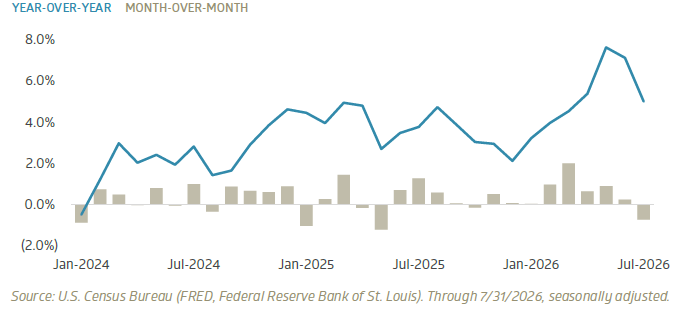
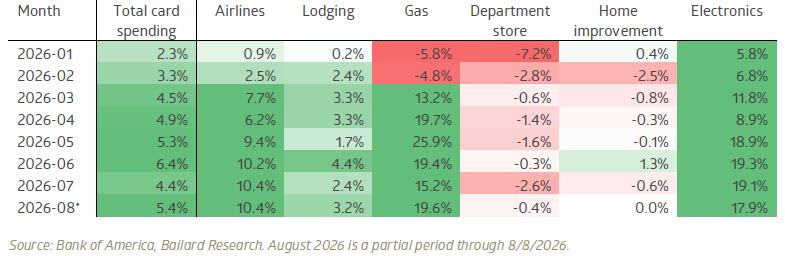
Other data appeared to reinforce that concern. Credit card spending growth in July moderated after an exceptionally strong June. Bank of America reported total card spending growth fell to 4.4% in July, down from 6.4% in June. Visa similarly flagged a moderation in year-over-year growth in portions of its payments data. The warning signs appeared to be building for investors. Critically, it is important to understand several underlying caveats in order to separate the signal from the noise.
One critical detail involves the base effect from 2025. Amazon’s Prime Day, the massive multi-day sales event from the world’s largest online retailer, typically occurs each summer. Since debuting the event in 2015, the magnitude has grown so significantly that it can now impact aggregate spending levels. In 2026, Prime Day shifted from mid-July to late June. The calendar shift effectively ‘borrowed’ spending from July and moved it into June. It also created a difficult year-over-year comparison for July, as this year’s spending was measured against the Prime Day-boosted results from July 2025.
Autos similarly distorted numbers. Last July saw strong motor vehicle sales as consumers rushed to purchase electric vehicles ahead of the EV tax credit’s September expiration. In 2025, July EV sales rose 22.7% versus the prior month, while in 2026 auto sales fell 1.8% month over month, making autos one of the largest single contributors to July’s weak print (National Automobile Dealers Association).
Finally, the FIFA World Cup introduced another distortion. The tournament provided a notable boost to spending in U.S. host cities. Following Spain’s victory over Argentina on July 19, select retail spending verticals, such as bars and restaurants, likely softened in the immediate aftermath, and the month is a more challenging data point from which to evaluate the underlying trend.
Viewed in this context, July looks less alarming. Retail sales still grew at a healthy 5%, and Mastercard characterized underlying spending as stable and strong. Significantly, high-frequency data from Bank of America through mid-August has been firm. None of this suggests the consumer is accelerating, but nor does it support a broad retrenchment.
There is another important caveat in the composition of recent spending growth. Many of the categories showing the most acceleration in spending are likely heavily impacted by inflationary drivers rather than by strong underlying demand, most notably gas, airlines, and electronics. Rising consumer spend on gas, with prices highly elevated due to the war in the Middle East, does little to tell us about the strength in underlying demand, and rising electronics prices due to the historic rise in memory prices do little to signal durability. These are not the categories economists would typically highlight when defining healthy spending growth.
Where credit card spending is growing, year-over-year change, select categories
The broader takeaway is that while data points on consumer weakness make for a good narrative, the underlying data is more nuanced. The consumer has cooled, with inflation, slower job growth, and rising credit card debt levels all legitimate risks to monitor. But the recent data were unusually distorted by one-off effects, and the evidence does not yet appear to indicate a significant retreat in demand. In sum, much like the labor market, the consumer overall appears cool but stable, not strong enough to dismiss risks but healthy enough to support a continued constructive market environment.
# # #
Past performance is no indication of future results. All investments have the risk of loss.
The information in this publication is based primarily on data available as of its publication date and has been obtained from sources believed to be reliable. Still, its accuracy, completeness, and interpretation are not guaranteed. Bailard undertakes no duty to update any of the information contained herein, and such opinions are subject to change without notice. We do not think this publication should necessarily be relied upon as a sole source of information and opinion. This publication is not a recommendation of, or an offer to sell or solicitation of an offer to buy any particular security or investment product. It does not take into consideration the particular investment objectives, financial situations, or needs of individual clients.
Any indices or other financial benchmarks referenced are provided for illustrative purposes only. Indices are unmanaged, reflect reinvestment of income and dividends, and do not reflect the impact of advisory fees. Investors cannot invest directly in an index. Any individual securities referenced herein are for illustrative purposes only and not necessarily representative of investments that have been made or will be made in the future. Bailard, Inc. makes no recommendation to buy or sell securities discussed herein. Bailard clients may hold positions in the securities discussed and may buy or sell such securities at any time.
The S&P 500 Index measures large-cap U.S. equities; the Russell 1000 Index measures large-cap U.S. equities, with the Russell 1000 Growth and Russell 1000 Value indices measuring the growth and value segments, respectively; the Russell 2000 Index measures small-cap U.S. equities, with the Russell 2000 Growth and Russell 2000 Value indices measuring the growth and value segments, respectively; the S&P MicroCap Index and Russell Microcap Index measure micro-cap U.S. equities; the MSCI EAFE Index measures developed-market equities outside the U.S. and Canada; the MSCI Emerging Markets Index measures emerging-market equities; the Bloomberg U.S. Aggregate Bond Index measures the U.S. investment-grade taxable bond market; the Bloomberg U.S. Treasury Inflation-Linked Bond Index measures U.S. Treasury Inflation-Protected Securities, or TIPS; and the Bloomberg Municipal Bond Index measures the U.S. investment-grade tax-exempt municipal bond market. The U.S. CPI refers to the Consumer Price Index, a measure of inflation based on prices paid by consumers for a representative basket of goods and services.
Certain information may constitute “forward-looking statements,” which can be identified by the use of forward-looking terminology such as “may,” “will,” “should,” “expect,” “anticipate,” “project,” “estimate,” “intend,” “continue,” or “believe,” or the negatives thereof or other variations thereon or comparable terminology. Due to various risks and uncertainties, actual events, results, or actual performance may differ materially from those reflected or contemplated in such forward-looking statements.
Bailard, Inc. does not provide investment advice in jurisdictions where it is not authorized to do so.
Recent Insights
Keep Informed
Get the latest News & Insights from the Bailard team delivered to your inbox.