

Morning Macro with Dave
Weekly perspective on current developments, emerging risks, and potential implications for investors.
When inflation lingers: What persistent CPI means for investors
Dave Harrison Smith, CFA
Chief Investment Officer
October 21, 2026
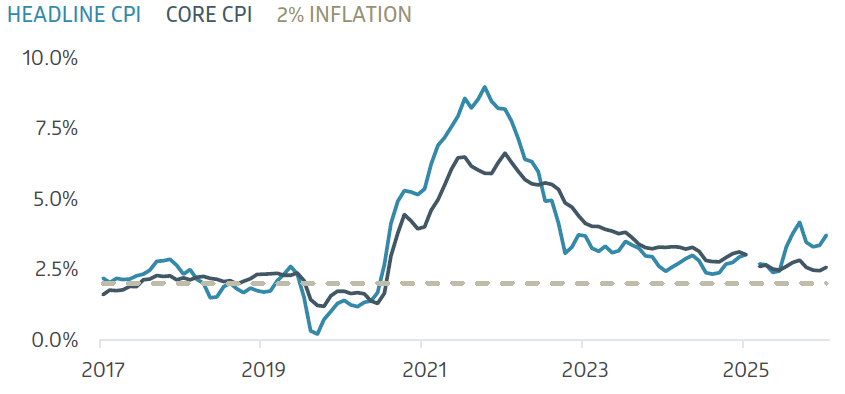
It’s the beginning of flu season, and inflation feels like a cold you just can’t shake. While we are far removed from the days of 9% inflation after the global pandemic, the inflation story has shifted to a more persistent mix of supply shocks and unusually strong demand in narrow parts of the economy. The net result is that inflation has been above the Federal Reserve’s (the “Fed’s”) 2% target for more than five consecutive years. Inflation is no longer at crisis levels, but persistent price creep creates a host of problems for investors and savers alike, and may be an underappreciated source of investment risk.
Headline and Core CPI inflation remain above the Fed’s 2% target
Sources: Bureau of Labor Statistics, the Federal Reserve Bank of St. Louis, retrieved via FRED on 10/20/2026. Missing data reflects the 2025 federal government shutdown.
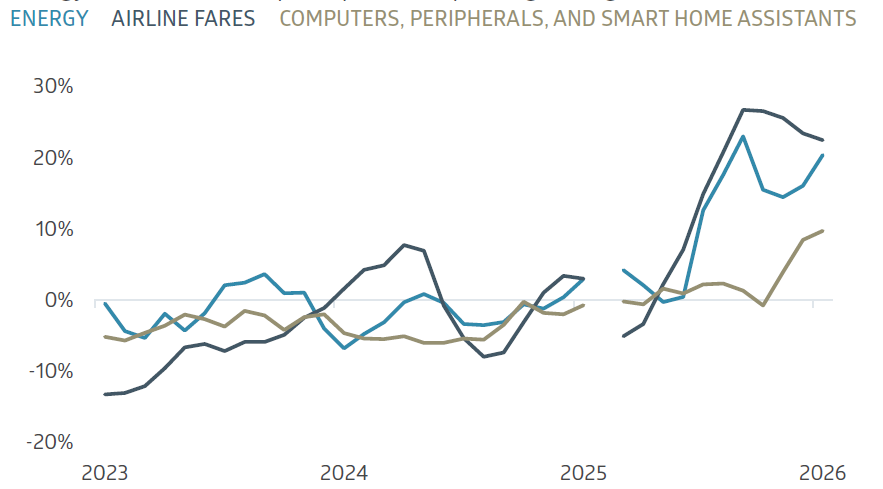
The September CPI report surprised to the upside, with headline inflation running hot at 3.7% and core at 2.6%. Energy was a clear source of pressure, evident every time you pass a gas station. The Energy component of the CPI basket rose 20.4% year-on-year. Thus far, however, higher energy prices have not fully transmitted to downstream categories. The risk lies in the duration. The longer the Middle East and Ukraine conflicts continue, the greater the risk of inflation contagion as businesses are forced to increase prices to offset fuel and energy costs. Early evidence suggests this is already happening: airfare, where fuel is a major input, rose 22.5% versus last year, and month-over-month changes have recently re-accelerated.
Technology is a less intuitive source of inflation. The AI infrastructure boom has created enormous demand for memory, storage, and other components, leading to significant price increases. The CPI category covering computers and peripherals has soared 41% annualized over the last three months. For an industry historically defined by increasing capabilities and deflationary prices, that data point is striking.
Energy, Airfare, and Computer prices are pushing CPI higher
Sources: Bureau of Labor Statistics, the Federal Reserve Bank of St. Louis, retrieved via FRED on 10/20/2026. Missing data reflects the 2025 federal government shutdown.
The contrast between energy and technology is interesting, as the two categories contribute to inflation through opposing pathways. Energy prices are rising because of constrained global supply, while technology component prices are rising because of exceptionally strong demand. One is a traditional supply shock, while the other clearly reflects economic strength.
The inflation challenge is not unique to the U.S., as elevated energy prices and other inflationary pressures are prompting a global shift toward tighter monetary policy. The European Central Bank and Reserve Bank of Australia have recently increased rates, and the Bank of England is expected to follow suit. After several years in which the global monetary-policy debate centered on when and how quickly central banks could ease, the conversation has changed.
Inflation impacts investors and savers in several ways. First and foremost, it erodes spending power. We feel its real effects every time we walk into a grocery store; a dollar simply doesn’t go as far as it used to. This burden is particularly painful for households living on a fixed nominal income or for consumers whose wages fail to keep up with rising prices.
For investors, inflation’s impact goes further. Central banks are tasked with maintaining price stability and have powerful tools to do so. However, these tools are blunt. The Fed cannot produce oil, nor can it manufacture memory chips. It can raise interest rates, which can reduce aggregate demand by making corporate borrowing, mortgages, and auto loans more expensive, but at the cost of slower economic growth. Higher rates not only slow aggregate demand in the sectors driving initial price pressures, but companies across sectors may also bear the burden. This is particularly relevant given the narrow avenues of strength in the current economic cycle.
Inflation remains one of the most important risks for investors at this moment in time. Recent data have turned less favorable, and persistently high energy prices risk passing through to other sectors of the economy. The two primary sources of inflation stem from very different causes, and neither is likely to respond much to conventional monetary policy.
For now, the economic expansion remains intact, supported by resilient consumers and strong business activity. Markets already anticipate additional rate hikes as central banks work to contain inflation. While the economy has shown considerable resilience amid multiple shocks, tighter policy risks reducing consumer spending and business investment or creating unanticipated financial stress. These risks are particularly consequential in an economy increasingly dependent on a relatively narrow set of growth drivers. For investors, the question is not simply whether inflation can be brought under control, but how much economic strength must be sacrificed in the process.
# # #
Past performance is no indication of future results. All investments have the risk of loss.
The information in this publication is based primarily on data available as of its publication date and has been obtained from sources believed to be reliable. Still, its accuracy, completeness, and interpretation are not guaranteed. Bailard undertakes no duty to update any of the information contained herein, and such opinions are subject to change without notice. We do not think this publication should necessarily be relied upon as a sole source of information and opinion. This publication is not a recommendation of, or an offer to sell or solicitation of an offer to buy any particular security or investment product. It does not take into consideration the particular investment objectives, financial situations, or needs of individual clients.
Any indices or other financial benchmarks referenced are provided for illustrative purposes only. Indices are unmanaged, reflect reinvestment of income and dividends, and do not reflect the impact of advisory fees. Investors cannot invest directly in an index. Any individual securities referenced herein are for illustrative purposes only and not necessarily representative of investments that have been made or will be made in the future. Bailard, Inc. makes no recommendation to buy or sell securities discussed herein. Bailard clients may hold positions in the securities discussed and may buy or sell such securities at any time.
The S&P 500 Index measures large-cap U.S. equities; the Russell 1000 Index measures large-cap U.S. equities, with the Russell 1000 Growth and Russell 1000 Value indices measuring the growth and value segments, respectively; the Russell 2000 Index measures small-cap U.S. equities, with the Russell 2000 Growth and Russell 2000 Value indices measuring the growth and value segments, respectively; the S&P MicroCap Index and Russell Microcap Index measure micro-cap U.S. equities; the MSCI EAFE Index measures developed-market equities outside the U.S. and Canada; the MSCI Emerging Markets Index measures emerging-market equities; the Bloomberg U.S. Aggregate Bond Index measures the U.S. investment-grade taxable bond market; the Bloomberg U.S. Treasury Inflation-Linked Bond Index measures U.S. Treasury Inflation-Protected Securities, or TIPS; and the Bloomberg Municipal Bond Index measures the U.S. investment-grade tax-exempt municipal bond market. The U.S. CPI refers to the Consumer Price Index, a measure of inflation based on prices paid by consumers for a representative basket of goods and services.
Certain information may constitute “forward-looking statements,” which can be identified by the use of forward-looking terminology such as “may,” “will,” “should,” “expect,” “anticipate,” “project,” “estimate,” “intend,” “continue,” or “believe,” or the negatives thereof or other variations thereon or comparable terminology. Due to various risks and uncertainties, actual events, results, or actual performance may differ materially from those reflected or contemplated in such forward-looking statements.
Bailard, Inc. does not provide investment advice in jurisdictions where it is not authorized to do so.
Recent Insights
Keep Informed
Get the latest News & Insights from the Bailard team delivered to your inbox.