

Country Indices Flash Report – April 2024
The Japanese yen hit its lowest level versus the dollar since the 1980s late in the month, followed by a sharp bounce in the currency, which most suspect was driven by official intervention.

Quarterly International Equity Strategy Q1 2024
The global economic environment changed dramatically in the first quarter as bond yields, which had marched down in the 4th quarter on the belief that central bank pivots were fast approaching, reversed course. Prospects for mid-year reductions in short-term interest rates remain high for Europe and the UK, but persistent strength in the U.S. labor market has pushed prospects for a shift there closer to the end of 2024. Still, non-U.S. equities found purchase in solid earnings even as they faced headwinds from a strong dollar due to the evolving central bank dynamics and heightened geopolitical risks. As noted below, we see a range of foreign stocks that can flourish in the current environment and remain excited for the potential of stocks both in developed and emerging markets to compete well against U.S. peers.
Quarterly Small Value Strategy Q1 2024
Equity markets rose again in Q1, but relative returns were skewed toward growth. The seven mega cap technology stocks that did so well in 2023 retained their “magnificence” in Q1, resulting in indices with Magnificent 7 exposure beating indices that lacked it. Curiously, rising interest rates over the quarter did not dampen investors’ enthusiasm for long duration (growth) assets, even with the Fed signaling that potential rate cuts may come later and to a lesser degree than had previously been anticipated.

How HSAs Can Bring Relief to High Healthcare Costs in Retirement
Lena McQuillen, CFP® Director of Financial Planning, explores the many ways that Health Savings Accounts (HSAs) can be used throughout your life—including in retirement—to help combat the high cost of health care, and what you should consider and know, from tax implications to beneficiary designations.
It’s no secret: health care costs often rank among the most significant expenses in retirement. A single retiree aged 65 in 2023 may need to have saved approximately $157,500—after tax—to cover health care expenses in retirement, according to Fidelity; for a retired couple, this number is doubled, coming in at a staggering $315,000.1
However, these figures will vary based on factors such as location, longevity, overall health, and types of accounts used to cover expenses—including Individual Retirement Arrangements (IRAs), taxable accounts, and Health Savings Accounts (HSAs). In this issue of the 9:05, we explore the pros and cons of HSAs to help combat the high cost of retirement health care expenses.
 What is a Health Savings Account (HSA)?
Health Savings Accounts (HSAs) have emerged as a popular savings vehicle for health care expenses. An HSA is similar to how a 401(k) plan is used to save for retirement, but is specifically designed for health care costs throughout one’s life. An HSA is a medical savings account that you can contribute to and withdraw from for qualified medical expenses—now, prior to retirement, or when retired. It’s also the only savings vehicle available today that offers a triple-tax benefit.
1. Tax-deductible Contributions: Contributions reduce your federal taxable income, regardless of how high your income. (Note: States will vary on deductibility; currently, residents of California cannot deduct HSA contributions on their state income tax returns.) Employers may contribute to the account on your behalf as well.
2. Tax-deferred Growth: Earnings on your contributions have an advantage of growing tax-free. Funds can also be invested in a brokerage account providing 2023additional flexibility in investment options allowing you to manage growth and risk to invest for the long term. The HSA is yours for life even if you leave the company where you opened the HSA.
3. Tax-free Withdrawals: Qualified medical expenses can be withdrawn tax-free at any time after the establishment of the account. Non-qualified expenses can be withdrawn, but will be taxed as income (Note: There is a 20% penalty in addition to income taxes on non-health care or non-IRS-qualified medical expenses if you are under 65 when you take the withdrawal.)
Contributions and High Deductible Plan Eligibility
To contribute to an HSA, you must also be covered by a high-deductible health plan (HDHP) with no other non-HDHP coverage. In 2024, the maximum contribution limit is $4,150 for singles and $8,300 for families, with a catch-up contribution of $1,000 for those age 55 and older. Additionally, you must cease contributing at least six months prior to enrolling in Medicare to avoid penalties.
For the high-deductible health plan itself to qualify, it must have a minimum deductible of $1,600 for singles and $3,200 for families. The maximum out of pocket allowed for an HSA-qualified plan is $8,050 for singles and $16,100 for families.
Who Does and Doesn’t Benefit from HSAs?
Given the high deductible associated with HDHPs, you might wonder if an HSA is right for you. Generally, HSAs are most advantageous for healthy individuals with fewer health care needs. If you anticipate minimal medical expenses in the near term, maximizing the tax-deferred growth of your HSA contributions can provide a valuable reserve for significant future medical costs.
However, if you have a chronic condition, anticipate frequent health care utilization throughout the year, or expect a major health event such as surgery or childbirth, a high deductible plan and HSA may not be the best option. A lower deductible insurance plan may be a more suitable choice, even if it comes with a higher monthly premium.
What are the HSA Withdrawal Rules?
Unlike traditional retirement accounts, HSAs have no minimum age requirement for tax-free qualified withdrawals nor do HSAs have required minimum distributions. Funds can be invested and left to grow, and you can be reimbursed for a qualified medical expense, even if it happened in the past, provided they were not previously reimbursed or taken as an itemized deduction. The expense must also have occurred between the time when the account opened and when you die.
 Why Consider an HSA?
While the annual contribution limits may not seem sizeable, early and strategic saving can result in significant HSA balances over time, especially if you opt to let funds accumulate rather than immediately reimburse qualified medical expenses. This approach means paying for some of your current medical expenses out of pocket, but can lead to a substantial balance in your HSA account by the time you retire. Considering the high costs of health care during retirement, having tax-free funds available through your HSA can alleviate the strain on your other retirement accounts, allowing them to last longer.
Who Can Inherit and Maintain an HSA?
It is important to consider the post-death rules governing HSAs, especially if you anticipate accumulating a substantial balance that may not be fully utilized during your lifetime. This can have significant tax implications, particularly if your beneficiary is someone other than your spouse.
Should your spouse be designated as your HSA beneficiary, they can inherit the account tax-free and integrate it into their own HSA (or create one if they do not have an existing HSA). However, if the beneficiary is someone other than your spouse, the account loses its HSA status, requiring the entire balance to be withdrawn and treated as taxable income to your beneficiary. Consequently, if your beneficiary is already in a high tax bracket, the taxes owed on the inherited funds could substantially erode its value and potentially push them into an even higher tax bracket.
Preparing For Tax-Efficient HSA Utilization
Considering the potential for significant HSA balances upon retirement, it’s essential to plan for tax-efficient utilization and the management of any remaining balance, especially in the event of your passing. Here are some proactive steps to ensure your HSA is used efficiently:
1. Utilize Funds During Your Lifetime: Actively utilize your funds for qualified medical expenses to prevent excessive accumulation, especially for larger medical expenses before or during retirement.
2. Plan For and Take A “Deathbed Drawdown”: Maintain records of unreimbursed and undeducted qualified medical expenses since the establishment of the account. This documentation will enable you to make an immediate and potentially substantial tax-free withdrawal before your passing, known as a deathbed drawdown. This can become challenging without proper documentation as IRS rules will require you to be able to substantiate any reimbursements. Documents you will want to hold onto include: medical expense receipts, tax records, HSA account statements, itemized bills, and other tax forms to prove the expenses were not previously deducted.
3. Assess Tax Implications of a Non-qualified Withdrawal: If you don’t have records to make a “deathbed drawdown,” consider the pros and cons of making a withdrawal anyway. Evaluate whether you or your designated beneficiary are in a lower tax bracket. If you are in the lower tax bracket, it may make sense to take a non-qualified withdrawal and pay taxes at your income tax rate—especially if you are over 65 and can avoid the 20% penalty.
Exploring an HSA and Retirement Planning Options
Planning for health care expenses in retirement is crucial for financial security and peace of mind. HSAs offer valuable benefits and tax advantages for managing these costs, but they require thoughtful consideration and strategic planning. By proactively utilizing your HSA, assessing tax implications, and preparing for the future, you can ensure that your health care needs are met efficiently and that your assets are passed on effectively to your beneficiaries. Your Bailard Investment Counselor can provide personalized insights and help you navigate the complexities of retirement planning with confidence.
1 “Fidelity® Releases 2023 Retiree Health Care Cost Estimate: For the First Time in Nearly a Decade, Retirees See Relief as Estimate Stays Flat Year-Over-Year”, https://newsroom.fidelity.com/pressreleases/fidelity–releases-2023-retiree-health-care-cost-estimate–for-the-first-time-in-nearly-a-decade–re/s/b826bf3a-29dc-477c-ad65-3ede88606d1c, 7/21/2023.
Additional Sources:
“Fidelity® Releases 2023 Retiree Health Care Cost Estimate: For the First Time in Nearly a Decade, Retirees See Relief as Estimate Stays Flat Year-Over-Year,” https://newsroom.fidelity.com/
“How To Quickly (And Tax-Efficiently) Draw Down HSA Assets,” https://www.kitces.com/blog/hsa-tax-benefits-withdrawal-qualified-medical-expenses-irs-records/, 2/15/2023
“5 HSA Rules You Need to Know – Ed Slott and Company, LLC (irahelp.com),” https://irahelp.com/slottreport/5-hsa-rules-you-need-know/, 4/5/2023


Economic Brief: Show of Hands
Jon Manchester, CFA, CFP® (Senior Vice President, Chief Strategist – Wealth Management, and Portfolio Manager – Sustainable, Responsible and Impact Investing) explores the quarter’s main themes: the hype (and rise in stock prices) of companies pursuing or enabling AI technology; risk-on in the options and credit markets; and an overall look at the economy.
The corporate version of name-dropping was on full display during fourth quarter earnings season. By definition repetitive, this ritual of reporting earnings every three months can seem like a “check-the-box” exercise. A press release is issued, and then select members of the management team host a call with Wall Street analysts to discuss the results. Generally, the prepared statements start with a raft of disclosures, followed by thanking employees for their hard work, and some sweeping comments meant to say that it was a good quarter in the face of various challenges. For those hardened analysts who follow the company on a daily basis, it can be a lot of white noise. There are, however, certain words or phrases that can pierce the solemnity. The buzziest of which today, of course, is to mention artificial intelligence (AI). These two words seem to have a near mystical way of transforming an otherwise staid affair into an event filled with promise.
This has not escaped executives. According to Goldman Sachs, 36% of companies in the Standard & Poor’s 500 Index discussed AI on their Q4 earnings calls, a new high.1 Over 80% of Tech sector companies mentioned AI, not surprisingly, but the prevalence is expanding in other areas. The Energy sector saw the largest increase in the percentage of companies mentioning AI, buoyed by a push to automate processes and analyze vast reams of data. Elsewhere, Bank of New York Mellon Corp said they are using AI to do mundane tasks and noted that AI is saving their research team two hours a day by harvesting data and assembling a rough draft of research communications. Procter & Gamble is using AI tools to optimize truck scheduling, fill rates, routing, and sourcing, which they identified as a combined $200 million to $300 million savings opportunity. Investors and analysts alike can embrace a slimmed down cost structure, which enables more revenues to drop to the bottom line. For some firms AI is a revenue opportunity (see: NVIDIA), while for others it might be a way to run leaner and squeeze more profits out of the same business.
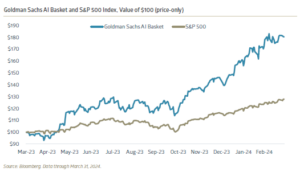
 The stock market continues to reward companies that are AI-hip, seemingly regardless of how early they are on the adoption curve. Goldman Sachs tracks companies either pursuing or enabling AI technology, and that basket of AI equities returned 24% in the first quarter, easily outpacing the S&P 500’s return of over 10%. The transformational nature of AI played a supporting role in the successful Initial Public Offering (IPO) of online platform Reddit during the closing days of March. The stock priced at $34/share initially, before jumping 48% on its first day of trading. This, for a company founded in 2005 that has yet to turn an annual profit, booking a roughly $91 million loss last year. With around one billion cumulative posts across 100,000 active communities on its site, Reddit is hoping it can license its content to companies that train AI models.2 Reuters reported in February that Reddit secured a deal with Google worth $60 million annually, providing a proof point for the bull case.
Yield Or Yield Not
For all of these direct or indirect beneficiaries of AI spend, analysts face an ongoing challenge to estimate both the size and duration of the AI revenue streams. In the meantime, investors aren’t waiting to catch a later train. In fact, some are resorting to unusual measures, Convertible bonds normally offer a positive interest rate in addition to the right to convert the bonds to equity shares at a set price. In March, San Jose, California-based Super Micro Computer rode a more than 1,000% AI-stoked rally over the trailing 12 months into a coveted spot in the S&P 500 Index. A leading provider of high-performance AI servers, Super Micro issued convertible debt in February with a 0% interest rate, and the yield quickly traded into negative territory, finishing the quarter at -2.1%. In other words, investors are paying for the privilege of lending money to Super Micro, the inverse of the typical arrangement. They do, however, have the carrot of potentially converting the bonds to equity shares by February 2029, which could prove worthwhile if the stock price continues to ascend.
Options trading is another area of the capital markets full of pep. In March, options volumes on U.S. single stocks exceeded trading volumes on the underlying equities for the first time since 2021.3 Technology stocks dominated the options leaderboard by absolute volumes, and options on companies involved with AI or cryptocurrencies proved a flytrap for investors buzzing around those themes. Super Micro’s average three-month options volumes equated to an astonishing 22% of the stock’s market capitalization as of mid-March, the highest percentage on that metric for the trailing three-month period, according to Goldman Sachs Derivatives Research. This is all a bit reminiscent of 2021, when meme stocks, options, and cryptocurrencies were running hot. Barron’s recently suggested the options market is in the throes of a speculative mania, due in large part to heavy trading on options that expire in under a week.4 That includes same-day expirations, also known as zero days to expiration (0DTE), and Barron’s sees echoes of the 1920’s bucket shops that enabled people to gamble on stock price changes without owning shares. Speculation is admittedly nothing new in financial markets, always burning at the edges of town, but has a bad habit of causing more widespread damage when the winds are right.
Not to be outdone, the credit markets have likewise adopted a risk-on approach. With the Federal Reserve still expected to begin reducing the Fed Funds target range during 2024, and an economic “soft landing” or even  no-landing viewed as in the works, investors feel emboldened to chase higher yields offered by lower-rated corporate issuers. The Barclays Capital U.S. Corporate High Yield Index spread over the 10-year U.S. Treasury Note yield declined to 346 basis points (bp) at the end of Q1. A year prior, that spread was 502 bps, close to the average of the last three decades. A Bloomberg piece said credit markets are acting like the go-go days of the easy money era are back again.5 Issuers with ratings deep into junk territory are returning to market and meeting strong demand, the article notes. The environment remains favorable, with default rates staying low. JPMorgan’s data puts the trailing 12-month U.S. high yield default rate at just 1.66% versus a 25-year average of 3.00%.6 With almost no room for improvement, reaching for yield down the credit spectrum may not pay off, particularly considering the availability of risk-free rates north of 5% at the short end of the Treasury yield curve.
The Simple Bare Necessities
Personification is a figure of speech, in which objects are given human traits. The next time you dine out with friends, for example, you might say the crème brûlée is calling your name. Although not literally true, it’s fun to imagine the siren call of the dessert menu. If we were to choose one word to describe inflation at present, stubborn seems to be the adjective of choice. After peaking at 9.1% year-over-year growth in June 2022, the Consumer Price Index (CPI) decelerated to just a 3.0% rate a year later. Since then, progress has stalled, leaving CPI up 3.2% year over year in February 2024. The Fed’s favored inflation metric, the Personal Consumption Expenditures (PCE) Core Index, was a little less stubborn, ringing in an increase of 2.8% year over year in February.
This has complicated decision-making for the Fed, and delayed the highly-anticipated pivot to easier monetary policy. Fed chairman Jerome Powell acknowledged the pickle they are in during his March 2024 press conference: “We know that reducing policy restraint too soon or too much could result in a reversal of the progress we have seen on inflation and ultimately require even tighter policy to get inflation back to two percent. At the same time, reducing policy restraint too late or too little could unduly weaken economic activity and employment.”7 Eight months past the last Fed Funds rate hike, economic data has largely remained solid. The unemployment rate has stuck under the 4% mark since January 2022. Gross Domestic Product (GDP) grew 3.1% inflation-adjusted in 2023, and the median Fed projection expects a little over 2% growth this year. Existing home sales jumped 9.5% in February 2024, an encouraging sign amidst elevated mortgage rates.
There are pockets of weakness. The Institute for Supply Management (ISM) monthly manufacturing survey posted a 16th-consecutive contractionary month in February, before finally creeping into expansion territory in March. Similarly, the Conference Board’s Leading Economic Indicators (LEI) Index managed a 0.1% month-over-month increase in February, snapping a nearly two-year journey in negative territory. Still, no recession, and perhaps it doesn’t need to be complicated. Consumers are employed, with added tailwinds from the financial markets, steady housing prices, and well-anchored inflation expectations.
Equity valuations for the largest U.S. companies seem to fully discount the “good enough” economy and the Fed pivot potential. Estimated S&P 500 Index operating earnings for 2024 actually slightly decreased during Q1, dropping from $242 per share at the outset to $240 at quarter end.8 Combined with a 10% price increase, the Index’s forward valuation was two points higher at nearly 22x at quarter end, driven up by those large Tech companies riding the AI wave. In comparison, the S&P 500 Equal Weighted Index trades at 17x, a better gauge of pricing for the average stock. Lower interest rates should be supportive of elevated valuations, assuming the Fed is able to avoid the “too late or too little” potholes. Ultimately, corporations will need to prove they can grow profits at a fast enough clip to justify market expectations, with or without a little help from their new AI friends.
1 “3 themes from 4Q 2023 conference calls: AI, supply chains, and the labor market,” Goldman Sachs S&P 500 Beige Book, 2/14/24.
2 “Reddit Eases Back After IPO Popped. There Are Still Challenges Ahead for Ad, AI Push.” Investor’s Business Daily, 3/22/24.
3 The Twenty US Stocks where Options Volumes Matter Most,” Goldman Sachs Derivatives Research, 3/13/24.
4 The Latest Options Craze Resembles Past Manias. That’s Not a Good Thing.” www.barrons.com, 3/20/24.
5 “Credit Markets Are Acting Like Easy Money Era Never Ended,” www.bloomberg.com, 3/8/24.
6 JPMorgan Asset Management “Guide to the Markets,” 3/11/24.
7 “Transcript of Chair Powell’s Press Conference,” www.federalreserve.gov, 3/20/24.
8 “S&P 500 Earnings and Estimate Report,” www.spglobal.com, 3/21/24.


The Weight Is Over: But Is It a Loss For Type 2 Diabetes Patients?
The “weight loss” drug Ozempic burst onto the scene in 2023 as a juggernaut winner for Danish drug maker Novo Nordisk. What began as a drug to treat Type 2 diabetes, however, soon proved efficacious to treat a much more widespread problem: obesity. That left Novo Nordisk in the driver’s seat of a blockbuster “off-label” drug. The challenge for Novo is making sure patients with Type 2 diabetes aren’t left on the side of the road.
Micro Cap Value Strategy Recognized as Manager of the Decade
San Francisco, CA – April 2, 2024 – Bailard’s Micro Cap Value Strategy has been recognized as Manager of the Decade and Bull/Bear Masters in the Micro Cap Value Universe in the PSN Top Guns list as of Q4 2024. The PSN Top Guns List for top performance in separate accounts, managed accounts, and managed ETF strategies.
The Micro Cap Value strategy was also recognized for:
- Top Gun status with 1, 3, and 4 Stars among the Micro Cap Value Universe (57 products as of Q4 2023)
- Top Gun status with 1 and 3 Stars among the US Equity Socially Responsible Universe (153 products as of Q4 2023)
“Micro caps value stocks tend to offer high potential for both reward and risk. Our team has worked hard to avoid taking unnecessary risks while seeking those high rewards,” said Thomas J. Mudge III, CFA, Senior Vice President and Director of Equity Research at Bailard. “Consistency is the key to long-term success in micro cap stock investing. We have a disciplined multi-input investment process coupled with rigorous and broad-spectrum risk controls.”
The inclusion of our Micro Cap Value strategy in the PSN Top Guns List is an indication of our dedication, expertise, creativity and a commitment to excellence riven stock section techniques and broad-spectrum risk controls (including ESG).
Through a combination of PSN’s proprietary performance screens, the PSN Top Guns list ranks products in six proprietary categories in over 75 universes based on performance over time. This recognition, presented by Zephyr, highlights the achievements of product offerings within the PSN peer reporting framework. The rankings were announced in February 2024. There was no fee to enter.
Below is a description of each ranking, based on gross of fee returns. The deduction of fees and expenses could have affected performance ratings.
- Top Gun One Star Rating means the strategy had one of the top ten returns for the quarter in their respective strategy.
- Top Gun Three Star Rating means the strategy had one of the top ten returns for the three-year period in their respective strategy.
- Top Gun Four Star Rating means the strategy had an r-squared of 0.80 or greater relative to the style benchmark for the recent five-year period. Moreover, the strategy’s returns exceeded the style benchmark for the three latest three- year rolling periods. The top ten returns for the latest three-year period then become the 4 Star Top Guns.
- Top Gun Manager of the Decade Rating means the strategy had an r-squared of 0.80 or greater relative to the style benchmark for the latest 10-year period. Moreover, the strategy’s returns were greater than the style benchmark for the latest 10-year period and also standard deviation less than the style benchmark for the latest ten-year period. At this point, the top ten performers for the latest 10-year period become the PSN Top Guns Manager of the Decade.
- Top Gun Bull & Bear Masters means the strategy had an r-squared of 0.80 or greater relative to the style benchmark for a three- year period. Moreover, the strategy had an upside market capture over 100 and a downside market capture less than 100 relative to the style benchmark. The top ten ratios of Upside Capture Ratio over Downside Capture Ratio become the PSN Bull & Bear Masters.
Past performance does not guarantee future results. All investments involve the risk of loss.
The complete list of PSN Top Guns and an overview of the methodology can be found at https://psn.fi.informais.com/. Registration is required.
About Bailard, Inc.
Founded in 1969, Bailard is an independent asset and wealth management firm serving individuals, families, and institutions alike. Bailard has built a long‐term asset management track record across domestic and international equities, fixed income, and private real estate, as well as robust, in-house sustainable, responsible, and impact investing expertise. We combine these investment capabilities with financial, tax, and estate planning to provide comprehensive wealth management. Through it all, Bailard works with clients to align their financial goals with their values. Based in the San Francisco Bay Area with $5.8 billion in assets under management as of 12/31/2023, Bailard is a majority employee-owned and women-led firm, a Certified B Corporation™, and a Principles of Responsible Investing signatory.
Important Disclosures
Bailard Micro Cap Value Strategy Key Risks: The Bailard Micro Cap Value Strategy is not by itself a complete investment program and is best suited for investors who can accept the above average risk generally associated with micro cap stocks. These companies may face greater economic cycle risk, credit risk, geographic risk, product, and customer concentration risk than that faced by larger companies. Micro cap stocks are more volatile and less liquid than larger cap stocks and may be more difficult to trade. There are times when the micro cap value equity style underperforms other equity investment styles.
The application of various environmental, social and governance screens as part of a socially responsible investment strategy may result in the exclusion of securities that might otherwise merit investment, potentially resulting in higher or lower returns than a similar investment strategy without such screens or other strategies that use a different methodology to exclude issuers or evaluate ESG criteria. Investors can differ in their views of what constitutes positive or negative ESG characteristics. As a result, the strategy may invest in issuers that do not reflect the ESG beliefs and values of any particular investor.
In evaluating a security or issuer based on ESG criteria, we are dependent upon certain information and data from third party providers of ESG research, which may be incomplete, inaccurate or unavailable. As a result, there is a risk that we may incorrectly assess a security or issuer. There is also a risk that we may not apply the relevant ESG criteria correctly or that the strategy could have indirect exposure to issuers that do not meet the relevant ESG criteria used by the strategy. We do not make any representation or warranty, express or implied, with respect to the fairness, correctness, accuracy, reasonableness or completeness of such ESG assessment. There may be limitations with respect to availability of ESG data in certain sectors, as well as limited availability of investments with positive ESG assessments in certain sectors. Our evaluation of ESG criteria is subjective and may change over time.
The market value of an investment will fluctuate as the securities markets fluctuate. There can be no assurance that this or any investment strategy will achieve its investment objectives. All investments have the risk of loss.
Additional Disclosures: This piece does not constitute advice or a recommendation or offer to sell or a solicitation to deal in any security or financial product. It is provided for information purposes only and on the understanding that the recipient has sufficient knowledge and experience to be able to understand and make their own evaluation of the proposals and services described herein, any risks associated therewith and any related legal, tax, accounting or other material considerations. To the extent that the reader has any questions regarding the applicability of any specific issue discussed above to their specific portfolio or situation, prospective investors are encouraged to contact Bailard or consult with the professional advisor of their choosing.
About PSN
For nearly four decades, PSN has been a top resource for investment professionals. Asset managers rely on Zephyr’s PSN to effectively reach institutional and retail investors. Over 2,800 firms, 285 universes, and more than 21,000 products comprise the PSN SMA database showing asset breakdowns, compliance, key personnel, ownership diversity, ESG, business objectives and strategy, style, fees, GIC sectors, fixed income ranges and full holdings. Unique to PSN is its robust historical database of nearly 40 Years of Data Including Net and Gross-of-Fee Returns. For more details on the methodology behind the PSN Top Guns Rankings or to purchase PSN Top Guns Reports, contact Robby Resendez at PSNdata@informais.com Visit PSN online to learn more.
 Interested in Learning More about the Technology Strategy, or Meeting with the Technology Strategy Team?
 Interested in Learning More about the Technology Strategy, or Meeting with the Technology Strategy Team?
Diana L. Dessonville
Executive Vice President | Director, Institutional Client Services
diana.dessonville@bailard.com
(650) 571-5800
The “Blocking and Tackling” of Estate Planning
Dave Jones, JD, LLM, CFP® Senior Vice President and Director of Estate Strategy, dives into how estate planning can be broken down into blocking and tackling— much like football—to create a “winning strategy.”
Legendary football coach Vince Lombardi once said: “Football is two things—blocking and tackling.” Perhaps an oversimplification, but the principle is correct. Winning in football boils down to whether the team does a few, essential things really well. If a team blocks and tackles better than the team they’re playing, they’re likely to win.
At Bailard, we recognize that achieving your estate planning goals often hinges on a few critical aspects of the planning process. These tasks may seem basic and perhaps even tedious, but their importance cannot be overstated. They are:
In this article, we explore these critical aspects of estate planning to help you accomplish your estate planning objectives.
Why—and How Often—to Regularly Review Estate Planning Documents
Estate planning documents—such as wills, trusts, powers of attorney, and healthcare directives—form the foundation of your estate plan. However, it’s not enough to simply create these documents and then forget about them. Since life is dynamic, circumstances change over time, which may necessitate revisions to your estate planning documents. Like a football game, you cannot necessarily set and forget a “winning” strategy—your approach must be dynamic, adjusted based on your team’s players, changing circumstances, and other factors.
It’s not uncommon for clients’ estate planning documents to be more than 10 or 20 years old—requiring significant updates to address changes in personal circumstances as well as changes in tax and state laws. We generally recommend that estate planning documents be reviewed every two to five years, even if personal circumstances haven’t drastically changed. Outside of this maintenance cadence, some common life events warrant immediate review:
Regularly reviewing and updating your estate planning documents in light of these and other significant life events—or every two to five years—helps ensure that your documents accurately reflect your wishes and that your assets are distributed according to your desires.
Creating and Funding Your Revocable Trust
A revocable trust is a valuable estate planning tool that offers numerous benefits, including probate avoidance, privacy, and flexibility in asset distribution. However, simply creating a revocable trust is not sufficient to reap these benefits; you must also fund the trust by transferring title of your assets into it.
By funding your revocable trust, you ensure that the above assets are held and managed according to the terms of the trust, thereby avoiding probate and streamlining the administration of your estate. (Note: In several states, such as California and New York, the probate process can be much more expensive and time-consuming than other states, such as Texas or Montana. You should consult your local counsel to guide you about the probate process in your state and county.) Additionally, a revocable trust provides continuity of asset management in the event of your incapacity, as your designated successor trustee can step in to manage the trust assets on your behalf. Assets that can be transferred to a revocable trust generally include:
Designate Beneficiaries of Retirement Accounts, Annuities, and Life Insurance
Beneficiary designations for retirement accounts, annuities, and life insurance policies supersede the instructions outlined in your will or trust. Therefore, it’s essential to review and update these beneficiary designations regularly to ensure they align with your current wishes and intentions, and are coordinated with your overall estate plan. Here are some key considerations:
Play Like a Team
Estate planning, much like football, hinges on mastering the basics—the blocking and tackling, so to speak. But winning still requires communication and playing like a team. For example, sometimes it is more advantageous to make a gift by beneficiary designation than through your will or revocable trust, or vice versa. It is common to remove a charitable beneficiary from the will or revocable trust and instead make the gift from a retirement account for tax reasons.
Regularly reviewing and updating your beneficiary designations ensures that your assets are distributed efficiently and in accordance with your wishes, while also minimizing the potential for unnecessary taxes, disputes, or challenges to your estate plan.
While estate planning may not be the most enticing topic for many (many may argue the same about football), it’s crucial to recognize estate planning’s significance in securing a smooth transition of wealth. By addressing these three “block and tackle” tasks—reviewing documents on a regular basis, funding your revocable trust, and designating beneficiaries—you lay the groundwork for a “winning” estate plan.