

Country Indices Flash Report – July 2023
All emerging market regions enjoyed a month of results in excess of EAFE’s. While a Fed rate hike cycle typically causes economic distress across emerging economies, EMs look relatively unscathed as the FOMC nears the end of sixteen months that brought the Fed Funds rate from near-zero to 5.5%.


ISSB’s Inaugural Global Sustainability Disclosure Standards Issue Brief
On June 26, 2023, the International Sustainability Standards Board (ISSB) released its much anticipated inaugural sustainability standards. The standards were launched by the IFRS Foundation, the non-profit, public-interest arm of the ISSB. The standards were launched at COP26 with the purpose of establishing a global baseline of sustainability-related disclosure standards.
As the governing body of the International Accounting Standards Board, the IFRS Foundation should be well-positioned to oversee global standards. The International Accounting Standards Board determines the accounting rules for financial statements of public companies used by most developed countries. The release of these standards followed a comprehensive consultation period that allowed global stakeholders to weigh in on the proposed standards. The standards integrate the recommendations of the Task Force on Climate-related Financial Disclosures (TCFD) as well as the Sustainability Accounting Standards Board’s industry-based disclosure requirements.
Quarterly International Equity Strategy Q2 2023
Non-U.S. stocks traversed an unusual landscape during the year’s second quarter. Wages continue to drive inflation globally, although the pressure is lessening in the U.S. relative to Europe. Policymakers everywhere need to remain vigilant as inflation is notoriously challenging to defeat. China’s underwhelming economic reopening may help dampen global inflation but also diminish the nation’s imports and exports in the near term. More broadly, emerging markets have weathered the developed world’s rate hike cycle better than history would suggest, potentially leading investors back to this long-ignored sector. Japan remains high in our Strategy’s model rankings, as higher-than-historical inflation may provide a backdrop for stronger spending. Local conditions broadly, combined with an overvalued dollar, provide long-term support for non-U.S. equities.


Quarterly Small Value ESG Equity Strategy Q2 2023
Generative Artificial Intelligence (AI) was a continuing theme in Q2, as interest in stocks exposed to AI has skyrocketed since ChatGPT launched in November of last year. Many investment strategists are enamored by the productivity enhancing promise of AI and don’t feel the hype surrounding it has gotten out of hand (yet). Indices with greater AI exposure trounced those with lesser representation, making Q2 a large cap growth stock paradise, with everything else rising at a lesser pace.
After a lengthy string of rate hikes, the Fed held steady in June but warned of potential hikes later this year should inflation continue to linger. The prospect of eventual interest rate declines gave further ammunition to growth stock enthusiasts, even though the reality was that interest rates rose throughout the quarter, which should benefit value stocks.
Value-Based Healthcare: A Transformative Approach
There’s an alternative to the traditional fee-for-service healthcare model. Ryan Vasilik, CFA, Equity Analyst, sheds light on the opportunities that abound with value-based care.
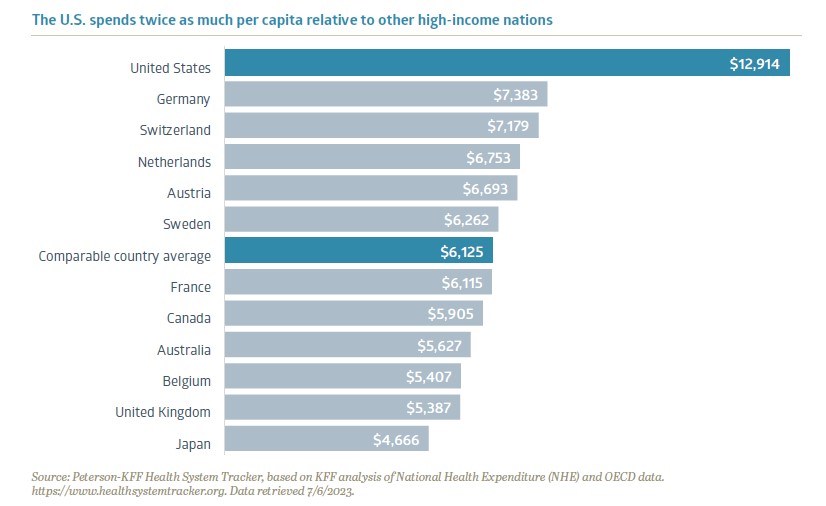
For decades, narratives about the escalating costs of healthcare and its impact on affordability have remained at the forefront of American concerns. Most people either know of, or have personally experienced, financial hardship when dealing with medical issues. In fact, medical bills are the leading cause of personal bankruptcy in the U.S.1 Compared to other industrialized nations, the U.S. spends twice as much per capita on healthcare services. High healthcare spending by itself isn’t necessarily a negative; shockingly though, despite spending twice as much as its peers, the U.S. also ranks dead last on measures like life expectancy and patient satisfaction.
While there are many stakeholders involved in our healthcare system, there is no single villain responsible for driving up costs and there is no silver bullet solution. Fortunately, new healthcare delivery alternatives are emerging to help bend the cost curve and substantially improve patient outcomes. One new healthcare paradigm to address these challenges is value-based care. We believe the emergence of value-based care will revolutionize our perception of the U.S. healthcare system and holds the potential to enhance cost efficiency, patient outcomes, and open new horizons for entrepreneurs and established companies alike.
A Game-Changing Approach
Value-based care (VBC) is a transformative approach to delivering healthcare, where stakeholders compete on the quality of patient outcomes instead of quantity. All parties have skin in the game and are financially at risk if patient results deteriorate. VBC healthcare providers receive a risk-adjusted annual fee per patient from insurance payors and are responsible if patient complications arise. Healthcare providers and payors are aligned to properly diagnose, direct, and treat patients throughout the medical episode, thus focusing on preventative care and keeping patients out of the hospital.
Under this new model, healthy patients and provider profitability go hand-in-hand. The goal for the provider is to generate excess profit by managing patient pools in a more efficient manner. Traditionally, the U.S. healthcare system has employed a “fee for service” delivery model, where providers are paid on patient visits. This model has been criticized due to the potential for conflicts of interest where the provider benefits the more a patient utilizes medical care. Insurance companies complicate the issue, as they are often responsible for covering the medical bills of patients and may attempt to ration care or shift costs to protect their bottom line. Value-based care is a new form of competition that focuses on long-term medical outcomes for patients and lowers costs for payors in a sustainable way. The beauty is that it corrects the downfalls of the fee-for-service model. While fee-for-service treatment is frequently criticized for waiting for a patient to get sick before receiving care, value-based medicine relies on investing in systems to help providers diagnose or even prevent illnesses early and match patients to the appropriate care facilities to improve their lives throughout the healthcare continuum.
 The push for value-based care originated through Medicare Advantage, an additional insurance program for seniors that offers supplementary benefits alongside regular Medicare. Utilizing a VBC model within the Medicare Advantage population was a logical first step, due to the significant potential for reducing costs in this program. Although comprising only one-sixth of the U.S. population, individuals aged 65 and above account for over one-third of all medical expenditures. The VBC model has been widely viewed as a success within Medicare Advantage. Today, roughly six million Medicare Advantage patients have physicians who contract with VBC providers.2 This figure is projected to increase as Medicare officials have expressed a goal to establish value-based care relationships for every Medicare beneficiary by 2030.3
Beginning with the PCP
The foundation of value-based care begins with the primary care physician (PCP). Providing concierge-level care, primary care physicians and their team interact with patients up to ten times per year at no additional cost to patients. Doctors spend a greater amount of time with their patients to monitor their health and provide follow-up care to make sure patients are achieving their health goals. These additional interactions are not trivial; for example, doctors found that weighing patients who have congestive heart failure once a day can help identify whether a patient’s heart failure is deteriorating. This additional data can help the patient’s medical team intervene earlier, potentially halt the deterioration, and keep the patient out of the emergency room.
Unfortunately, data has shown that under the current system, many patients use the emergency room as their primary care doctor, racking up thousands in unnecessary medical bills and often leading to an expensive downward spiral. Some of the lowest hanging fruit for cost reduction is directing patients to the appropriate center as an alternative to expensive emergency room visits. Steering patients to lower-cost locations, such as suburban offices instead of city centers or even coming to the patient’s own home, can achieve the same or potentially superior medical benefit at a fraction of the cost. Ultimately, under VBC, a healthier patient leads to less medical spending that needs to be reimbursed by payors, leading to better healthcare outcomes at lower costs.
Nearing an Inflection Point
The value-based care industry has experienced enormous growth over the past few years, and we are now reaching an inflection point. As the healthcare industry gets more comfortable with VBC models, we believe the next evolution will be focused on three key areas: optimizing care coordination, broadening data capture, and expanding VBC to reach new patient populations.
The move towards VBC within specialty chronic conditions, like kidney disease or diabetes, is a logical next step. Managing chronic diseases involves interacting among multiple specialty physicians and teams. By organizing care coordination specifically around these diseases, we can break down information barriers and eliminate redundant treatments.
Payors will increasingly demand clinical studies from drug and medical device companies that not only demonstrate the efficacy of the product, but also quantify the total lifetime savings generated by these products. Companies that present data showing how their drugs or devices both directly and indirectly prevent future complications will earn higher status in formularies.
The principles of value-based care can also be applied to younger patient demographics. Helping facilitate this demographic expansion are private healthcare information technology companies who provide software and patient management insights that enable providers to enter into value-based relationships at minimal financial risk. As healthcare providers and payors accumulate more data, they can adopt best practices and realize the benefits observed in senior populations.
Change is Not Impossible
As a nation, we all have a stake in healthcare reform and improving patient care. The destiny of the U.S. healthcare system is not predetermined, and it would be a mistake to assume that change is insurmountable. Each year, a new class of visionaries sets out to tackle the healthcare cost dilemma.
While still in early days, we believe value-based care can materially shift the U.S. healthcare delivery model. Given the nascent state and dynamic evolution of the model, it presents a golden opportunity for entrepreneurs and investors, promising lucrative rewards for those who emerge as winners. Monumental progress has been made since the beginning days, and we have real world data measured over years that shows VBC works. The shift towards this new model will not happen overnight, but the evidence is clear that our path forward to reimagining healthcare is through value-based care.
1 Bedayn, J. (2023, April 17). States confront medical debt that’s bankrupting millions. AP News. https://apnews.com/article/medical-debt-legislation-2a4f2fab7e2c58a68ac4541b8309c7aa.
2 U.S. Centers for Medicare & Medicaid Services. (2023, April 5). Medicare Advantage Value-Based Insurance Design Model Extension Fact Sheet: CMS Innovation Center. Innovation Center. https://innovation.cms.gov/vbid-extension-fs.
3 King, R. (2022, April 29). CMMI’s Liz Fowler calls for better approach to educating public, lawmakers on value-based care. Fierce Healthcare. https://www.fiercehealthcare.com/providers/cmmis-liz-fowler-calls-better-approach-educating-public-lawmakers-value-based-care.


Economic Brief: Portfolio Theory
This quarter’s economic perspective of Jon Manchester, CFA, CFP® (Senior Vice President, Chief Strategist – Wealth Management, and Portfolio Manager – Sustainable, Responsible and Impact Investing) runs the gamut from Harry Markowitz to Taylor Swift.
In late June, at 95 years old, Nobel prize-winning economist Harry Markowitz passed away in San Diego, CA. He leaves behind an immense legacy in the investment field, with his fingerprints in virtually all professionally-managed portfolios today. As the Financial Times put it: “The study of finance can easily be split into two eras: before and after Harry Markowitz.”1 Prior to the 1952 publication of his groundbreaking University of Chicago PhD dissertation titled “Portfolio Selection,” investment portfolios tended to be assembled in a somewhat haphazard manner, a collection of individual securities each assessed in isolation from a risk and return perspective with scant attention paid to how the puzzle pieces fit together. Diversification was a well-known concept, but Markowitz’s work provided a mathematical approach to evaluate risk/return tradeoffs holistically, at the portfolio level. Rob Arnott, founder of asset management firm Research Affiliates, noted “Before Harry, investing was a bunch of rules of thumb.”2
In awarding him the 1990 Alfred Nobel Memorial Prize in Economic Sciences—shared with Merton Miller and William Sharpe for separate (but in Sharpe’s case, related) achievements—the Royal Swedish Academy of Sciences lauded Markowitz’s pioneering contributions to portfolio choice. Importantly, Markowitz illustrated the importance of how each asset in a portfolio contributes to the overall risk by considering how the securities move in relation to one another. In other words, how correlated are the assets in a given portfolio? This had significant and enduring implications for portfolio management. Adding a high-risk biotechnology stock to a portfolio otherwise composed entirely of low-risk, regulated utilities stocks could in fact lower the risk of the overall portfolio compared to a broad equity benchmark, given the low correlation between the price movements of the two vastly different industries. This enabled investment managers to evaluate a potential investment in the context of the overall risk picture, and gave rise to the construction of more well-diversified portfolios across asset classes.
The adoption was not immediate, however. According to a Financial Analysts Journal article, Markowitz’s ideas took more than 20 years to catch on.3 It required the “shock wave of the early 1970s stock market selloff and the passage of ERISA” to compel investors to build sturdier portfolios, plus the eventual development of faster computing power to handle the necessary calculations.
The investment world has, not surprisingly, evolved at a dizzying pace in the half-century since the inflationary 1970s, but Markowitz’s core architecture of creating optimal, efficient portfolios across the risk-return spectrum still has a place in the latest iterations of his Modern Portfolio Theory (MPT). It does not necessarily help CNBC gain viewers, though, which is why a recent Bloomberg opinion piece on Markowitz observed that “most investment coverage today is about which securities will go up or down in price, not which ones are shrewd bets, and definitely not which ones have desirable correlations to be part of portfolios with attractive risk/return ratios.”4
The Big Seven
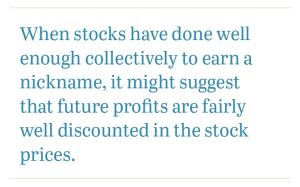
One can’t help but wonder how Markowitz would assess the current state of the U.S. large-cap equity market. As someone who was reportedly consumed with the statistical properties of portfolios of securities, it’s probably safe to assume he would be intrigued by the very narrow band of stocks carrying the overall Standard & Poor’s 500 Index. The Index returned 8.7% including dividends in the second quarter, taking its year-to-date total return up to 16.9%. Nearly three-quarters of the Index’s 2023 return thus far can be attributed to just seven stocks: Apple, Microsoft, Nvidia, Amazon, Meta Platforms, Alphabet, and Tesla. Three of those companies—Nvidia, Meta Platforms, and Tesla—saw their stock prices soar more than 100% higher during the first half of 2023. Media outlets have started referring to this group as either the “Big Seven” or sometimes the “Magnificent Seven,” which in itself is concerning. When stocks have done well enough collectively to earn a nickname, it might suggest that future profits are fairly well discounted in the stock prices. At present, the Big Seven trades for an average forward price/earnings ratio of roughly 36x. The overall Index trades at a robust 20.5x estimated 2023 operating earnings per share, and Morgan Stanley calculates that the median S&P 500 stock valuation lands in the 89th percentile historically.5
 For companies outside the Big Seven, returns haven’t been as gaudy. The median total return for S&P 500 companies was a relatively pedestrian 4.8% over the first half of 2023. Tracing back further to the end of 2021, one trading day short of the market’s all-time peak, only 35% of S&P 500 stocks had higher prices on June 30 compared to then. The remaining 65% were still trying to climb back following an ugly 2022, and that list includes Big Seven members Tesla, Alphabet, and Meta Platforms. All this is to say the list of winners within the U.S. large-cap universe is a fairly exclusive club, and a common theme for outperformers this year has been stocks perceived to benefit directly or indirectly from generative artificial intelligence (AI). Per a Bloomberg article: “The market’s fascination with the power of generative AI has trumped every major issue that could potentially drag down sentiment this year: recession fears, elevated levels of inflation, prospects for more Federal Reserve hikes, geopolitical risks, the debt-ceiling debate and the collapse of a few regional banks.”6
Despite the AI frenzy, research from Strategas points out that the real bull market has been in money market flows. Since the S&P 500’s low point last October, investors have directed four times as much into money market funds as compared to equity exchange-traded funds.7 Strategas believes those flows reflect a “ton of equity market apathy,” but sharply higher money market yields are no doubt a major factor as well, plus the scramble to avoid holding bank cash above limits insured by the Federal Deposit Insurance Corporation (FDIC). The Federal Reserve’s (the Fed’s) monetary tightening campaign has lifted short-term yields up near 5%, attracting the income-focused crowd. Meanwhile, the distrusted rally in equities continues to climb the wall of worry that Bloomberg outlined, and it has the potential to continue as more investors get off the sidelines and belatedly look to participate in further upside. There are some signs of froth in the markets, however, whether it’s increasingly rich valuations paid for growth stocks or the mid-June initial public offering (IPO) of unprofitable restaurant chain CAVA Group, which saw the stock nearly double on its first day of trading amidst a dearth of listings.
Mind the Lag
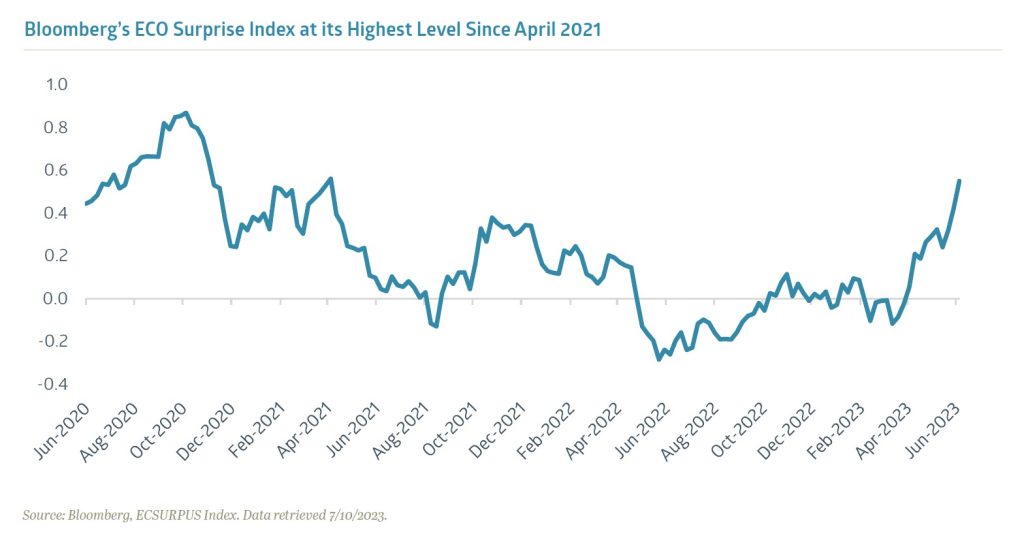
Economic growth in the U.S. has aided the markets thus far in 2023 by being neither too hot nor too cold, the precise porridge that can keep bears at bay. Gross Domestic Product (GDP) rose at a 2% annualized pace in the first quarter, adjusted for inflation, and the Atlanta Fed’s GDPNow estimate for second quarter growth is about the same. With many economists initially projecting a mild recession during 2023, the economic data thus far has proved better-than-feared. Bloomberg’s ECO Surprise Index measures the aggregate differentials between the actual values of economic releases and analyst forecasts. After a flattish start to the year, the ECO Surprise Index moved steadily higher in May and June to its highest level since April 2021. While asking if it’s time to cancel the recession altogether, Bloomberg columnist Jonathan Levin observed that economists have started throwing in the towel on a recession starting in the third quarter.8 The consensus estimate for Q3 real GDP annualized growth is now roughly flat, up from a trough forecast of -0.9% in May.
There remain ample reasons to be pessimistic. Chief among those is the Fed’s yet unfinished inflation battle. Although inflation has shown significant improvement—with the headline Consumer Price Index (CPI) decelerating to a 4.0% year-over-year growth rate in May—the Fed’s dot plot indicates it expects to raise the target Fed Funds rate by another 50 basis points9 to 5.75% at the upper end. Whether or not that happens, there is concern that the economy has yet to truly feel the impacts of tighter monetary policy. There is typically a lag between the policy changes and when economic metrics start to reflect those moves. Given the Fed lifted its target rate by five percentage points between March 2022 and May 2023, the fastest hiking pace in over four decades, it seems reasonable to withhold judgement before declaring the economy immune to higher rates.
 There is also the inconvenient truth that the U.S. Treasury yield curve has been consistently inverted for a year now, with the two-year yield at 4.89% as the second quarter ended, versus 3.83% for the 10-year note. Historically, this has suggested a recession lies ahead. The Conference Board’s Leading Economic Index (LEI) hasn’t inspired confidence either, moving lower 14 consecutive months through May. Projecting that the U.S. economy will contract over the Q3-2023 to Q1-2024 timeframe, The Conference Board said the “recession likely will be due to continued tightness in monetary policy and lower government spending.”10
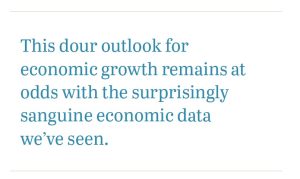
This dour outlook for economic growth remains at odds with the surprisingly sanguine economic data we’ve seen. Notably, few cracks have emerged in the all-important labor market. Retail sales advanced at a 1.7% year-over-year rate in the three months ending in May, which might qualify as desirably lukewarm. Perhaps music superstar Taylor Swift deserves some credit for the economic resilience. As her current tour rolls around the country providing a boost to local economies—which some have compared to hosting the Super Bowl—one study estimated the Swifties will generate $5 billion in economic impact, more than the GDP of 50 countries.11 While admittedly small in the context of a roughly $26 trillion U.S. economy, Swiftonomics is clearly not the problem. We just need her to continue touring the states indefinitely, until generative AI is ready to take over completely.
1 “Harry Markowitz, economist, 1927-2023,” www.ft.com, 6/30/2023.
2 Ibid.
3 “Harry M. Markowitz: Profile of an Industry Leader,” www.cfainstitute.org, Q4 2017.
4 “Nobel Laureate Harry Markowitz Was a Misunderstood Economist,” www.bloomberg.com, 6/26/2023.
5 “US Equity Strategy,” Morgan Stanley Research, 6/26/2023.
6 “Big Seven Powering $5 Trillion Nasdaq 100 Rally,” www.bloomberg.com, 6/30/2023.
7 “Key Charts For 1H Client Letters & Look Ahead,” Strategas ETF Research, 6/27/2023.
8 “Is It Time to Cancel the Recession Altogether?,” www.bloomberg.com, 6/27/2023.
9 A basis point (bp) is 0.01%.
10 “LEI for the U.S. Declined Further in May,” www.conference-board.org, 6/22/2023.
11 “Generating $5 billion, the Taylor Swift The Eras Tour has an Economic Impact Greater than 50 Countries,” www.bloomberg.com, 6/8/2023.

Exploring the Possibilities of Generative AI
Dave Harrison Smith, CFA, Executive Vice President, Domestic Equities, and Head of Technology Research delves into—both massive and more mundane—potential advancements, impacts, and risks as generative AI leaps forward.
“ChatGPT just saved me,” my wife exclaimed earlier this week. As a legal manager she is often tasked with communicating complex issues, and in the past has found that she too often can come off as brusque and overly direct. She found herself spending hours wordsmithing memo introductions to strike a warmer tone while still maintaining a professional manner. This week, she dropped a draft introduction into the prompt box for the generative AI superstar ChatGPT and asked it to soften the tone and spin up a novel, friendlier introduction. Thirty seconds later her memo was complete, and she was thrilled.
While the Artificial Intelligence (AI) field has been under development since the 1950s, over the past year we have witnessed a monumental leap forward in a sub-branch of AI called generative AI. Specifically, the private company OpenAI released a revolutionary interface, ChatGPT, which comprised a powerful large language model (LLM) and a modern chat-based user interface. The readily accessible, easy to use interface—combined with the power of a learning model with hundreds of billions of parameters—had one AI expert saying it was akin to “looking into the face of God.” What has followed has been nothing short of remarkable: ChatGPT became the fastest consumer product to reach 100 million users (in a mere two months), academic scholars and open-source developers have made incredible strides with almost daily breakthroughs in generative AI research, and massive, trillion-dollar companies and well-known start-ups have rapidly pivoted strategies to embrace the potential of generative AI.
ChatGPT saving my wife a half hour of work writing an email introduction may not sound groundbreaking, but it’s our belief that generative AI has the capacity to make a powerful difference in the world. The average individual’s perception of economic progress is unfortunately frequently tied to the business cycle or stock market returns. Ask a person on the street how humanity has done over the past 40 years and the answer may well depend on the state of their local economy. Economists would argue that, in the long run, prosperity is tied directly to productivity growth. An increase in the average output per hour of labor worked means that the economy is growing, with our per capita income similarly increasing. Unfortunately, by many measures, productivity growth has stalled since the early 2000s. Disappointed economists have offered a myriad of reasons for the slowdown, including demographics and the lack of life-changing inventions, like the internal combustion engine, but the growth stagnation has continued unabated.
Enter Generative AI
Through our research, we have come to believe generative AI technology is key to unlocking a step function increase in productivity growth and, longer term, our quality of life. News and social media feeds alike are already flooded with peers using generative AI to save immense amounts of time. Professors are generating the framework of a new paper in hours rather than days. Programmers are debugging code in minutes rather than hours. Marketers are creating content drafts in seconds rather than minutes or hours.
These productivity gains are showing in academic studies, as well. Scholars Brynjolfsson, Li, and Raymond found that access to a generative AI tool increased call center worker productivity by 14% and by 30% for lower skilled and newer employees.1 Kazemitabaar et al found that the productivity of programmers was increased by 1.8x when they were paired with a code generating AI co-pilot.2 Incredibly, we believe we are just scratching the surface of what this technology can do, and we expect to see a Cambrian explosion of uses and products over the coming months and years. In a thought piece from its research team, Goldman Sachs stated that the “…proliferation of consumable machine learning and AI has the potential to dramatically shift the productivity paradigm across global industries, in a way similar to the broad scale adoption of internet technologies in the 1990s.”3 Like the early days of the internet, many of these products will sputter, but we believe the next crop of great technology products is poised to rise from this new ecosystem.
Acknowledging the Ghosts in the Machine
The benefits of generative AI have the potential to be profound. Yet, it is important to recognize the risks as well. The media is already awash with stories of students using ChatGPT to generate essays. While cheating should never be excused, these stories may one day seem trivial to larger threats that are far more dangerous. We are just beginning to grasp the impact of disinformation in the democratized media world of Twitter and Facebook. Imagine now, that bad actors can generate AI optimized content in text, image, and even video form that appears accurate and true. Unfriendly nations and terrorist organizations will gain a powerful new weapon when the cost of generating new falsehoods falls to zero.
Potential Effects of Productivity Change
The impact on employment is another topic of significant debate. We have argued in the past that technological shifts are not zero sum games. If call center employees are 15% more productive, that may mean a company needs to employ fewer call center agents. However, these agents are now able to find employment in other jobs and, from an aggregate standpoint, the overall economy grows. Yet, this line of reasoning can feel heartless and myopic; looking at aggregate numbers ignores the fact that these are real people with real families losing their jobs. “The productivity effects of generative AI are likely to go hand in hand with a significant disruption in the job market as many workers may see downward wage pressures,” according to the Brookings Institute.4
We are reminded of John Steinbeck’s famous work The Grapes of Wrath, where the breakthrough technology of the tractor enabled one farmer to do the work of 15, displacing tens of thousands of poor farmers and sharecroppers. The misery of these families is chronicled in detail, despite the long-term economic growth the technology enabled. It is critical that our society recognizes the pain that frictional unemployment can cause and ensures that proper investments in job training and safety nets are in place.
There is still a great deal of uncertainty surrounding generative AI. The common maxim that we are overestimating the impact in one year and underestimating the impact in ten years will likely hold true. As investors, we need to be aware of the hype surrounding the technology, as it can create bubbles of over-valuation, a la countless transformational technologies in the past. As users and as a society, we need to be aware of the risks and threats that the new technology can precipitate.
It’s our belief that this represents the next great technological evolution and, in the medium to long term, has the potential to meaningfully impact worker productivity and significantly enhance our daily lives, perhaps on par with some of the great technological leaps of the past century. We also believe there will be a significant opportunity set created for entrepreneurs and savvy investors over time. Bill Gates called generative AI the most revolutionary technology he has seen since the graphical user interface,5 which spawned the Windows operating system. Certainly, Gates knows a thing or two about generational technological shifts. We can’t wait to see what the future holds.
1 Brynjolfsson, E., Li, D., & Raymond, L. R. (2023, April 24). Generative AI at work. NBER. https://www.nber.org/papers/w31161.
2 Kazemitabaar, M., Chow, J., Ma, C. K., Ericson, B. J., Weintrop, D., & Grossman, T. (2023, April 19). Studying the effect of AI Code Generators on Supporting Novice Learners in Introductory Programming. ACM Digital Library. https://doi.org/10.1145/3544548.3580919.
3 Goldman Sachs Global Investment Research. (2016, November 14). Profiles in Innovation: Artificial Intelligence. https://www.gspublishing.com/content/research/en/reports/2019/09/04/a0d36f41-b16a-4788-9ac5-68ddbc941fa9.pdf.
4 David Kiron, E. J. A., David Autor, A. S., Sanjay Patnaik, J. K., Ajay Agrawal, J. S. G., Sukhi Gulati-Gilbert, R. S., & Nicol Turner Lee, A. K. (2023, June 29). Machines of mind: The case for an AI-powered productivity boom. Brookings. https://www.brookings.edu/articles/machines-of-mind-the-case-for-an-ai-powered-productivity-boom/.
5 Gates, B. (2023, March 21). The age of AI has begun. GatesNotes. https://www.gatesnotes.com/The-Age-of-AI-Has-Begun.