


Morningstar: "What to Know About the Software Stock Selloff"
Dave Harrison Smith, CFA, as source in a recent article published by Morningstar.

Country Indices Flash Report – January 2026
U.S. asset leadership continued to slide from its early-2025 peak. Gold briefly hit record highs above $5,400/oz as the Fed held rates steady, foreign currencies rallied, and more than 80% of country equity indexes outperformed the U.S. in January. [Read more…]
Quarterly International Equity Strategy Q4 2025
2025 closed by continuing the year’s theme: equity strength driven by economic and corporate resilience, despite policy uncertainty. The U.S.-centered nature of much of this uncertainty gave non-U.S. stocks an edge over U.S. peers for the quarter and year—resulting in the largest annual gap seen in over 30 years. International stocks have shown remarkable breadth—spanning numerous disparate countries, industries, and stocks—in contrast to a narrow U.S. market. A diversity of thematic tailwinds, ranging from AI infrastructure to security spending and improvements in governance, along with undemanding valuations and pressures on the U.S. dollar, support our belief that the year’s strength is just the beginning of a multi-year period of non-U.S. equity leadership.

Why International Equities Led Global Markets in 2025

Three Drivers Behind the Rally and the Case for Continued Outperformance in 2026
In contrast to a narrow U.S. market, international equity strength had remarkable geographic and industry breadth.
For more than a decade, global portfolios were defined by a singular theme: the undisputed dominance of U.S. equity markets. International markets, tethered by sluggish growth and structural headwinds, largely remained in the shadows. In 2025, however, the tides finally turned. The MSCI EAFE Index surged 31.2% for the year, outperforming the U.S. by a margin not seen since 1993.1
While the U.S. market continued to deliver respectable returns—with the S&P 500 up 17.9% for the year—its performance remained precariously concentrated on a narrowing cohort of mega-cap technology names. By contrast, the rally in international markets has been defined by its extraordinary breadth.
Over one-third of MSCI ACWI ex USA constituent countries (16 of 46) posted returns exceeding 50% in 2025, a level of widespread global growth reminiscent of the 2009 post-crisis recovery. Conversely, only 6 ACWI ex USA nations sat in negative territory. Sector diversity further underscores this health. Growth was powered by a diverse set of catalysts across the globe rather than a single sector; every EAFE sector was up at least 13%, with Financials, Utilities, and Industrials outperforming the broader index. Notably, Technology—the historical engine of U.S. returns—was up a relatively modest 24% in EAFE, signaling that the international rally is built on a much more durable, eight-cylinder engine.
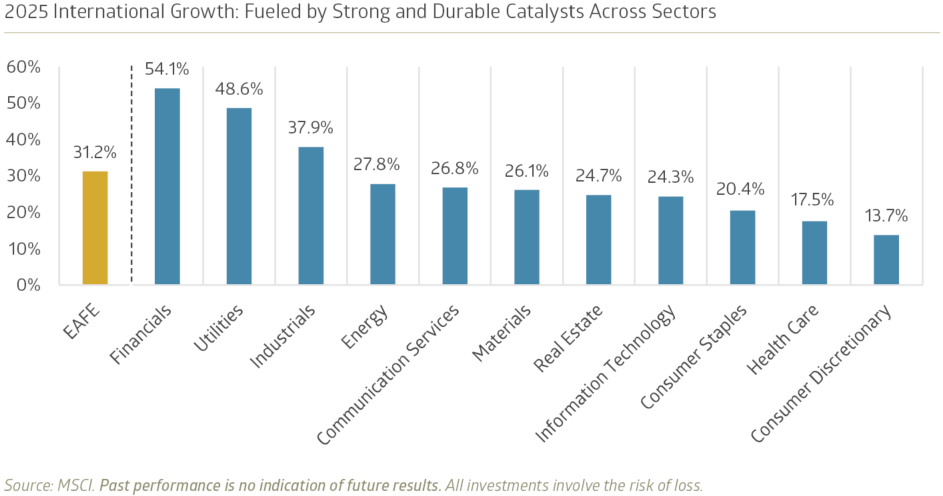
So what fueled that horsepower? Notable drivers behind international equities’ 2025 performance included lasting structural reforms, policy shifts, and secular growth themes. This was most powerfully illustrated by aggressive governance reforms in South Korea, a long-awaited structural recovery in Southern Europe, and a secular boom in global defense. Because these are enduring changes rather than fleeting cyclical blips, we believe this leadership rotation is in its early stages and will likely continue to drive strong international performance through at least 2026.
South Korea: Dismantling the “Korea Discount”
South Korea has emerged as the undisputed standout in the Asia-Pacific region, soaring 99.8% for the year. This outperformance was the result of a powerful convergence between secular AI-driven growth, improved U.S.-Korea trade relations, and shareholder-friendly policy shifts.
The Infrastructure of Intelligence
As U.S. tech giants focus on developing cutting-edge AI software and models, and driving a massive buildout of data centers, Korean firms provide critical hardware infrastructure. Fueled by demand for high-bandwidth memory chips, Samsung Electronics and SK Hynix—which together represent nearly half of the country’s index—contributed 58% of Korea’s total returns in 2025.2 This AI play has been bolstered by favorable trade agreements with the U.S., involving deep investment commitments in defense and shipbuilding, as well as a relaxation of restrictions on nuclear development.
Shareholder-Focused Policy Shifts
The government’s “Value-Up Program” emphasizes corporate governance and capital efficiency in an effort to address the “Korea Discount” and boost the valuations of domestic listed companies. With policy changes well underway, the program has already seen positive impacts and a shift in the investment case for Korean equities.
- Tax Reform: The reduction of the dividend income tax (capping the rate at 30% for high-payout firms, down from 49.5%) has unlocked trapped capital.
- Treasury Mandates: Proposals to mandate cancellation of treasury shares within one year of a buyback are ending the practice of “hoarding” shares to protect family control, forcing capital back to shareholders.
- Governance: Stricter minority shareholder rights and caps on majority voting for audit committees have fundamentally changed the risk profile for foreign investors.
This shift has ignited numerous industries. Hyundai Rotem (Defense) rallied 272%, while Doosan Enerbility (Nuclear) surged 329%. Major financials like KB and Shinhan are no longer value traps, but vehicles for capital return.
Spain: A Decade of Discipline Pays Off
In Europe, Spain delivered its best equity performance in decades, up 82.4% for the year. This rally was powered by its banking sector, which constituted almost 50% of the benchmark at 2025’s end. Heavyweights Banco Santander (+164%) and BBVA (Banco Bilbao Vizcaya Argentaria +154%) acted as the primary engines of growth.
This is not a speculative bubble, but the payoff of a decade-long austerity and deleveraging cycle. Since the Eurozone crisis, Spanish corporates and households have spent ten years cleaning up balance sheets and are now primed to re-lever as European Central Bank rates declined from 4.5% to 2.0%. Consequently, in 2025, we reached an inflection point where lending growth finally began to outpace GDP growth.
Critics point out that valuations are no longer cheap; for example the ‘EURO STOXX Banks Index (SX7E) forward price-earnings ratio is at a slight premium to its 10-year average. But comparing today’s overcapitalized, streamlined banks to the distressed banks of a post-Global Financial Crisis Europe is like comparing apples and oranges. With sector consolidation and expected deregulation providing tailwinds, these institutions’ macroeconomic and policy backdrop has never been stronger, and is paying off for company fundamentals and investor returns.
Security as a Secular Growth Engine
The war in Ukraine—coupled with the United States’ increasing unilateralism and insistence on European strategic autonomy—has catalyzed a permanent shift in European fiscal policy: Europe must own its own security. This is no longer a cyclical reaction to conflict, but a structural pivot.
As a result, NATO’s 2.0% GDP spending target has transformed from a ceiling into a floor. Total EU defense spending topped €380 billion in 2025, a record high.
This rally has broadened beyond ammunition to include infrastructure and energy resilience. We are seeing a “Security Premium” applied to companies involved in, for example, cabling, cyber defense, and energy grid security—creating an investment cycle that can be immune to standard business cycle fluctuations.
The Global Mosaic: Winners and Laggards
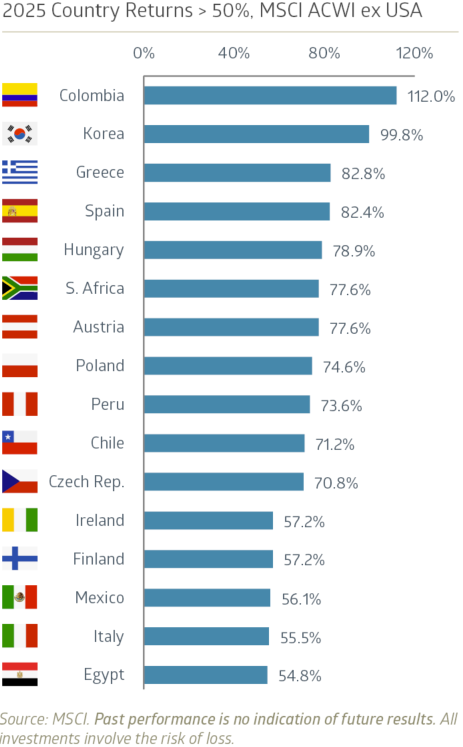 International investing in 2025 was not a “rising tide” for all. It required navigating distinct national idiosyncrasies.
Other winners included Poland, which benefited from EU recovery funds and massive industrial acceleration; South Africa, which surged on record gold prices and improved energy stability; and Mexico and Brazil (+49.7%), which saw gains as “nearshoring” trends and high real rates attracted carry-trade yield.
Those left out to sea in 2025 included Denmark, which was down 13.5% for the year as Novo Nordisk faced valuation digestion after its meteoric, GLP-1-driven rise; and Indonesia (-2.8%), hampered by a stubborn dollar and domestic inflation battles. India, too, delivered a sluggish 2.6% return as investors rotated out of its expensive valuations into cheaper Korea and China.
The year’s wide range of country successes, as well as some failures, serve as a good reminder that international equities are a mosaic of distinct geographies, industries, and markets—each with their own drivers. This intricate mix provides a compelling risk-adjusted profile for the asset class, as well as an attractive landscape for active managers to apply a range of skills to identify opportunities and risks.
Outlook: The Case for 2026
U.S. equities and non-U.S. equities have traded off dominance over the past 50 years, typically in cycles lasting 5 – 10 years. Following the Great Financial Crisis, U.S. equities had a historic leadership run of nearly 15 years. It is clear that international equities’ outperformance in 2025 was not a “catch-up” trade, but a fundamental regime change—and we believe this rotation is only revving up. There’s much to support continued international outperformance in 2026.
Despite the 2025 rally, the EAFE index still trades at a 37% discount to the U.S. on a P/E basis. With the U.S. market still top-heavy and largely reliant on technology leadership, the diversity of the international market can provide investors with a differentiated risk-adjusted profile compared to single-country or domestic-only portfolios. However, risk and return characteristics will vary over time and are subject to changing market conditions. The structural drivers of 2025—governance reform in Asia, banking health in Europe, and global security spending—highlight the variety of catalysts driving non-U.S. stock performance. Further, each of these trends typically last multiple years, so we believe they will continue to contribute to the mix of drivers shaping international performance in 2026 and beyond.
The U.S. is home to some of the most innovative and resilient businesses in the world, and U.S. holdings will remain a cornerstone of any global portfolio. But international holdings have earned their place. Rather than an afterthought, international exposure has become a strategic necessity for those looking to align their portfolios with these awakening global markets.
1 Unless otherwise stated, data and market performance are based on the MSCI EAFE and MSCI country indexes. Past performance is no indication of future results. All investments involve the risk of loss.
2 Specific investments described herein may represent some but not all investment decisions made by Bailard. The reader should not assume that investment decisions identified and discussed were or will be profitable. Specific investment advice references provided herein are for illustrative purposes only and are not necessarily representative of investments that will be made in the future. Bailard, Inc. makes no recommendation to buy or sell securities discussed in this white paper.
About the Bailard International Equities Team
Bailard’s International Equities team is managed by Eric Leve, CFA, and Dan McKellar, CFA, who have a 27-year average firm tenure. The team intentionally reflects the firm’s approach to international portfolios, combining fundamental and quantitative perspectives and closely integrated to make and implement portfolio decisions thoughtfully. With an investment career spanning more than three decades, Eric Leve has helped shape the firm’s thinking across international equities—always with an eye on how geopolitics, demographics, and macroeconomic systems intersect to influence investment outcomes. Dan McKellar leads the team’s quantitative research, driving model enhancements in country and security selection—and working closely with the firm’s analysts to bridge quantitative and fundamental insights which collectively determine strategy implementation. The investment team also includes the expertise of analysts Irene Liando, CFA, who focuses on fundamental equity research and analysis; and Yelena Bobyor, who leads top-down macroeconomic, thematic, and geopolitical research across global developed and emerging markets. The team also draws upon the talents of Bailard’s quantitative analysts, trading desk, and broader researchers.
About Bailard, Inc.
Bailard is an independent firm that has served individuals, families, and institutions since 1969 with comprehensive wealth management and disciplined asset management solutions. Our work is rooted in clear values, long-term thinking, and a steady commitment to putting clients first.
Across the firm, we provide financial and wealth planning, portfolio management, and asset management strategies spanning domestic and international equities, fixed income, sustainable and responsible investing, private real estate, and customized mandates.
Headquartered in the San Francisco Bay Area, Bailard is woman-led and majority employee-owned. The firm manages more than $7.5 billion in assets as of December 31, 2025, and is a Certified B Corporation™ and signatory to the UN Principles for Responsible Investing. We are built on clarity, accountability, and a long-term commitment to doing what’s right for our clients.
For more information about Bailard’s international equity capabilities, please visit www.bailard.com/equity-strategies/
 Diana L. Dessonville
Executive Vice President | Director, Institutional Client Services
diana.dessonville@bailard.com
(650) 571-5800
CONTACT US
DISCLOSURES: This publication contains the current opinions of the author, and such opinions are subject to change without notice. Information herein is based primarily on data available as of December 31, 2025, and has been obtained from sources believed to be reliable, but its accuracy, completeness, and interpretation are not guaranteed. We do not think it should necessarily be relied on as a sole source of information and opinion.
Distribution of this publication is for informational purposes only and is not a recommendation of, or an offer to sell or solicitation of an offer to buy any particular security, strategy, or investment product. It does not consider the particular investment objectives, financial situations, or needs of individual clients. Any references to specific securities are included solely as general market commentary and were selected based on criteria unrelated to Bailard’s portfolio recommendations or the past performance of any security held in any Bailard account. All investments have risks, including the risks that they can lose money and that the market value will fluctuate as the stock and bond markets fluctuate. There is no guarantee that any investment strategy will achieve its objectives. Charts and performance information portrayed in this piece are not indicative of the past or future performance of any Bailard product, strategy, or account unless otherwise noted. Market index performance is presented on a total return basis (assuming reinvestment of dividends) unless otherwise noted. Bailard cannot provide investment advice in any jurisdiction where it is prohibited from doing so.
There are risks involved in investing, including the risk of loss and the risk that the market value of your investments will fluctuate as the stock market fluctuates. International and emerging market equities are subject to increased risks due to economic or political instability, differences in accounting principles, and fluctuating exchange rates, with heightened risks for emerging markets. Investments in a particular style may underperform other styles of investing or the overall market.
Past performance is no guarantee of future results. All investments have the risk of loss.
Index definitions: The MSCI Europe, Australasia, Far East Index, “MSCI EAFE” index is a free float-adjusted market capitalization index that is designed to measure developed market (ex-US & Canada) equity performance. The MSCI ACWI ex USA Index is a free float-adjusted adjusted market capitalization index that is designed to measure equity market performance in the global developed and emerging markets. The index includes developed and emerging market country indices. The MSCI USA Index is designed to measure the performance of the large and mid cap segments of the US market. With 576 constituents, the index covers approximately 85% of the free float-adjusted market capitalization in the US. The S&P 500 Index is a market-capitalization-weighted index of the 500 largest U.S. publicly traded companies. All MSCI indices are presented U.S. dollar terms on a total return basis, assuming the reinvestment of dividends after the deduction of withholding taxes. All indices are unmanaged, uninvestable, and do not reflect any transaction costs.

Bailard Real Estate Completes Leadership Transition
“This was the right move for our real estate team,” said Sonya Mughal, CFA, CEO of Bailard. “Care and discipline are core to how this group works. Tess and James have built their experience at Bailard together over time, and this next step follows naturally from that.”
At a glance
Co-Heads: Tess Gruenstein; James Pinkerton
Gruenstein: Head of Portfolio Management
Pinkerton: Head of Investments
Fund leadership: Co-CEOs, Bailard Real Estate Fund
Effective: January 1, 2026
Continuity: Alex Spotswood (SVP); Preston Sargent (Strategic Advisor)
New hire: Neha Desai (VP, New York)
Leadership Experience and Responsibilities
Gruenstein has been with Bailard for more than a decade and has played a central role in the development and oversight of the firm’s real estate business. As Executive Vice President and Head of Portfolio Management, she oversees portfolio management, fund operations, and compliance, and serves on the firm’s executive leadership team.
Pinkerton’s experience spans property types and market cycles, grounded in years of hands-on work across acquisitions, dispositions, and financings. As Executive Vice President and Head of Investments, he leads transaction activity and execution across Bailard’s real estate platform, with responsibility for acquisitions, research, and institutional business development.
Together, Gruenstein and Pinkerton serve as co-CEOs of BREF, the firm’s open-end, diversified core private real estate fund. Pinkerton also joins the Fund’s Board of Directors.
Depth and Momentum as 2026 Begins
The real estate team’s leadership builds on a year of meaningful investment activity and an experienced bench. Alex Spotswood, Senior Vice President, continues to focus on sourcing acquisitions and driving portfolio management, working closely with Gruenstein and Pinkerton across the investment cycle.
Following his retirement at year-end 2025, Sargent remains involved as a strategic advisor, providing continuity and perspective. The team has also expanded its senior bench with the addition of Neha Desai, Vice President, who joined Bailard in December and is based in New York, extending coverage in a key market.
Taken together, the leadership structure supports consistent decision-making, clear ownership, and a long-term approach to managing real estate investments.
###
About the Bailard Real Estate Fund
The Fund is an actively managed, open-end core equity real estate vehicle diversified within property type, major metro areas, and investment life cycle. As of December 31, 2025, the Fund’s Gross Asset Value was $1.3 billion, invested in 31 properties across 21 U.S. markets. An investor in the Bailard Real Estate Fund must be an “accredited investor” as defined in Regulation D and provide documentation verifying such status as requested by the Fund.
About Bailard, Inc.
Founded in 1969, Bailard is an independent, values-driven wealth and asset management firm serving individuals, families, and institutions. Bailard has built a long‐term asset management track record across domestic and international equities, fixed income, private real estate, and sustainable, responsible, and impact investing. The firm helps clients align their financial goals with their values. Headquartered in the San Francisco Bay Area, Bailard had over $7.7 billion in assets under management as of 12/31/2025. Bailard is majority employee-owned, woman-led, a Certified B Corporation™, and a UN Principles of Responsible Investing signatory.
Disclosures
Bailard, Inc. (Bailard) is the investment and operating manager of the Bailard Real Estate Investment Trust, Inc. (the “Bailard Real Estate Fund” or the “Fund”); Bailard receives annual fees from the Fund, which are based on the Net Asset Value (NAV). As of 12/31/2025, the Fund’s NAV was $1.0 billion. The Fund invests primarily in real estate and, as a result, an investment in the Fund entails significant risks that are customarily associated with the development and ownership of income-producing real estate, including illiquidity, changes in supply and demand, and inexact valuation. The Fund’s shares fluctuate in value and may be illiquid due to a lack of redemption, the lack of a secondary market and restrictions on transfer. Fees and expenses may offset the return on the investment. The Fund may be leveraged. While projections utilized for acquisitions are based on assumptions that Bailard believes are reasonable under the circumstances, they are subject to uncertainties, changes (e.g., changes in public health, economic, operational, political, legal, tax, and other circumstances), and other risks including, but not limited to, future operating results including rents, occupancy, and other property cash flows, and other expenses. Investors may lose all or a substantial portion of their investment. For a more thorough discussion of the fees and the risks involved in making an investment in the Fund, please refer to its Offering Memorandum. Past performance is no indication of future results. All investments have the risk of loss.
Country Indices Flash Report – December 2025
International equities staged a major comeback in 2025, with MSCI EAFE outperforming MSCI USA by 13.9%—the widest gap since 1993—while broader MSCI ACWI ex-US outperformed by 15.1% on emerging market strength. Precious metals sparkled even more: gold climbed 65% and silver—up 27% in December alone—soared 148%. [Read more…]

(Video) AI’s Next Wave: Setting up for Value Beyond Hardware
Where might the next AI investment opportunities lie beyond hardware? Bailard’s Chief Investment Officer, Dave Harrison Smith, CFA offers his perspective as a seasoned technology investor and portfolio manager.
Reuters: "US software stocks slammed on mounting fears over AI disruption, lose $1 trillion in week"
Dave Harrison Smith, CFA, as source in a recent article published by Reuters.