


Financial Spring Cleaning: Small Steps for Big Impact
In a special feature this quarter, Lena McQuillen, CFP® (Vice President and Director of Financial Planning) and Dave Jones, JD, LLM, CFP® (Senior Vice President and Director of Estate Strategy) have joined forces and prepared a set of practical ways to refresh and organize your finances this season.
As the seasons change, it’s an ideal time to refresh and organize different aspects of life—including your finances. Making improvements doesn’t have to be overwhelming or time-consuming. The power of small, actionable steps is that they add up over time, leading to meaningful progress. Instead of tackling everything at once, focusing on quick, manageable tasks ensures steady progress without the stress of a complete financial overhaul.
Each of the following steps is simple to implement and provides a tangible benefit. Whether you take on one today and another next month or work through them gradually, every action moves you toward a stronger financial foundation. Setting aside just 15-30 minutes each week for financial check-ups can make these tasks feel effortless while delivering long-term security and peace of mind.
- Use Everplans for Important Documents
Keeping important financial documents in order can make a significant difference in times of need. Yet, many people store essential papers in multiple places, making access difficult for both them and their families. Everplans is a secure digital platform that allows you to safely store and organize important financial, legal, and personal documents in one place. This simple step helps ensure critical information is available when needed.
Time commitment: 30-45 minutes.
How to get started:
- Upload estate planning documents—wills, trusts, powers of attorney, and advance directives.
- Store financial records, such as bank accounts, investment portfolios, and retirement plans.
- Keep personal records (birth certificates, marriage licenses, Social Security information) in a secure location.
- Don’t forget to include legacy items like family recipes, cherished photos, and letters to loved ones.
- Assign access to trusted individuals so they know how to retrieve documents when needed.
- Freeze Your Credit and Monitor Your Credit Report
Identity theft can be financially and emotionally devastating, and prevention is much easier than recovery. One of the most effective ways to protect yourself is by freezing your credit, which blocks unauthorized access to your financial profile. It’s free and quick to freeze your credit, and you can temporarily lift or remove the freeze when needed. Additionally, monitoring your credit report helps catch inaccuracies and signs of fraud early.
Time commitment: 15 minutes.
How to take action:
- Contact each of the three major credit bureaus separately to place a freeze on your credit. They’ll ask for your full name, date of birth, Social Security Number, and address, so be prepared.
- Equifax – Freeze Your Credit Here or call 1-800-349-9960
- Experian – Freeze Your Credit Here or call 1-888-397-3742
- TransUnion – Freeze Your Credit Here or call 1-800-680-7289
- Each bureau will issue a PIN or password, store this securely for future updates
- Review your credit report annually to ensure accuracy.
- Streamline Subscriptions and Recurring Expenses
Monthly and annual subscriptions can quietly accumulate, leading to unnecessary spending. Many of these expenses go unnoticed or are no longer providing value. Taking a few minutes to review and optimize recurring charges can free up resources for more meaningful financial priorities.
Time commitment: 15-20 minutes.
Steps to simplify your subscriptions:
- Review recent bank and credit card statements to identify recurring charges.
- Cancel or downgrade subscriptions that are no longer used or needed.
- Set calendar reminders for renewals of major services to reassess their value before automatic charges occur.
- Update Digital Passwords and Security Measures
Cybersecurity threats continue to evolve, and financial accounts are prime targets for fraud. Strengthening your digital security doesn’t require complicated tech skills—small updates can make a big difference in protecting your wealth.
Time commitment: 20 minutes.
Easy ways to enhance digital security:
- Update passwords for financial and personal accounts—if you’ve been using the same password for years, now is the time to change it.
- Avoid using the same password across multiple platforms.
- Enable two-factor authentication whenever possible to add an extra layer of protection against unauthorized access.
- Use a password manager to securely store login credentials rather than relying on memory or sticky notes.
- Conduct a Beneficiary Check-Up
Most financial institutions allow you to designate beneficiaries, which ensures that your assets transfer smoothly to the right individuals when the time comes. However, life events—such as marriages, divorces, or births—can impact your original choices. A quick check of your financial accounts, either online or with your provider, ensures that your assets are aligned with your wishes. This small but essential step prevents unnecessary legal complications down the road.
Time commitment: 20-30 minutes.
Where to check beneficiaries:
- Retirement Accounts, including 401(k), IRA, and Roth IRA
- Life Insurance Policies
- Bank and Investment Accounts
- Estate Planning Documents
- Review Annual Gifting and Charitable Contributions
Strategic annual gifting can help reduce estate tax burdens while allowing you to support your loved ones and favorite causes. Whether giving to family, friends, or charities, a structured approach can ensure your generosity is both intentional and efficient.
Time commitment: 30 minutes
How to approach gifting:
- Review annual exclusions – You can gift up to $18,000 per recipient in 2024 without incurring gift taxes.
- Evaluate Donor-Advised Funds (DAFs) or direct charitable gifts to optimize tax efficiency.
- Plan the timing of gifts, as early-year contributions may provide greater impact.
- Ensure Proper Titling of Accounts and Assets
Properly titling your financial accounts and assets is one of the simplest yet most effective ways to ensure your estate plan functions as intended. Incorrect titling can help you avoid future headaches including probate delays, tax inefficiencies, or unintended asset distribution.
Time commitment: 30-45 minutes.
What to review:
- Confirm that bank, brokerage, and investment accounts are correctly titled.
- Ensure real estate properties are held under the appropriate ownership structure.
- If you have a trust, check that assets are titled in the trust’s name to avoid probate delays.
Final Thoughts: Small Steps, Big Impact
Taking small, thoughtful steps today can make a significant difference in your financial security. Whether you tackle one item this month or make financial check-ups a regular habit, each action helps build a stronger, more organized financial future.
As always, your Investment Counselor is here to help with any of these steps. If you have questions or need guidance, don’t hesitate to reach out.
A few minutes each week can go a long way, keep track by checking off each step below.
- Use Everplans for Important Documents
- Freeze Your Credit and Monitor Your Credit Report
- Streamline Subscriptions and Recurring Expenses
- Update Digital Passwords and Security Measures
- Conduct a Beneficiary Check-Up
- Review Annual Gifting and Charitable Contributions
- Ensure Proper Titling of Accounts and Assets
1 Berkshire Hathaway Inc. News Release. 25 November 2024. https://www.berkshirehathaway.com/news/nov2524.pdf


Economic Brief: It Don't Mean a Thing, If It Ain't Got That Swing
This quarter, Jon Manchester, CFA, CFP® (Senior Vice President, Chief Strategist – Wealth Management, and Portfolio Manager – Sustainable, Responsible and Impact Investing) delves into the paradoxes of momentum investing, inflation’s persistent influence, and the resilience of the U.S. economy in an era of shifting market dynamics.
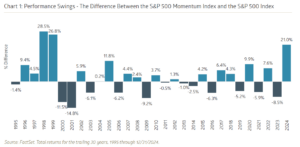
Contrarians are not having a moment. Those resolute and hardy investors who row against the tide of popular opinion—shunning trendy stocks and embracing the unloved—found themselves sinking in 2024. A tidal wave of capital flowed into the fashionable set of equities, largely comprised of companies with a plausible artificial intelligence (AI) story. Winners kept on winning, resulting in a historic rout for momentum investing. In fact, the Standard & Poor’s (S&P) 500 Momentum Index had its best year relative to the overall S&P 500 Index since 1999. It soared 46%, including dividends, outpacing the benchmark S&P 500 by 21 percentage points.
Launched a decade ago—but recalculated back to 1994—the S&P 500 Momentum Index includes the top quintile of the S&P 500 based on trailing 12-month price performance. The Index is rebalanced on a semi-annual basis. As investment concepts go, it does not get any simpler than selecting stocks solely based on price strength. It also challenges conventional thinking: buy low, sell high. Nonetheless, momentum investing has worked over longer timeframes (see Chart 1), although the approach can suffer painful reversals and has not outperformed in more than two consecutive years since the late 1990s. Academics have struggled to pinpoint why momentum investing succeeds. The performance edge is well-documented with a long track record. A 1993 article in the Journal of Finance is cited as the pioneering study on momentum.1 The authors presented data showing that buying recent stock winners and selling losers produced significantly higher short-term returns than the overall U.S. stock market during the 1965 to 1989 time period. This ongoing performance anomaly could be partly attributed to behavioral factors such as FOMO (fear of missing out) and a bandwagon effect.2 The “Big Mo” might also reflect fundamental strength (rising sales, e.g.) already embedded in prices that can persist in the short-term.
Akin to a snowball rolling downhill, momentum investing is driving ever-larger market capitalizations and a more concentrated U.S. large-cap stock market. As one example, the four largest holdings in the S&P 500 Momentum Index—Amazon.com, NVIDIA, Broadcom, and Meta Platforms—carry a combined market capitalization of $8.2 trillion, greater than the cumulative market cap of roughly the bottom 64% of the S&P 500. Morgan Stanley equity strategist Mike Wilson touched on the intersection between momentum and market concentration in a December note. “Another consideration is the growing propensity of investors to use price momentum as a key factor in their investment strategy. Rebalancing has also been de-emphasized as many investors have let their winners run, given the lack of mean reversion in the past several years. This all helps to explain the extreme concentration we’re seeing in many equity markets, not just in the United States.”3
To borrow from Sir Isaac Newton, momentum is the product of mass times velocity, so perhaps this makes some sense. We have exceptionally large companies moving at a fast pace and creating the momentum that helped lift the S&P 500 Index to a greater than 20% return in 2024 for the third time in the last four years. These market moves have been underpinned by robust asset flows into U.S. equities. According to The Wall Street Journal, investors added over $1 trillion to U.S.-based exchange-traded funds (ETFs) last year, shattering the previous record set in 2021.4 Not surprisingly, momentum ETFs were a popular choice. Invesco’s S&P 500 Momentum ETF pulled in over $3 billion of net purchases over the first 11 months of 2024—incredible growth considering the fund now has around $4 billion under management.5 The hot money trades seeking instant gains may prove ill-timed if the AI trade falters, but until then investors are siding with inertia. As the late New York Yankee great Yogi Berra once said: “Nobody goes there anymore. It’s too crowded.”
The Real Return
A leading kryptonite candidate for the equity markets could be higher-than-expected interest rates. The post-COVID inflation shock still reverberates today, even though the Consumer Price Index (CPI) year-over-year growth rate peaked in mid-2022. As of November 2024, the CPI growth rate was down to 2.7%, a full point below the 50-year average of 3.7%. Price growth has clearly decelerated, but not reversed, and the cumulative impact has made life uncomfortable for policymakers. There is a compelling argument that inflation cast a deciding vote in the recent presidential election. U.S. Federal Reserve Chair Jerome Powell acknowledged in his December press conference that inflation “remains somewhat elevated relative to our two percent longer-run goal.”6 This comment followed after the Fed’s decision to cut the Federal Funds target range to an upper limit of 4.5%, marking a third consecutive easing from its peak of 5.5%.
Any enthusiasm for the (expected) rate cut was quickly doused when Fed watchers realized that the updated Federal Open Market Committee (FOMC) projections implied only two additional rate cuts in 2025. Questioned on this in the press conference, Powell flagged the uncertain inflation outlook. He continued: “And, you know, the point of that uncertainty is it’s kind of common sense thinking that when the path is uncertain you go a little bit slower. It’s not unlike driving on a foggy night or walking into a dark room full of furniture. You just slow down.” An apt metaphor with wonderful imagery, but investors were not impressed. The S&P 500 Index traded down 2.95% in response, the second-worst trading session of 2024 and one of only four greater than 2% daily declines for the year.
Rate anxiety is real. With a more cautious FOMC outlook, the 10-year U.S. Treasury Note yield rose 78 basis points,7 or 0.78%, during the fourth quarter, finishing at 4.57%. The S&P 500 Equal Weighted Index declined 2.3% price-only in Q4, perhaps illustrating the perceived impact of higher rates on the average (smaller) S&P 500 company. Further down the market cap spectrum, the S&P SmallCap 600 Index declined 1.0% over the final quarter of 2024. Ebbing inflation will obviously continue to be a key to interest rate stability in 2025. Without further disinflation progress, bond investors may require a higher real, or inflation-adjusted, return. Longer-term rates may rise regardless, considering our country’s inconvenient $36 trillion (and counting) debt load. This has some analysts watching the horizon for the return of the “bond vigilantes,” those disaffected bond traders who sell bonds—driving yields higher—to signal unhappiness with fiscal and/or monetary policies.
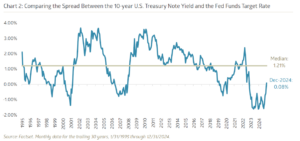
Over the last 30 years, as seen in Chart 2, the median spread between the 10-year U.S. Treasury Note yield and the Fed Funds target rate has been 121 bps. At year-end 2024 the spread was a miniscule 8 bps. The most straightforward path to normalize that relationship is further easing by the FOMC, combined with a steady 10-year yield. However, as the Fed would say, this will all be data dependent. Inflation will need to cool further, which would allow the FOMC to proceed on its intended rate cut plan. Any missteps could result in higher long-term yields, harming not only the bond market, but equities as well. With the S&P 500 Index trading at nearly 22x projected 2025 operating earnings—versus a long-term median of approximately 17x—there is not a lot of room for error.
Steady as She Goes
Although inflation dominated headlines again in 2024, particularly during the run-up to the presidential election, overall U.S. economic growth has been resilient. Gross Domestic Product (GDP) grew at a roughly 3% inflation-adjusted rate over the middle six months of 2024, and is estimated to have decelerated to a still solid 2.4% growth rate in Q4.8 The ongoing struggle to foster economic gains for a wider swath of the population continues. While the service economy chugs along, the goods-producing sector remains stuck in neutral. The Institute for Supply Management (ISM) reported that economic activity in the manufacturing sector declined for a ninth consecutive month in December.9 ISM’s survey has actually indicated a manufacturing contraction for 25 of the last 26 months, although the December reading did include some green shoots with new orders and production both in expansion territory.
The U.S. economy is much more dependent on services than goods, of course. In 2023, over 67% of Personal Consumption Expenditures (PCE) went to services, with goods accruing the other 33%.10 According to BlackRock’s Rick Rieder, head of global asset allocation, we may be needlessly worrying about whether the economy will experience a hard or soft landing. Instead, he suggests we think about the U.S. economy as a satellite: “Satellites don’t land. They just get tired over time, and they need a bit more energy…The Fed raises rates 500 basis points, and it doesn’t make a difference, and it’s because the service economy is not cyclical. Goods are hugely cyclical.”11
 Rieder’s argument feels like a trap: an explanation designed to fit the narrative since we have only experienced one, technically brief (COVID) recession over the trailing 15 years. It likely contains some truth, however. The economy has recently weathered some “rolling recessions” in which only certain sectors experience a downturn. Perhaps our predominantly service economy can help minimize overall cyclicality, outside of the black swan events. Disappointingly, it will not remove uncertainty, unless AI solves that problem, too. To pull another Yogiism, or pearl of wisdom from Yogi Berra: “It’s tough to make predictions, especially about the future.”
1 “Momentum Investing: It Works, But Why?”, www.anderson-review.ucla.edu/momentum, 10/31/2018.
2 “Momentum Investing: what it is, why it works and what to buy,” www.moneyweek.com, 6/15/2018.
3 “What Is Breadth Telling Us?”, Morgan Stanley Research Sunday Start, 12/22/2024.
4 “A Record-Shattering $1 Trillion Poured Into ETFs This Year,” www.wsj.com, 12/30/2024.
5 “Investors Are Looking to Momentum ETFs in 2024,” www.etftrends.com, 11/29/2024.
6 “Transcript of Chair Powell’s Press Conference,” www.federalreserve.gov, 12/18/2024.
7 A basis point (bp) is 0.01%.
8 GDPNow, www.atlantafed.org, 1/3/2025.
9 “Manufacturing PMI® at 49.3%,” www.ismworld.org, 1/3/2025.
10 “Gross Domestic Product (Third Estimate), Third Quarter 2024,” www.bea.gov, 12/19/2024.
11 “DealBook: R.T.O. battle,” www.nytimes.com, 10/12/2024.


Planning for Generational Wealth: Maximizing Tax Efficiency
Lena McQuillen, CFP®, Vice President and Director of Financial Planning, outlines the distinctions between Traditional and Roth retirement strategies, when each is most effective, the implications of new laws, and ways to share these insights with your family.
For those who have already built their wealth, the focus shifts to preserving it, optimizing its use in retirement, and empowering future generations to achieve financial success in a tax-efficient manner. Many readers will have already made key decisions about their retirement accounts—such as 401(k)s, 403(b)s, or 457(b)s—during their working years. Now, the opportunity lies in maximizing those decisions to enhance your family’s financial well-being. Just as you’ve built and managed your wealth, you can pass on the knowledge and strategies to help your family achieve similar success. The choice between Traditional and Roth accounts remains pivotal, offering different advantages for optimizing outcomes both now and in the future. Understanding these options can help refine your strategy and empower your heirs, equipping them with the tools to build on your financial legacy.
Understanding the Basics
A Traditional 401(k) allows contributions on a pre-tax basis, reducing taxable income during your working years. Over time, these funds grow tax-deferred, but taxes are owed on withdrawals. Required minimum distributions (RMDs) begin at age 73 (or age 75 if born in 1960 or later), impacting your taxable income in retirement.
Roth 401(k) contributions, made with after-tax dollars, offer a different advantage: earnings grow tax-free, and qualified withdrawals are not taxed if the account has been open for at least five years and withdrawals are made after age 59½. Additionally, Roth accounts bypass RMDs, allowing assets to grow tax-free indefinitely—a benefit particularly valuable for estate planning. For families managing wealth across generations, Roth accounts can provide a powerful vehicle for tax-free growth over your lifetime.
How Much Can You Contribute?
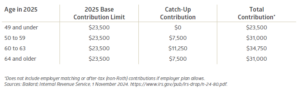
The SECURE 2.0 Act has introduced new opportunities for optimizing retirement accounts. In 2025, enhanced catch-up contributions allow individuals aged 60 through 63 to contribute up to $11,250 beyond the $23,500 base limit. If your children or grandchildren are early in their careers, encouraging them to maximize contributions to their own accounts can set the stage for long-term financial security.
Additionally, employers now have the option to match contributions to Roth accounts, providing additional flexibility for wealth transfer and reinforcing the value of maximizing contributions to these accounts early.
How Much Should You Contribute?
- While contributing the maximum may no longer apply to you personally, consider how these strategies can be leveraged for your family: For Children and Grandchildren: Encourage them to maximize Roth contributions early in their careers, reaping the benefits of tax-free growth over decades. Highlight the importance of contributing enough to qualify for employer matching funds—essentially free money that accelerates their savings—to make the most of their retirement plans. Also encourage them to evaluate their living expenses relative to their salary for a sustainable savings rate that balances immediate needs with long-term goals.
- Managing Your RMDs: Strategically converting portions of Traditional accounts to Roth during years with lower taxable income can reduce the impact of future RMDs. For your heirs, guiding them in understanding how RMDs may affect inherited accounts and encouraging early planning can optimize their tax efficiency, supporting a smoother transfer of wealth.
- Integrating Contributions: Use your resources to gift or match contributions to family members’ retirement accounts, fostering their financial independence. Consider offering a dollar-for-dollar match on your grandchild’s Roth IRA contributions. For instance, if they contribute $3,000 from their summer job earnings, you match it with another $3,000 (up to their total earnings or annual limit, whichever is less). This not only incentivizes their savings habit but also allows them to maximize tax-free growth potential from a young age, leveraging decades of compounding.
These actions not only benefit your family but also extend the tax-efficient strategies that have supported your success. If contributing the maximum feels daunting to your younger loved ones, suggest they start small. Gradually increasing the allocation as income rises or debts are paid off can ease the transition while building wealth consistently.
Factors to Consider: Maximizing Family Wealth
When planning for your family’s financial future, understanding the role of Traditional and Roth accounts is critical. These tools offer unique advantages that can help optimize your wealth strategy and leave a lasting legacy.
 Traditional Pre-Tax Accounts
Traditional 401(k) accounts are effective for managing current cash flow but require thoughtful tax planning to maximize their benefits and minimize liabilities. By reducing adjusted gross income (AGI), they can also provide additional flexibility for managing tax brackets. Converting funds to Roth accounts during low-income years can mitigate RMD impacts and leave more tax-efficient assets to heirs.
Roth Accounts
Roth 401(k)s offer significant flexibility for legacy planning. Contributions grow tax-free, withdrawals are not taxed, and they provide a strategic tool for multi-generational wealth transfer. Encouraging younger family members to prioritize Roth contributions amplifies these benefits.
Splitting Contributions Between Pre-Tax and Roth Accounts
Allocating contributions across pre-tax and Roth accounts provides flexibility to adapt to tax law changes or shifting financial priorities. This approach helps families draw funds in the most tax-efficient manner. Additionally, starting in 2026, catch-up contributions for high earners must be directed to Roth accounts, highlighting the importance of considering both account types in your overall strategy.
An Example of Strategic Allocation in Action
Meet Chloe and Nathan: Recently retired professionals, Chloe and Nathan transitioned from high-earning careers to focusing on wealth preservation and supporting their family’s financial growth. With significant Traditional and Roth retirement accounts, their approach emphasizes tax efficiency and legacy planning.
- Strategic Conversions: During low-tax years, they convert portions of their Traditional 401(k) accounts to Roth accounts. This minimizes future RMDs, maximizes tax-free growth, and provides greater flexibility for drawing retirement income.
- Legacy Planning: Chloe and Nathan prioritize leveraging their Roth accounts to create tax-efficient wealth transfer opportunities. This strategy enables their heirs to benefit from tax-free growth while supporting the family’s long-term financial goals.
- Mentoring the Next Generation: They mentor their adult children on the importance of early saving and tax diversification, particularly through Roth contributions, fostering strong financial habits and long-term independence.
Chloe and Nathan’s thoughtful strategy not only secures their retirement but also sets up their family for financial success, illustrating how retirement planning evolves with life’s stages.
Next Steps
Managing wealth in retirement involves more than sustaining your lifestyle; it’s about building a foundation for future generations to thrive financially. Consider these steps:
- Evaluate Family Tax Strategies: Collaborate with your Investment Counselor to optimize tax efficiency for both current and future generations. For individuals in a higher tax bracket now, contributing to a Traditional 401(k) may make the most sense. Conversely, for those currently in a lower tax bracket, Roth contributions may be more advantageous.
- Foster Financial Education: Use your experience to mentor younger family members on the value of Roth accounts, tax diversification, and long-term planning. Estimate retirement income needs and work with your Investment Counselor to model various scenarios. This includes understanding the impact of diverse income sources such as Social Security and investments.
- Reassess Regularly: Life events, tax law changes, and shifting priorities necessitate periodic adjustments to any strategy. Annual check-ins help keep your plan aligned with financial objectives.
For those no longer contributing to a 401(k), integrating these practices helps you leave a legacy that supports your family’s financial success while minimizing tax burdens.
Conclusion
Choosing between a Traditional pre-tax 401(k) or a Roth 401(k) is not a one-size-fits-all decision; it depends on your unique financial situations, long-term goals, and tax environment. As you transition into retirement, the focus shifts from building wealth to preserving it and empowering your family. Thoughtful planning and informed choices today lay the groundwork for a secure tomorrow. Working closely with a trusted partner helps to ensure that your legacy not only supports your heirs but also instills financial independence and security for generations to come.

Estate Planning Gold: Insights from Warren Buffet's 2024 Letter
Join Director of Estate Strategy, Dave Jones, JD, LLM, CFP®, as he explores Warren Buffett’s timeless insights on estate planning, highlighting actionable principles to guide thoughtful and purposeful generational wealth strategies.
On November 25, 2024, just days before Thanksgiving, Warren Buffett released a letter to shareholders of Berkshire Hathaway Inc.1 Unlike the usual updates on business operations or investments, this letter carried a heartfelt message filled with timeless wisdom on estate planning. Buffett shared reflections on mortality, responsibility, simplicity, and transparency—principles that are as practical as they are profound. For those tasked with managing generational wealth, his insights provide not only lessons but a roadmap for purpose-driven planning. As we begin the new year, let’s examine these lessons and consider how they might inspire our own approach to estate planning.
Acknowledge Mortality
“Father time always wins. But he can be fickle—indeed unfair and even cruel—sometimes ending life at birth or soon thereafter while, at other times, waiting a century or so before paying a visit. To date, I’ve been very lucky, but, before long, he will get around to me.”
In reflecting on the passage of time, Buffett addresses an essential truth: none of us can escape it. Planning for the future is both prudent and necessary. While reflecting on his own life and luck, he emphasizes the importance of taking proactive steps to ensure that his estate planning is handled responsibly. For Buffett, this means facing mortality head-on and making thoughtful decisions about the future.
The new year is an ideal time to consider your own plans. How can you prepare now to give your loved ones clarity and peace of mind when the time comes?
Choose the Right Successor(s)
“[T]omorrow’s decisions are likely to be better made by three live and well-directed brains than by a dead hand. As such, three potential successor trustees have been designated. Each is well known to my children and makes sense to all of us.”
Choosing the right successors is a cornerstone of Buffett’s estate planning philosophy. His selection of capable trustees—respected by both himself and his family—emphasizes the importance of communication, collaboration, and accountability. By involving his children in the process, Buffett fosters alignment and clarity.
For your own estate, think about the individuals who could best carry out your wishes. Are they prepared to handle the responsibilities you’re entrusting to them? Clear communication and thoughtful choices now can make all the difference later.
Give Responsibly
“[Susie] left $10 million to each of our three children, the first large gift we had given to any of them. These bequests reflected our belief that … wealthy parents should leave their children enough so they can do anything but not enough that they can do nothing.”
This sentiment encapsulates Buffett’s philosophy of responsible giving. While financial security is a gift, excess can stifle ambition and purpose. By leaving “enough to do anything but not enough to do nothing,” Buffett fosters independence and encourages his heirs to carve out their own paths in life.
Not every family will relate to or need such a framework, but it’s a principle worth reflecting on. What balance will empower your loved ones without diminishing their drive? This new year, evaluate how your legacy can support growth and self-reliance.
Make It Simple
“I change my will every couple of years – open only in very minor ways – and keep things simple. Over the years, Charlie [Munger] and I saw many families driven apart after the posthumous dictates of the will left beneficiaries confused and sometimes angry.”
Simplicity is a hallmark of Buffett’s estate planning philosophy. Complexity breeds confusion, resentment, and potential conflict among beneficiaries. By keeping his will straightforward and regularly updated, Buffett avoids potential disputes and provides clarity.
As you think about your own plans, ask yourself: Could someone easily understand and implement your wishes? Simplicity may be the key to preserving harmony within your family.
Be Transparent and Flexible
“I have one further suggestion for all parents, whether they are of modest or staggering wealth. When your children are mature, have them read your will before you sign it.
Be sure each child understands both the logic for your decisions and the responsibilities they will encounter upon your death. If any have questions or suggestions, listen carefully and adopt those found sensible. You don’t want your children asking ‘Why?’ in respect to testamentary decisions when you are no longer able to respond.
Over the years, I have had questions or commentary from all three of my children and have open adopted their suggestions. There is nothing wrong with my having to defend my thoughts. My dad did the same with me….”
Transparency is perhaps Buffett’s most transformative principle. By discussing his will openly with his children, he fosters alignment, understanding, and a shared sense of purpose. This collaborative approach strengthens familial bonds and preempts conflicts that could arise later.
While not all family dynamics allow for such openness, it’s worth considering where possible. Honest conversations about your intentions can reduce misunderstandings and increase trust. As we move into a new year, could greater transparency in your plans create more unity and clarity?
Final Thoughts
Warren Buffett’s 2024 letter provides a compelling framework for intentional, values-driven estate planning. By acknowledging mortality, giving responsibly, keeping things simple, and prioritizing transparency, Buffett offers a model for creating a legacy that balances financial security with purpose.
As you reflect on your plans for the year ahead, take inspiration from Buffett’s insights. Estate planning isn’t just about transferring wealth—it’s about fostering unity, empowering future generations, and making meaningful impact. May the new year bring clarity and peace to your planning.
1 Berkshire Hathaway Inc. News Release. 25 November 2024. https://www.berkshirehathaway.com/news/nov2524.pdf

‘Tis the Season: Maximizing Gifting Exclusions for Family
Director of Estate Strategy, Dave Jones, JD, LLM, CFP®, explains how to optimize the impact of your year-end family gifting by leveraging tax exclusions for education, medical expenses, and annual giving.
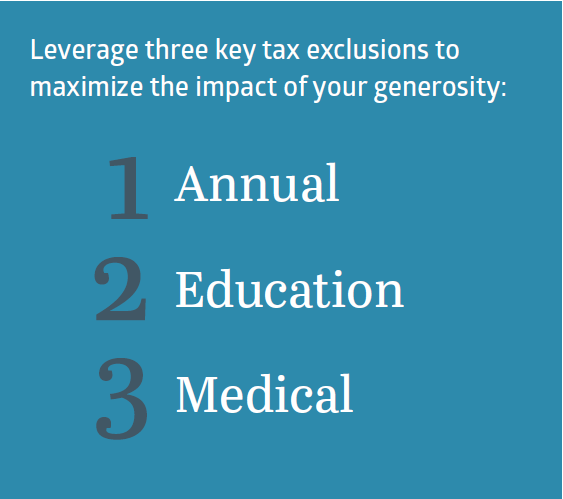
As we move into the final months of the year, now is an excellent time to review your financial situation and consider opportunities to give to family and loved ones. Thoughtful gifting can not only help support those you care about, but also strengthen relationships and assist in achieving important life goals and objectives. This article explores how you can leverage three key tax exclusions to maximize the impact of your generosity: the annual exclusion, the education exclusion, and the medical exclusion.
The Annual Exclusion
 The foundation of family gifting and wealth transfer is the annual exclusion gift. In 2024, the annual exclusion limit is $18,000 per recipient, meaning you can give up to $18,000 to as many recipients as you wish without reducing your lifetime exemption ($13.61 million in 2024) or incurring federal gift taxes. For married couples, this exclusion doubles to $36,000 per recipient. Annual exclusion gifts typically take three forms: direct gifts, loan forgiveness, or contributions to certain irrevocable trusts. It’s important to consult with your tax advisor about using these strategies for your specific situation and confirm whether they align with broader estate planning goals.
It’s also worth noting that gift recipients are not responsible for paying any gift taxes; the responsibility lies with those making the gift (and only when the giver has exhausted their annual exclusion and lifetime exemption and no other exclusion applies).
- Direct Gifts: The simplest method is giving an outright gift. For example, a parent could write a check to each of their children for $18,000 annually without any tax consequences. As mentioned above, married couples can combine their exclusions to give up to $36,000 per child, doubling the tax-free gift amount. This method can be used to transfer significant wealth when executed over many years.
- Loan Forgiveness: Forgiving a loan, or a portion of it, can be treated as a gift that qualifies for the annual exclusion. If you’ve loaned $50,000 to a family member, you could forgive $18,000 of that loan without incurring taxes. If the loan is forgiven in an amount greater than the annual exclusion, the excess would be applied against your lifetime exemption.
- Paying Insurance Premiums: Another strategic use of the annual exclusion is by paying life insurance premiums on behalf of someone else, typically through an irrevocable life insurance trust (ILIT). An example of this is when a parent or grandparent makes annual gifts to an ILIT, which then pays the life insurance premiums for a policy benefiting their children and/or grandchildren. Properly structured and administered, this can fund life insurance policies while minimizing estate taxes for your heirs.
The Education Exclusion
Another powerful tool is the education exclusion. Federal tax law allows individuals to pay for someone’s tuition directly to an educational institution without triggering gift taxes or reducing your lifetime exemption. This exclusion applies to all levels of education, from elementary to graduate school. As long as the payments are made directly to the school, the exclusion applies. However, keep in mind that only tuition qualifies: expenses like books, uniforms, and room and board do not. There is no limit on the amount that can be excluded under this rule.
The Medical Exclusion
The medical exclusion allows you to pay for someone’s qualified medical expenses without it counting toward your annual exclusion or lifetime exemption, providing a tax-efficient way to assist loved ones with healthcare costs. Payments must be made directly to the healthcare provider or insurance company, and can include medical treatments, surgeries, dental care, and health insurance premiums. As with any tax strategy, individuals should consult with a tax advisor to ensure compliance and proper implementation of this benefit. Like the education exclusion, there’s no limit on the amount you can pay under this rule.
The Annual Exclusion and 529 Plans: A Special Super-Funding Rule
Fortunately, while the education exclusion applies only to tuition, other educational expenses can be covered through contributions to a 529 plan. Qualified expenses generally include room and board, books, supplies, computers and technology, special needs expenses, and even K-12 tuition and apprenticeship programs. A key tax advantage of 529 plans is the ability to “front-load” contributions by using up to five years’ worth of annual exclusion amounts at once. For example, you can contribute $90,000 to a 529 plan in 2024 and spread the gift over five years for tax purposes, provided you make the proper election on a timely filed gift tax return. For married couples, this amount can be doubled to $180,000.
Combine Gift Exclusions for Maximum Impact
- Gifting to Grandchild in College: Imagine you have a grandchild who is living in Los Angeles, has $50,000 in tuition expenses each year, and has regular medical needs. In this scenario, you could pay some or all of the tuition expenses directly to the university, assist with room and board through annual exclusion gifts, and cover their medical expenses using the medical exclusion—all without triggering gift taxes or reducing your lifetime exemption.
- Helping an Entrepreneur Child: Now suppose your child is starting a business and facing lean years. They have high-deductible health insurance, do not own a home yet, and your two grandchildren are in private elementary school. You could use the medical exclusion to pay for better health coverage, and loan funds for a down payment on a home. Over time, you could forgive portions of the loan using some or all of the annual exclusion. Finally, you could cover private school tuition for your grandchildren using the education exclusion.
With the holiday season on the horizon, it’s the perfect time to consider how strategic gifting can align your generosity with your family’s needs while preserving your wealth. Whether you’re making a direct gift, helping with tuition, or covering medical expenses, these gifting strategies can be tailored to fit a wide range of family situations and financial goals. By working with a tax advisor, you can ensure that your gifts are implemented effectively, maximizing their financial and personal impact—making this season one of lasting significance for those you care about.

When to Consider Roth Conversions for Retirement
Join Lena McQuillen, CFP®, Vice President and Director of Financial Planning, in an exploration of how Roth IRA conversations can lower your lifetime tax burden and maximize retirement flexibility.
With the expiration of the Tax Cuts and Jobs Act looming in 2025, many are considering Roth conversions as a savvy move to lock in today’s low rates and secure tax-free income in retirement. This strategy not only offers tax-free growth and future tax-free withdrawals, but also eliminates required minimum distributions (RMDs) in retirement. For those looking to reduce their lifetime tax burden and gain more control over their retirement income, Roth conversions can be an appealing solution.
What is a Roth Conversion and How Does it Work?
Traditional IRAs are funded with pre-tax dollars, allowing tax deductions on contributions, while Roth IRAs are funded with after-tax dollars. Both offer the long-term benefit of tax-free growth, but qualified withdrawals from a Roth IRA—including earnings—are tax-free (as long as certain conditions are met).
A Roth conversion involves moving funds from your pre-tax retirement account, such as a Traditional IRA, into a Roth IRA. Though you must pay taxes on the amount converted, the long-term benefit of tax-free growth and withdrawals often outweighs this drawback. Additionally, Roth IRAs do not require RMDs during your lifetime, so your account can continue growing tax-free for as long as you let it. You can convert all or part of your retirement account, allowing you to tailor a strategy based on your current tax situation and long-term financial goals.
What Should You Weigh Before Converting?
 Before deciding to convert, it’s important to compare your current tax rate to your expected tax rate in retirement. Many people assume they’ll be in a lower tax bracket during retirement, but that’s not always true. As pre-tax retirement accounts grow, future RMDs—which are taxed as ordinary income—can push you into a higher bracket. Other income sources like Social Security, investment income, and capital gains can further elevate your tax rate.
Also, it’s crucial to ensure you have cash available to cover the taxes owed, as the IRS requires you to pay taxes on the converted amount in the year of conversion. Avoid using IRA funds to pay this tax, as this would unnecessarily increase your taxable income and reduce the benefits of the conversion. Instead, consider using cash or assets from a taxable account to cover the tax bill, if it doesn’t lead to a much larger capital gains tax.
Who Might Benefit from a Roth Conversion?
Roth conversions are especially beneficial for retirees in the transition window between stopping work and the start of RMDs. This period often sees a drop in income, making it an ideal time for conversions at a lower tax rate.
If you’re still working and anticipate higher future earnings or are in the early stages of your career, you may also benefit from a Roth conversion. Converting your Traditional IRA or employer-sponsored plan while in a lower tax bracket allows you to take advantage of today’s lower rates, maximizing tax-free growth and withdrawals in retirement.
 Additionally, consider a Roth conversion during years with significant deductions or tax credits to help offset the income generated by the conversion. Although capital losses can’t offset Roth conversion income, strategically choosing favorable tax years (with lower income) can reduce the immediate tax impact while still allowing for long-term tax-free growth.
Who Should Avoid Roth Conversions?
Roth conversions aren’t for everyone. If you’re nearing or in retirement and plan to use IRA funds for living expenses soon, converting those funds may not make sense. Conversions need time to grow and offset the tax bill.
If charitable giving is a part of your financial plan, keeping your assets in a Traditional IRA may be wiser. Donating directly from a Traditional IRA through a Qualified Charitable Distribution (QCD) satisfies RMD requirements without creating taxable income. Leaving a Traditional IRA to a qualified charity at death allows them to receive the full value tax-free. Converting funds results in unnecessary taxes.
For individuals relying on financial aid or income-based benefits, the increased taxable income from a Roth conversion could affect your eligibility. And for those subject to mandatory RMDs—currently starting at age 73—Roth conversions are not practical as you’d pay taxes on both the RMD and the amount converted, potentially adding an extra tax burden.
Finally, if you’re uncomfortable paying the upfront taxes, a Roth conversion may not be right for you.
Looking Beyond the Immediate Tax Impact
For decades, you’ve been encouraged to save in pre-tax accounts like Traditional IRAs. While this strategy is sound, especially in peak earning years, these accounts grow tax-deferred and can result in significant balances by retirement, particularly when RMDs begin.
Many people focus on the immediate tax hit of a Roth conversion, but it’s essential to take a long-term view. Not only will converted funds grow tax-free, but so will their earnings, leading to potentially significant savings over time.
A key benefit of this strategy is tax diversification. Having a mix of Traditional IRAs, Roth IRAs, and taxable accounts provides flexibility in managing your taxes during retirement. While RMDs from Traditional IRAs are taxed as ordinary income, Roth IRAs allow tax-free withdrawals. This diversification gives you more control over your tax exposure and can help you minimize taxes in retirement.
Ultimately, while a Roth conversion might increase your taxes in the year of conversion, it can reduce your overall tax burden over your lifetime. A well-timed, strategic conversion can help manage the taxation of your retirement income and potentially lower your total tax bill in retirement. The goal is to create a balance between taxable and tax-free accounts, providing more control and flexibility over your finances.
Conversion Strategy
A smart approach to Roth conversions is to consider partial or staged conversions over several years. This strategy lets you convert smaller amounts each year based on your tax bracket, helping you avoid moving into a higher tax bracket. By converting just enough each year, you can minimize the immediate tax impact while still reaping the long-term benefits of a Roth IRA.
Is a Roth Conversion Right for You?
Considering a Roth conversion is a significant decision. Work closely with your tax professional and investment counselor to evaluate your situation. Keep in mind that a conversion may impact your adjusted gross income (AGI), potentially reducing deductions or triggering Medicare surcharges. However, don’t shy away from the conversion due to these short-term impacts. The tax hike and loss of benefits will only affect you for one year, while the benefits of a Roth IRA—growing tax-free for decades—can far outweigh the temporary drawbacks. By carefully planning and understanding the long-term implications, you can make a Roth conversion a cornerstone of a more tax-efficient retirement.
Planning Ahead: Maximizing Your 401(k) Strategy
In addition to considering a Roth conversion of your Traditional IRA, it’s essential to think about your retirement savings strategy moving forward. In a future article, we’ll dive into whether contributing to a Traditional 401(k) or a Roth 401(k) makes the most sense. With numerous recent changes made to retirement plans introduced by the SECURE Act, we’ll explore which strategy aligns best with your family’s financial goals. Stay tuned as we explore how these factors could shape your retirement savings strategy.

Economic Brief: Accounting on You
This quarter, Jon Manchester, CFA, CFP® (Senior Vice President, Chief Strategist – Wealth Management, and Portfolio Manager – Sustainable, Responsible and Impact Investing) takes us on a thoughtful journey through the changing landscape of executive leadership, the ripple effects of Sarbanes-Oxley, and how the Fed’s latest moves could realign market dynamics.
The Beatles occupied the top spot on the Billboard Hot 100 list a record 20 times, all between 1964 and 1970.1 Their final #1 hit came in June 1970 for a melancholy tune called “The Long and Winding Road.” Its release occurred roughly a month after Paul McCartney announced he would take a break—which ultimately proved permanent—from the legendary Liverpudlian group. The song reflected the somber mood of a band searching for an off-ramp following a transformational stretch atop the global charts and consciousness. Their music helped create the zeitgeist of that era and remains relevant 60 years later, but Beatlemania was no more sustainable than any other mania. It weighed heavily on the Fab Four, ultimately fracturing their collective desire to soldier on. They faced shifting agendas and the daily pressure of trying to be The Beatles.
Although on a much different level, Chief Executive Officers (CEOs) have their own journeys down a long and winding road. McCartney said the song was “all about the unattainable; the door you never quite reach…the road that you never get to the end of.”2 Running a Fortune 500 company must feel somewhat the same: you are a temporary caretaker of a business designed to last in perpetuity. Not surprisingly, CEOs tend to have relatively short stays in the hot seat. Spencer Stuart is an executive search and leadership consulting firm based in Chicago, IL. According to its 2023 CEO Transitions report, the average CEO tenure at a Standard & Poor’s 500 (S&P 500) company was 8.9 years as of 2023.3 In part, tenure is limited by a long-term trend toward an older starting age, with Spencer Stuart noting that in 2023 the average S&P 500 CEO assumed the role at 56.4 years old, an all-time high. Although the vast majority of CEO departures are categorized as planned, so-called “resignations under pressure” jumped from 7% in 2022 to 16% in 2023. Per Spencer Stuart, CEO departures under pressure are more common at the larger S&P 500 companies due to elevated media and investor scrutiny.
To replace these sunsetting CEOs, corporations tend to look internally, and an increasingly popular choice is the Chief Financial Officer (CFO). Across the pond, around a third of FTSE 100 CEOs have previously served as CFOs, up from 21% in 2019.4 This may be a result of the more expansive role taken on by CFOs, including corporate strategy, plus the heightened importance of risk management. Some CFOs are even the face of the franchise, so to speak. Long-time Costco Wholesale CFO Richard Galanti recently retired after nearly 40 years on the job. Galanti was the one who met with Wall Street analysts each quarter to review Costco’s results, not (former) CEO Craig Jelinek. He also, importantly, spent essentially his entire career reassuring customers that Costco’s famous hot dog-and-soda combo meal would stay at $1.50. Beyond serving as an inflation fighter (at least for the revered combo meal), Galanti helped Costco generate a remarkable 17.7% annual return, including dividends, for shareholders over the 38 years spanning 1986-2023. His story is fairly unique, but the CFO as influencer and future CEO seems more common, particularly as the complexity of running multinational corporations only increases.
 Mind the GAAP
 Mind the GAAP
Perhaps we can trace the rising prominence of the CFO back to the Sarbanes-Oxley Act of 2002. Crafted in response to a series of accounting scandals at Enron, Tyco, and other companies, the Act sought to strengthen accounting practices and oversight. It established the Public Company Accounting Oversight Board (PCAOB), whose charge is to regulate the auditors (that is, audit the auditors), ending a long history of self-regulation for accounting firms offering audit services. Sarbanes-Oxley also requires that the company’s principal officers—typically the CEO and CFO—certify and approve their company’s financial reports each quarter. Criminal penalties await those who certify falsified reports, including significant monetary fines and/or prison.
The driving purpose of the Act’s reforms was to restore investor confidence, especially in periods of economic uncertainty. Co-sponsor Michael Oxley, former U.S. House member from Ohio, later said: “We often think of money as the currency of a free market system, but in truth the system rises and falls on the confidence of its investors. Those who invest capital do so based on an understanding and knowledge of the risks and potential rewards involved.”5 That confidence would be greatly tested once again, of course, during the global financial crisis (GFC) of 2007-08. Unfortunately, these episodes of diminished trust are a seemingly unavoidable facet of being a long-term investor. On the plus side, reforms are made, lessons are learned (the hard way), and sharp drawdowns in asset values can provide attractive entry points for opportunistic and patient investors.
At a high level, one way we can monitor an uptick in strained corporate finances is to compare company earnings calculated using Generally Accepted Accounting Principles (GAAP) versus non-GAAP earnings. With non-GAAP earnings, companies have the latitude to exclude income statement items they consider to be one-time, or nonrecurring. These may include expense items such as restructuring costs or asset write-downs, or a sizeable gain from selling assets. Monitoring the relationship between GAAP and non-GAAP earnings helps us spot signs of financial strain. In periods of economic stress, these numbers tend to deviate, indicating that companies are recording more one-time losses and driving down GAAP earnings, while non-GAAP earnings benefit from excluding those items. In Chart 1 on the following page, the ratio of S&P 500 GAAP earnings per share (EPS) to non-GAAP EPS suffered sharp declines during both the Tech bubble’s pop (2000-02) and the credit crisis. Over the last 30 years, the median for this ratio has been roughly 89%. In 2023, the ratio was 90%. This metric appears to be more of a coincident than leading indicator, but it’s worth keeping tabs on to gauge whether CFOs, in aggregate, are busier than usual excluding items from the standardized GAAP earnings calculation. Through the first half of 2024, the ratio is inline with that trailing 30-year median number.

T-Bills and Chill
The highly-anticipated Federal Reserve (Fed) pivot finally arrived in mid-September. To the surprise of some Fed watchers, it was a 0.5% (or 50 basis point6) cut to the Fed Funds rate, taking the upper end of the target range to 5.0%. Fed Chairman Jerome Powell described it as a “recalibration of our policy…as we begin the process of moving toward a more neutral stance.”7 Members of the Federal Open Market Committee (FOMC) estimated the target rate would drop to 4.4% by year-end 2024, and 3.4% by the end of 2025. With inflation in much better shape—the Consumer Price Index rose 2.5% year-over-year in August—the Fed is now turning its attention to supporting the labor markets by lowering short-term rates. This ongoing tightrope walk by the Fed is an attempt to properly balance its dual mandates of stable prices and maximum employment. Thus far, Chairman Powell has successfully navigated these choppy waters, but we know it’s too early to declare victory. If the Fed ends up reducing the target rate by roughly two percentage points while avoiding an economic recession, it would be an outlier over the last few decades. That scale of monetary easing has always been in response to a significant negative shock to the economy.
Markets aren’t sure exactly what to make of all this. Risk assets have enjoyed a strongly-positive 2024 to this point, but at the same time, the price of gold has hit new highs and the 10-year U.S. Treasury note yield has fallen from nearly 5% in October 2023 to approximately 3.8% by third quarter-end. There is some logic to this considering the anticipated Fed easing cycle, yet it still feels like investors are hedging bets on both sides of the economic “soft landing” question. One clear repercussion of lower short-term interest rates is a decline in income from money market funds and ultrashort bonds. The short-lived era of 5%-plus yields will come to an end, and in fact rates have already moved significantly lower ahead of the Fed. The “T-Bills and Chill” approach—meaning parking cash in Treasury bills yielding 5% and then sitting back to relax—will need a new moniker. It may end up pushing investors into equities in search of higher returns. Stocks offering higher dividend yields fared well in the third quarter, suggesting the yield-focused crowd might already be moving on.
To complicate things further, the U.S. presidential election looms ahead. If you want to know the winner ahead of time, Comerica Wealth Management’s 2024 Election Chartbook points out that the S&P 500’s performance for the August through October timeframe has correctly predicted each presidential election since 1984.8 In years when the S&P 500 Index is positive over those three months, the incumbent party has won. Comerica reasons that equity performance reflects broader economic sentiment, so when voters are satisfied with the economy’s direction, they tend to support the status quo. From a bigger picture standpoint, Comerica reminds us to separate our investments and politics, saying elections have little impact on long-term investment returns and that markets tend to do well regardless of which party holds the Oval Office.
So, take a deep breath, we’ll get through this. It’s a long and winding road, after all. At least, for now, we are passing through an economic landscape of steady growth, tempered inflation, and supportive monetary policy.

1 “Artists With the Most No. 1 Songs on the Hot 100, From The Beatles to Rihanna & More,” www.billboard.com, 4/30/2024.
2 “The Long and Winding Road,” www.wikipedia.org.
3 “2023 CEO Transitions,” www.spencerstuart.com, January 2024.
4 “Why more CFOs are becoming CEOs,” www.ft.com, 3/13/2024.
5 “The Sarbanes-Oxley Act of 2002 – Restoring Investor Confidence,” www.publications.aaahq.org, 12/1/2007.
6 A basis point is 0.01%.
7 “Transcript of Chair Powell’s Press Conference,” www.federalreserve.org, 9/18/2024
8 “Election Chartbook 2024,” www.comerica.com, September 2024



Bailard Named One of the Top Workplaces in the SF Bay Area
Values-Driven Firm Honored with Multiple Awards During Summer 2024
 FOSTER CITY – September 4, 2024 – Bailard, Inc., an independent wealth and asset management firm, is proud to announce its recognition as one of the Bay Area’s 2024 Top Workplaces by the San Francisco Chronicle. The firm was ranked second in its category (for companies with 35-149 employees).
This widely-regarded list is based entirely on employee feedback gathered through a confidential, third-party survey conducted by Energage LLC, a leader in employee engagement technology. The survey uniquely assessed key aspects of the employee experience, including respect, support, grow opportunities, and empowerment.
Bailard’s CEO, Sonya Mughal, CFA, was also honored with the Leadership Award for the company’s category, a testament to her values-driven approach to leading the firm.
“I’m incredibly proud that Bailard has been recognized as a Top Workplace and humbled to receive a leadership award,” said Sonya Mughal, CEO of Bailard. “The trust and mutual respect we’ve cultivated at Bailard are among our greatest strengths. Leading a team that not only strives for excellence but leads with compassion in all that they do is deeply rewarding. Together, we will continue to build on our strong foundation, always with an eye toward upholding our values, supporting one another, and delivering for our clients.”
This latest recognition adds to a series of awards Bailard has received over the summer, underscoring the firm’s achievements in workplace culture and community engagement, as well as wealth and asset management. Recent accolades include:
- San Francisco Business Times’ 2024 Top Bay Area Corporate Philanthropists: Bailard was recognized as one of the Bay Area’s most generous corporate citizens for a fourth consecutive year;
- AdvisorHub’s 2024 Advisors to Watch: Bailard Wealth Management President, Mike Faust, CFA, ranked #6 out of 200 RIAs to Watch for his leadership, professionalism, and ability to scale the wealth management team without compromising service; and
- Worth Top RIAs 2024: Bailard was named to the Leading Advisor program, following a rigorous selection process designed to highlight top registered investment advisors.
These awards reflect Bailard’s long-standing commitment to success, driven by its six core values of accountability, compassion, courage, excellence, fairness, and independence.
# # #
About Bailard, Inc.
Founded in 1969, Bailard is an independent, value-driven wealth and asset management firm serving individuals, families, and institutions alike. Bailard has built a long‐term asset management track record across domestic and international equities, fixed income, and private real estate, as well as robust, in-house sustainable, responsible and impact investing expertise. Through it all, Bailard works with clients to align their financial goals with their values. Based in the San Francisco Bay Area with over $6 billion in assets under management as of 6/30/2024, Bailard is a majority employee-owned and women-led firm, Certified B Corporation™, and a Principles of Responsible Investing signatory.
Past performance is no indication of future results. All investments have the risk of loss. These awards and recognitions do not evaluate the quality of services provided to clients and are not indicative of Bailard’s future performance. There were no fees to enter. Please see important award disclosures for each award, as well as the linked text for additional important information regarding award eligibility and methodologies. The 2024 Top Workplaces is an annual award from the San Francisco Chronicle, released in August 2024, where Bailard ranked #2 out of 105 participants in the small company category (35-149 employees). The Top 100 Bay Area Corporate Philanthropists is an annual award, given by the San Francisco Business Times in July 2024, July 2023, July 2022, and July 2021. AdvisorHub’s RIAs to Watch was given in July 2024. Advisors are ranked on the scope and growth of the practice, as well as professionalism, which includes regulatory record, community service, and team diversity. The Worth Top RIA Firms 2024 was released in May 2024, using a rigorous selection process, including AUM of over $500 million, predominance of high-net-worth clients, and unbiased advice independent from broker-dealers.
Economic Brief: Tariff for Tat
Jon Manchester, CFA, CFP® (Senior Vice President, Chief Strategist – Wealth Management, and Portfolio Manager – Sustainable, Responsible and Impact Investing) reflects on the start of America with Benjamin Franklin and the role of, and impact on, these $100 bill “Benjamins” today on trade, negotiations, and tariffs.
Founding father Benjamin Franklin wore many hats for our nascent republic, both literally and figuratively. Often depicted wearing a tricorn hat—de rigueur for the colonial era—Franklin famously donned a fur cap when he traveled to France in late 1776 as the key member of America’s first diplomatic delegation. Tasked with securing the vital support of Great Britain’s arch rival following the Declaration of Independence, he methodically curried favor at Versailles and amongst French nobility. Using the skills he honed while representing the colonies in London, Franklin worked relentlessly to advance America’s interests and procure France’s military and financial backing.
His carefully cultivated homespun image, complete with the fur cap, won Franklin a great deal of popularity. Fur caps became fashionable in Paris, and his likeness was embossed on collectible candy dishes, stitched into clothing, and engraved into snuff boxes and walking sticks. In February 1778, his efforts culminated in the signing of treaties that provided for a military alliance, recognized the United States as an independent nation, and established terms of commerce. It was a remarkable coup for our fledgling country and proved instrumental in winning the Revolutionary War. To Stacy Schiff, author of “Benjamin Franklin and the Birth of America,” France’s affection for Franklin was a critical factor: “Every other American envoy who approached Versailles bungled along the way. Franklin was inventing the foreign service out of whole cloth.”1
For over a century now the $100 bill has featured Franklin’s portrait, in honor of his indispensable role in America’s push for freedom. Today, it could be said that U.S. foreign relations depend more than ever on Benjamins—meaning those crisp $100 bills that cross oceans in exchange for goods. After an extended period of globalization, the current U.S. administration appears determined to rapidly de-globalize. Longtime foreign allies are scrambling to adjust to this policy pivot and the new D.C. power brokers are clearly not afraid to ruffle diplomatic feathers. In this “America First” approach, relationships with foreign governments seem to be largely transactional in nature and ruled by protectionist instincts. It is indeed all about the Benjamins in this new world order.
As the economy struggles to adapt to this paradigm shift, even the agenda setters have warned of possible near-term pain. In a March 2025 interview with CBS News, Commerce Secretary Howard Lutnick said the administration’s economic policies are worth it even if they lead to a recession. Many economists disagree, including former Treasury Secretary Larry Summers. He referred to tariffs as “a self-inflicted supply shock” and cautioned that inflation should move higher in response. Michael Goldstein, managing partner at New York-based Empirical Research Partners, estimates that the direct tariff impacts—combined with the impact from the associated uncertainties—could reduce 2025 real GDP (Gross Domestic Product) growth to the 1.0% to 1.5% range, while adding 0.5% – 1.0% to inflation. Similarly, Goldman Sachs hiked its 2025 core PCE (Personal Consumption Expenditures) inflation forecast to 3.5% due to tariffs, and lowered its 2025 GDP growth forecast to 0.5%. In doing so, Goldman Sachs upped its twelve-month recession probability to 45%, citing the expectation for sluggish growth, a deterioration in household and business confidence, and statements from White House officials indicating a greater willingness to tolerate near-term economic weakness in pursuit of their policies.
The Tariff Gambit
If the daily barrage of tariff-related news has you confused, you’re not alone. In fact, corporate executives feel the same. According to analysis from MarketWatch, 64 companies in the Standard & Poor’s (S&P) 500 Index mentioned policy uncertainty on their quarterly earnings call with analysts, up from 33 in the prior quarter. This lack of clarity could weigh on economic activity in the near-term, simply by slowing decision-making. Gill Segal, a University of North Carolina economist, observed that “Policy uncertainty, in particular, typically leads to lower business investment and lower future GDP, as a result.”
Empirical Research Partners has taken to titling their recent notes “The Fog of War.” A trade war is admittedly a different type of war, but it is sowing confusion. A trio of academics created an Economic Policy Uncertainty Index with data back to 1985. On their methodology, the level of uncertainty has only reached a higher level during the Great Financial Crisis (GFC) and the initial stages of the pandemic—both recessionary periods. Perhaps it’s not surprising that consumer sentiment readings have moved sharply lower year to date. The March 2025 reading for the University of Michigan’s Consumer Sentiment Index declined 28% year over year. In the release, Director Joanne Hsu said, “Consumers continue to worry about the potential for pain amid ongoing economic policy developments. Notably, two-thirds of consumers expect unemployment to rise in the year ahead, the highest reading since 2009.” Speaking at the U.S. Monetary Policy Forum in March, Federal Reserve (Fed) Chairman Jerome Powell assuaged these worries somewhat, noting that “Sentiment readings have not been a good predictor of consumption growth in recent years.”
Reboot Button
Historically, political risk has been a factor that carries more weight in emerging market countries. Broadly defined as the risk that investment returns could be impacted by country instability or political changes, it has leapt up the list of concerns for investors in 2025. We don’t have to look too far back to see the political changes the market desires. In the wake of November’s election, optimism reigned around tax-friendly legislation, deregulation, inflation relief, and directional improvement in our nation’s fiscal fitness. Although the administration is working on each of those items, the checklist has clearly taken a backseat to an unwanted, deeply unpopular trade war. This is not the business-friendly approach that was promised. For a U.S. equity market that entered the year with high expectations built into valuations, this distraction (at best) has been enough to derail the market’s momentum.
With the stroke of his pen—and President Trump has signed 109 executive orders alone thus far in his second term—we could see a realignment of the administration’s priorities. It is not too much to hope for, although the tariff troubles have already gone much further than expected. This myopic focus on our balance of trade is a bit puzzling, looking at historical data. Net exports as a percentage of GDP have drifted around the -3% territory since the Great Financial Crisis. It does subtract from U.S. GDP growth, but from a big picture standpoint the headwind is not particularly impactful. It seems like there is more risk in killing the goose that lays the golden eggs, so to speak.
Ultimately the equity markets should refocus on corporate profits, the long-term driver of stock prices. Earnings expectations for 2025 have edged lower, but only by around two percent for the S&P 500 year to date. For the multinational companies that heavily populate the large-cap universe, it will be more challenging to maintain profitability with rising input costs and reciprocal tariffs. The quarterly S&P 500 operating margin averaged close to 12% last year—but its average since 2006 has been 9.6%. To avoid an earnings shortfall versus expectations, corporations will need to carefully manage the trade off between passing prices along to customers and absorbing costs (sacrificing margins) to preserve sales. The foggy environment isn’t helping with that decision tree. Target Corporation, known for its bulls eye logo, announced in March that it will eschew offering quarterly guidance and move to only providing annual guidance numbers. Chief Financial Officer James Lee commented: “This change reflects our expectation of continued elevated volatility, which limits the effectiveness of quarterly forecasts.” Separately, Target said it would continue to move sourcing for its in-store brands, including All in Motion and Cat & Jack, away from China and toward Guatemala and Honduras.
In November 1789, about five months before his death, Benjamin Franklin wrote a letter to a French scientist. In that letter, Franklin offered what is now a famous quote: “Our new constitution is now established, everything seems to promise it will be durable; but, in this world, nothing is certain except death and taxes.” A wise man, that Franklin.
1 “Ben Franklin in Paris: How He Won France’s Support for the Revolutionary War,” www.history.com, 3/20/2024.
2 “Wall Street Journal editorial calls Trump tariffs ‘dumbest trade war in history,’ www.theguardian.com, 2/2/2025.
3 “Where We Stand: The Fog of War,” Empirical Research Partners, March 2025.
4 “US Daily: Countdown to Recession,” Goldman Sachs Investment Research, 4/6/2025.
5 “The word from U.S. companies to Wall Street in new Trump era is ‘uncertainty’,” www.morningstar.com, 3/20/2025.
6 “Surveys of Consumers,” www.sca.isr.umich.edu, March 2025.
7 “Guide to the Markets,” JPMorgan Asset Management, March 2025.
8 “S&P 500 Earnings and Estimate Report,” www.spindices.com, 3/31/2025.
9 Target Corporation Q4 2024 earnings call, 3/4/2025.
10 “Target braces for first-quarter profit pressure due to tariffs, low demand,” www.reuters.com, 3/4/2025.
11 “Benjamin Franklin’s last great quote and the Constitution,” www.constitutioncenter.org, 11/13/2023.