




Bailard’s View on the Economy: Everybody Act Normal
In this quarter’s closing brief Jon Manchester, CFA, CFP® (Senior Vice President, Chief Strategist – Wealth Management, and Portfolio Manager – Sustainable, Responsible and Impact Investing) takes a look at the difficulties of defining, and returning to, normal.
In the 1920 United States presidential election, 55-year-old Ohio Republican Senator Warren G. Harding handily defeated Ohio’s Democratic Governor James Cox, winning 37 states and amassing 60.4% of the popular vote. Two-term incumbent Woodrow Wilson—eligible to run again—had been brushed aside by the Democratic party after suffering a severe stroke and amidst tepid enthusiasm for his foreign policies in the wake of World War I. The election was notable for many reasons. It closely followed the passage of the Nineteenth Amendment to the U.S. Constitution, giving women the right to vote in all 48 states (at the time). That greatly helped in boosting the total number of voters by over eight million, or nearly 45%, compared to the 1916 election. The 1920 ballot also featured two future presidents as vice presidential candidates in Republican Calvin Coolidge and Democrat Franklin D. Roosevelt.
When voters went to the polls in November 1920, the U.S. was mired in a recession marked by sharp deflation, an overcorrection from high wartime inflation. The nascent Federal Reserve, founded seven years prior to stabilize the banking system, had hiked its lending rate as high as 7% in mid-1920 in an attempt to temper what had been rising prices. Nobel-prize winning economist Milton Friedman and colleague Anna Schwartz later argued in a landmark 1963 book titled A Monetary History of the United States that the Fed miscalculated the lag times associated with monetary policy changes, resulting in the central bank still raising rates during the early stages of the recession.1 Unemployment jumped higher, and the Dow Jones Industrial Average sank nearly 30% over the twelve months leading up to the election. Tensions ran high seemingly everywhere: labor strife, race riots, plus a bombing on Wall Street that killed 40 and injured hundreds.
Meanwhile, the world was still reeling from the Great Influenza pandemic. An estimated 500 million people worldwide were infected by the virus in the 1918 to 1920 timeframe, or roughly one-third of the world’s population.2 A staggering 50 million or more died, including approximately 675,000 in the United States. In comparison, the World Health Organization (WHO) currently estimates 6.67 million have died globally from COVID-19.3 Needless to say, it was a challenging time.
In retrospect, then, it doesn’t seem particularly surprising that Harding’s main campaign slogan was “return to normalcy.” It had a simple, timeless appeal. Malleable and open to interpretation, normalcy is somewhat in the eye of the beholder. A main facet of Harding’s pitch was to put America first, a phrase which ironically Wilson had used to justify staying out of World War I in its initial years. In a May 1920 speech in Boston, Harding suggested America’s present need was “not submergence in internationality, but sustainment in triumphant nationality.”4 For a nation weary from battles both home and abroad, the message resonated sufficiently to carry Harding and Coolidge to the White House.
Back to the Future
A century later, with the COVID-19 pandemic hopefully on the wane and the Fed again in inflation-battling mode, there appears to be some clear parallels to that time. One interesting link from a societal standpoint—although certainly not unique to either time period—is the collective yearning to see things get back to some version of normal (however defined). We’ve been through this before, whether it was the aftermath of 9/11 or the credit crisis. In each instance, what follows seems to be a race to declare a “new normal” has arrived. There is some truth to this, of course. The COVID-19 pandemic has likely indelibly altered the way we work, for instance. Other behaviors, such as returning to crowded arenas or airports, quickly revert.
Each crisis alters the landscape in its own way. Roughly three years past the onset of the COVID-19 pandemic, the global economy is still trying to find its footing. In a November 2022 outlook piece, the Organization for Economic Co-Operation and Development (OECD) projected global real GDP (gross domestic product) growth of just 2.2% in 2023. Per the OECD: “Tighter monetary policy and higher real interest rates, elevated energy prices, weak household income growth, and declining confidence are all expected to take a toll on growth, especially in 2023.”5 For the U.S., they estimate scant 0.5% growth this year, followed by still negligible 1.0% growth in 2024.
Any economic growth in the U.S. for 2023 might be viewed as a minor victory. The consensus view seems to be coalescing around a shallow recession at some point this year. The Bloomberg Economics team foresees a 0.9% GDP contraction in the second half of 2023, driven by an investment downturn as companies reduce inventories amidst slower consumer spending.6 They also expect a decline in residential investment due to higher interest rates, and note that U.S. home prices would need to fall around 15% to restore the housing market to equilibrium. This is not 2008, Bloomberg assures us: a structural undersupply of houses and higher credit quality of mortgage borrowers limit the downside and the spillover risks to the wider economy. After 124 consecutive months of growth for the Case-Shiller U.S. National Home Price Index, October 2022 marked four straight months of declines. Before we hit the panic button, the Index was still up 9.2% on a year-over-year basis.
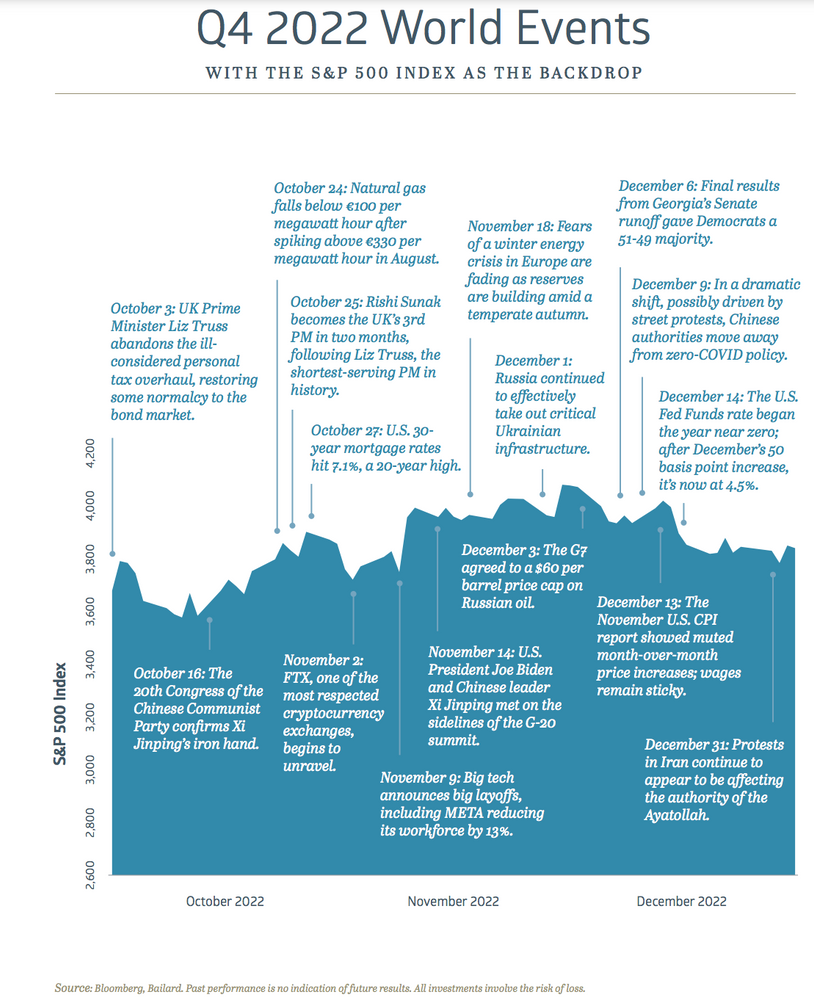
 The big question remains whether the Fed’s rate hiking campaign will tip the U.S. economy into recession, as it did in 1920. Faced with inflation not seen since the early 1980s, the Fed was forced last year to rapidly raise the Fed Funds target rate from 0.25% all the way to 4.5%. In December, the Fed’s projections indicated a peak rate in the 5% to 5.25% range. That is well above the 2.5% level that the Fed considers neutral—meaning neither accommodative or restrictive—when inflation is at 2%. With the Consumer Price Index (CPI) running at +7.1% year-over-year in November, though, the Fed has to play bad cop until prices cool further. Attempting to define what is “normal” for the Fed Funds rate is highly dependent on the time frame. Over the last 50 years, the average Fed Funds rate has been approximately 4.9%. Shortening the time horizon to the last 20 years, however, the average rate was just 1.4%. Tricky word, normal.
Too Much of a Good Thing?
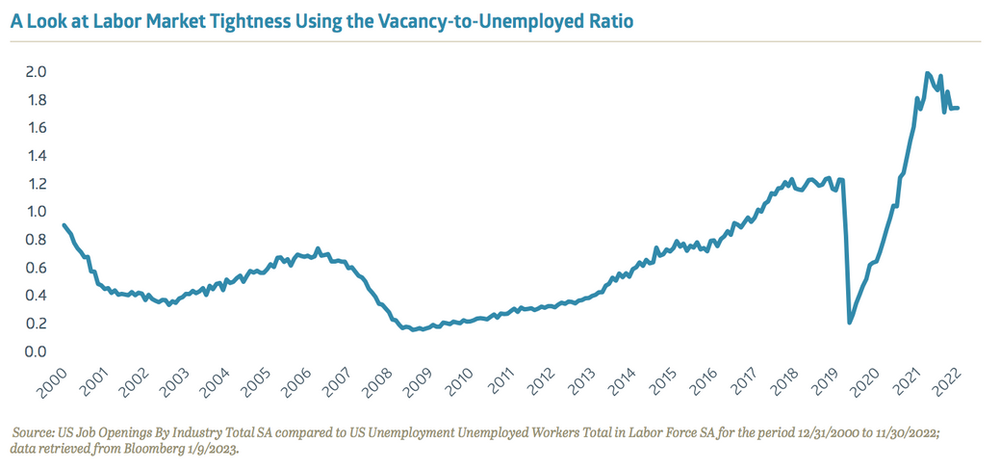
nKeeping inflation in check remains the Fed’s primary focus, but its other mandate is to maximize sustainable employment. With the unemployment rate at just 3.5% nationally as of December, matching a five-decade low, you’d have to say that box is checked. However, Fed Chair Powell has been clear that the labor market is too tight. Job openings have slowed, but remain elevated at roughly 10.5 million as of November. The Fed’s favored gauge for labor market tightness—shown below—is the vacancy-to-unemployed ratio, which was 1.74 versus 1.15 at the end of 2019.7 This excess demand for workers puts upward pressure on wages, and makes the Fed’s inflation-fighting job more difficult.
The December jobs report provided some good news. Average hourly earnings rose 4.6% year-over-year, a deceleration from +4.8% in November and a continuation of a slowing trend that saw this metric hit a 2022 high point at +5.6% last March. If sustained, this is the formula that could potentially deliver a “soft landing” for the economy: unemployment remains low, but wage growth and inflation moderate. As former Fed governor Randall Kroszner said: “It’s not that the Fed wants fewer jobs. What they want is lower wage growth more because they’re worried about persistent inflation.”8
If employment stays strong and housing prices remain resilient, it’s hard to imagine a near-term recession. Layoffs have picked up, but at a reasonable clip. According to the data firm Challenger, U.S. companies announced 320,173 layoffs over the first eleven months of 2022, a six percent increase. Just over 25% of those occurred in the tech sector where Amazon, Facebook, and others are attempting to right-size their operations. Despite the pressure on tech companies, California’s unemployment rate declined 1.7 points over the twelve months ending with November 2022 to 4.1%. The lowest state unemployment rates were in Utah (2.2%), Minnesota (2.3%), and North Dakota (2.3%).
Transitioning away from ultra-low interest rates never promised to be an easy road. This process of normalization took some prisoners in 2022. The tech-heavy Nasdaq Composite Index sank 33% on a price-only basis as investors repriced high growth, high valuation stocks. Some of the biggest winners in 2021 dropped to the bottom of the 2022 scoreboard, including California-based chipmaker Nvidia, which soared 125% two years ago before a 50% plunge in 2022. The lone S&P 500 Index sector that posted a positive price-only return in 2022 was Energy. The closing price of West Texas Intermediate (WTI) crude oil jumped as high as $123/barrel last March, up 64% from its year-end 2021 level, before fading to $80/barrel when 2022 came to a close. Nevertheless, the S&P 500 Energy sector returned 59% price-only last year, helped by attractive dividends and low valuations. It was an abnormal year, as usual.
A couple years after that 1920 presidential election, poet Robert Frost composed “Stopping by Woods on a Snowy Evening” at his home in Vermont. It contained the famous concluding (and repeated) line “And miles to go before I sleep.” That is a pretty apt saying for the markets in 2023. Many challenges remain for corporate America: higher interest rates, higher input costs, and likely lower margins. The easy money era is over.
1 “In the Shadow of the Slump: The Depression of 1920-1921,” www.econreview.berkeley.edu, 3/18/2021
2 “History of the 1918 Flu Pandemic,” www.cdc.gov
3 “WHO Coronavirus (COVID-19) Dashboard,” www.covid19.who.int, 1/4/2023
4 “Warren G. Harding’s pledge to ‘return to normalcy’,” www.britannica.com
5 “OECD Economic Outlook, Volume 2022 Issue 2,” www.oecd-ilibrary.org, 11/22/2022
6 “US Growth Outlook 2023,” Bloomberg Intelligence, 12/29/2022
7 “US REACT: Quitters Make It Hard for Fed to Cool Wages,” www.bloomberg.com, 1/4/2023
8 “Fed Gets ‘Goldilocks’ Report: Slower Wage Growth, Solid Hiring,” www.bloomberg.com, 1/6/2023

The Bailard Foundation Annual Update 2022
June 30, 2022
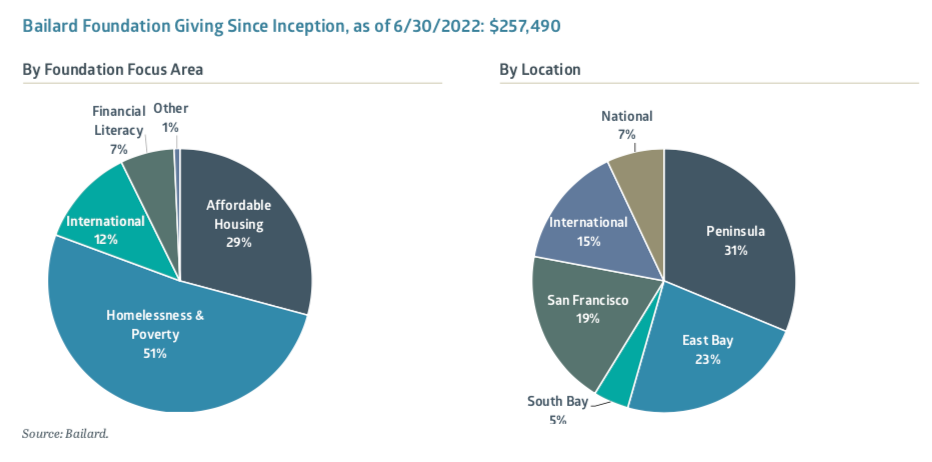
The Bailard Foundation celebrated its third anniversary in May. Bailard’s values shine through in many ways at the firm and the Foundation has quickly become another way for Bailard to exemplify its values of compassion, courage, and fairness. The Foundation channels Bailard’s strong commitment to the community through three focus areas: affordable housing, homelessness and poverty, and financial literacy. Since inception, the Foundation has donated $257,490 to grantees and remains appreciative of the incredible support receivedn by clients, employees, and friends of the firm during several challenging years. As we look to the future, the Foundation remains committed to building out additional in-person employee volunteer opportunities and expanding our grantee partnerships.
Giving Highlights
Employee Drives: The Foundation has conducted seven employee fundraising drives over the past three years, raising nearly $50,000 between employee contributions and the Foundation’s match. Our most successful drive to date was in March 2022 to support the ongoing crisis in Ukraine and highlights our employees’ commitment and generosity. In December 2021, we also held our Annual Holiday Drive, where employees received a match for contributions to their local food bank.
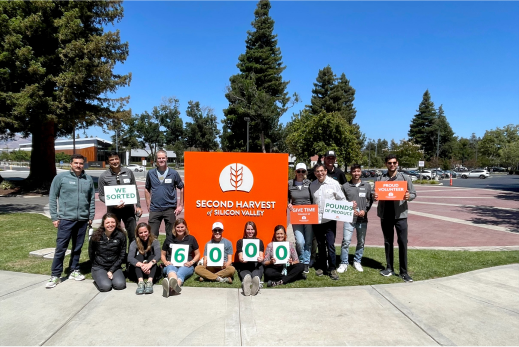
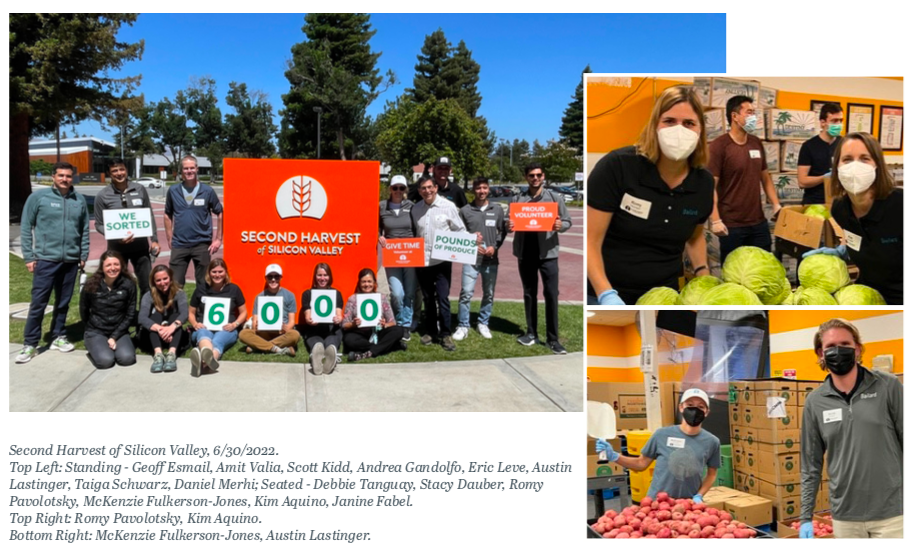
Volunteer Events: The Foundation held its inaugural in-person volunteer day on June 30 at Second Harvest of Silicon Valley. Fourteen Bailard employees gathered to sort 6,000 pounds of food for those facing food insecurity in the Bay Area. The Foundation looks forward to many future volunteer events around the Bay Area, underscoring our ultimate goal to build material relationships with our grantees by going beyond financial support and giving our direct time and effort. The next employee event will be at the SF-Marin Food Bank later in the summer.
Grantee Highlight – St. Francis Center
Mission: St. Francis Center provides opportunity for families living in Redwood City and the surrounding communities to live with dignity and build self-sufficient livelihoods.
Services: In addition to supplying food, housing, clothing and other essential services, the thriving community-based center seeks to reduce the cycle of poverty through skill building courses, mentorship programs and social services.
Grantee Highlight – World Central Kitchen
Mission: World Central Kitchen (WCK) works to provide food to global communities during crises, by being at the frontlines providing meals and by helping build resilient food systems in areas with chronic food system challenges.

Services: Founded in 2010 by Chef José Andrés, WCK is first to the frontlines, providing meals in response to humanitarian, climate, and community crises while working to build resilient food systems with locally led solutions. WCK has served more than 100 million fresh meals to people impacted by natural disasters and other crises around the world. WCK’s Resilience Programs strengthen food and nutrition security by training chefs and school cooks; advancing clean cooking practices; and awarding grants to farms, fisheries, and small food businesses while also providing educational and networking opportunities.
The Bailard Foundation supports initiatives that the firm, its employees, and its clients value, as we seek to collectively improve the communities in which we live, work, and engage. The Bailard Foundation has a board of directors that is led by chairwoman Terri Bailard, widow of firm co-founder Tom Bailard, and features both select friends of Bailard, Inc. and employees.
Photo credit: World Central Kitchen/WCK.org.


The Bailard Foundation Annual Update 2021
June 30, 2021
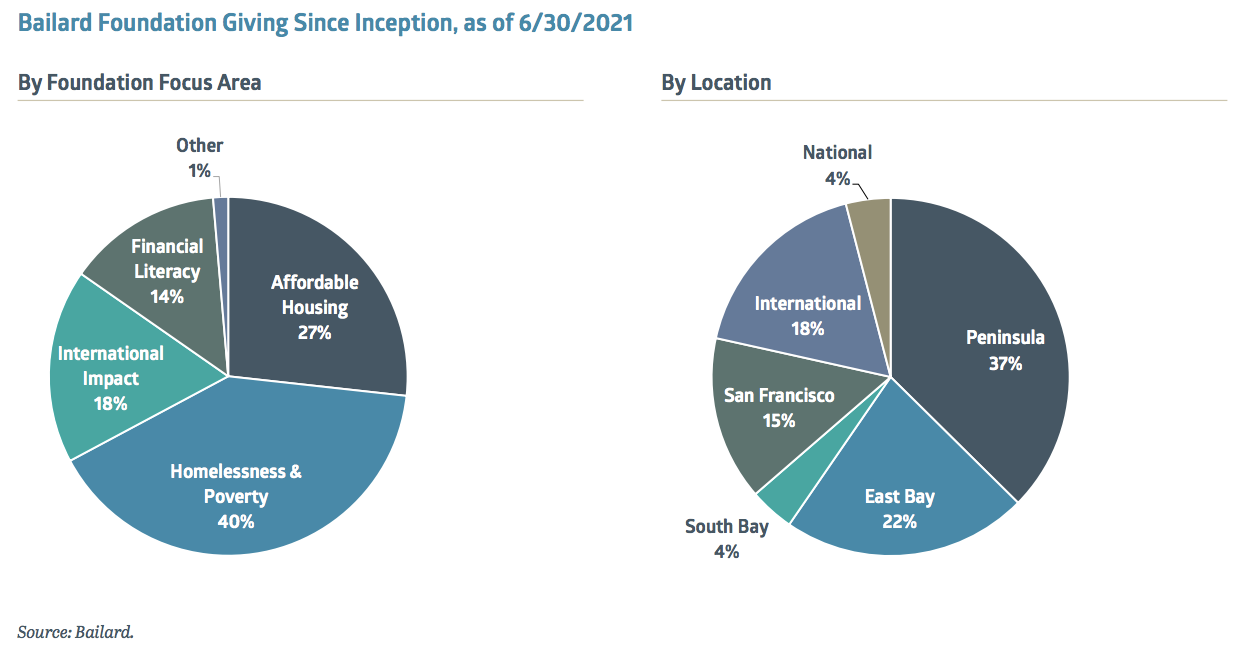
Serving the community in which we live has long been ingrained in the values of Bailard and the mindset of its employees. The desire and effort of helping our communities was foundational for the company, but there had never before been a formal channel to organize or amplify Bailard’s service. To solidify the company’s commitment to our communities and increase the impact of what Bailard, its employees, and clients support, the Bailard Foundation was created in May of 2019 in tandem with the Firm’s 50th Anniversary. The Bailard Foundation supports initiatives that the Firm, its employees, and its clients value, as we seek to collectively improve the communities in which we live, work, and engage. The four focus donation areas of the Bailard Foundation are Affordable Housing, Homelessness & Poverty, Financial Literacy, and International Impact projects. Since inception, the Foundation has donated $126,508 to various grantees and remains appreciative of the incredible support received by clients, employees, and friends of the Firm.
Giving Highlights
Pandemic Relief: The pandemic drove a number of the Bailard Foundation’s charitable strategies over the past year. Given exceptional economic need, the Foundation focused on accelerating grant giving within its core values of Homelessness & Poverty and Affordable Housing. The jeopardizing of basic human needs such as shelter and food steered the Foundation’s giving to a number of food banks including SF-Marin Food Bank, Second Harvest Silicon Valley, Alameda County Community Food Bank, and the Food Bank of Contra Costa & Solano Counties. The Foundation also gave to a several San Francisco Bay Area grantees addressing homelessness, including First Place for Youth, Glide Foundation, and Larkin Street Youth.
Black Lives Matter Movement: In regards to the Black Lives Matter movement, the Foundation implemented a number of initiatives beginning in the summer of 2020, starting with a $500 match on any employee gift to an organization that seeks to address and end systematic racism and oppression of Black, Indigenous and People of Color (BIPOC). Additionally, the Foundation gave new contributions in support of Larkin Street Youth Services, Hope SF, and the San Francisco Bay Area chapters of 100 Black Men and 100 Black Women. Through both campaigns, nine organizations received close to $19,000 in grants.
New Grantees: The Bailard Foundation’s new grantees over the past year spanned all four focus areas of Financial Literacy, Affordable Housing, Homelessness & Poverty, and International Impact. A notable new grantee within the Homelessness & Poverty focus area includes First Place for Youth, which helps Bay Area foster youth transition to responsible adulthood. In regards to International Impact, the Foundation granted $5,000 to Raising the Village, which partners with rural communities in Uganda on economic self-sufficiency initiatives, helping lift villages out of poverty. On the Financial Literacy front, the Foundation made a new $5,000 grant to Able Works, which supplies youths and young families with financial education and life skills to help overcome economic hardship.
Grantee Highlight – First Place for Youth
Mission: First Place for Youth helps foster youth build the skills they need to make a successful transition to self-sufficiency and responsible adulthood.
Services: Each year, more than 25,000 young people “age out” of the foster care system and face the prospect of independent living. First Place for Youth steps in to support young people coming of age in the foster care system whose families can’t be there for them. Beginning with safe places to live, program participants are then matched with mentors, housing and employment specialists and youth advocates who help them to persist and succeed in school, build life and job skills, and work toward careers in high-growth fields.
Grantee Highlight – The Samburu Project
Mission: To provide access to clean water and continue to support well communities with initiatives that promote health, education, women’s empowerment and general well-being.
Bailard’s Involvement: In 2020, The Samburu Project drilled seven new wells that now provide clean water to communities in Samburu, Kenya. One of these wells was co-funded by the Bailard Foundation, and will support the 670 people of the Pasinae Self Help Group of Lechur Village.

The Bailard Foundation supports initiatives that the firm, its employees, and its clients value, as we seek to collectively improve the communities in which we live, work, and engage. The Bailard Foundation has a board of directors that is led by chairwoman Terri Bailard, widow of firm co-founder Tom Bailard, and features both select friends of Bailard, Inc. and employees.

The Origins of Socially Responsible and Sustainable Investing
One of the fastest growing areas in investing today is socially responsible investing (SRI) and environmental, social, and governance (ESG) investing. The growth in SRI and ESG has not just been driven by the heightened desire of individual investors to align social and environmental values with portfolios, but also by the realization that ESG metrics can be a valuable gauge of risk and can drive investment performance. It may be surprising to some that SRI has been around for decades, and ESG arrived in the mid-2000s. Inside this research paper published in The Journal of Impact and ESG Investing, “From SRI to ESG: The Origins of Socially Responsible and Sustainable Investing,” Bailard’s own Blaine Townsend, CIMC®, CIMA®, explores the history of SRI and ESG investing.
Inside, you’ll learn:
- How the history of SRI and ESG investing has roots not only faith-based investing but also in the civil rights, antiwar, and environmental movements of the 1960s and 1970s;
- How investment risks posed by climate change and poor corporate governance were a large catalyst to ESG investing;
- How ESG data is now much more widely available than even a decade ago, making ESG investing much more viable; and
- The impact of SRI and ESG on investment returns.
The Bailard Foundation’s First Annual Update
“Doing what is right. Right by the client, by each other, by the firm and by society.” This is what Ron Kaiser—one of the three co-founders of Bailard, Inc.—said last October when speaking about what it takes for a company to last 50 years. This idea of “doing right” exemplifies what the company and its late founder and long-time CEO, Tom Bailard, stand for to this day. And, in honor of its first 50 years and with excitement for the future, last year Bailard set about creating a list of values that it views as defining for the company. One of these six core values is Compassion, which Bailard strives to demonstrate through understanding and improving its communities.
Charitable Gifts throughout the Years
Bailard has long been involved with numerous charitable groups. This support has come in a variety of ways and has often been associated with those causes closest to our employees and clients.
Donations: Bailard has consistently provided support for a number of Bay Area non-profits including AbilityPath, United Way Bay Area, Boys & Girls Club of the Peninsula, and Community Housing Partnership. Employees have organized volunteer days with Rebuild Together and Second Harvest Food Bank. Bailard recognizes the power and impact found in academic sponsorships as well, and has supported research prizes including the University of California Berkeley Moskowitz Prize. Over the past five years alone, Bailard has provided over $500,000 in charitable donations and sponsorships.
Employee Matching: The culture at Bailard lends itself to attracting employees who are passionate about community engagement and charitable causes. To provide support for its employees, Bailard has long offered an annual match on employee donations.
Emergency Fundraising: As we are now experiencing with the COVID-19 pandemic, the world is unpredictable and situations often arise that fall outside of Bailard’s normal targeted giving. Bailard has reacted to these extra needs through company-wide matching initiatives in addition to its annual per employee match limit. Donations have been given to support victims of wildfires, food banks during the onset of COVID-19, and most recently a match to employees for any organization that seeks to address and end systematic racism and oppression of Black, Indigenous, and People of Color (BIPOC).
The Next Step Forward: The Bailard Foundation
Serving the community in which we live has long been ingrained in the values of Bailard and the mindset of its employees. The desire and effort of helping our communities was foundational for the company, but there had never before been a channel to organize or amplify Bailard’s service. To solidify the company’s commitment to our communities and increase the impact of what Bailard, its employees, and clients support, the Bailard Foundation was created in 2019.
We are pleased to provide the Foundation’s first annual update below, following a spotlight on a community partnership Bailard has supported for nearly thirty years.
Community Partnership over the Years: AbilityPath
Mission: To empower people with special needs to achieve their full potential through innovative, inclusive programs and community partnerships. Together, we are creating a world where people of all abilities are fully accepted, respected and included in all aspects of life: in the classroom, the workplace, and in our communities.
Services: Range from early intervention for infants to play therapy for children, social activities for teens, and employment training for adults along with support and counseling for families. All programs are designed to help children and adults thrive at school, at work, at home, and in the community.
Bailard’s Involvement: Bailard has supported AbilityPath through both financial donations and employee volunteer days. The company continues to act as a major sponsor for AbilityPath’s largest annual fundraiser and other events throughout the year.
Bailard Foundation Annual Update
The Bailard Foundation was launched in May of 2019, in celebration of the firm’s 50th anniversary. The Foundation’s aim is to centralize Bailard’s robust history of charitable giving and promote impactful donations that align with the Foundation’s mission statement and focus areas.
Mission Statement: The Bailard Foundation supports initiatives that the Firm, its employees, and clients value as we seek to collectively improve the communities in which we live, work, and engage.
Four Focus Areas: Affordable Housing, Financial Literacy, Homelessness & Poverty, and International Impact Initiatives.
In the year since its launch, the Foundation has worked to expand connections with local and international charitable organizations. As of June 30, 2020, the Foundation will have provided over $70,000 in grants to 24 organizations within its focus areas, as summarized below.

A Look Forward
In its second year, the Foundation plans to further build out its operational base to better serve the charitable organizations chosen by the Foundation Board as well as the company and Bailard employees. The newly-launched Bailard Foundation website (www.bailard.com/ foundation) includes information on the mission, focus areas, and grants awarded to date. We also hope to expand our relationships with some of our grantee groups through volunteer days and specific fundraising drives. The Foundation is open to all suggestions from employees, clients, and friends on organizations in our focus areas.
Grantee Highlight – JobTrain
Mission: Committed to helping those who are most in need to succeed. JobTrain aims to improve the lives of people in the community through assessment, attitude and job skills training, and high potential career placement.
Services: Career training through 11-week programs at no cost for students with four focus areas: Healthcare, Culinary Arts, IT Service and Support, and Carpentry. Other offerings include youth services, job seeking services, onsite daycare, and evening classes all aimed to provide those looking to better themselves and their careers with the tools and support to do so.
Why JobTrain: The Bailard Foundation was impressed by the array of services offered and core focus on skilled training offered. Relevant job skills are so important for unemployed and under employed to increase their options for employment.

ESG-related Regulatory Requirements
While ESG has become mainstream, it has become a much more polarized political issue in the United States. Nevertheless, regulators at home and abroad are working to improve ESG disclosures and build a better framework for ESG investors.