


When to Consider Roth Conversions for Retirement
Join Lena McQuillen, CFP®, Vice President and Director of Financial Planning, in an exploration of how Roth IRA conversations can lower your lifetime tax burden and maximize retirement flexibility.
With the expiration of the Tax Cuts and Jobs Act looming in 2025, many are considering Roth conversions as a savvy move to lock in today’s low rates and secure tax-free income in retirement. This strategy not only offers tax-free growth and future tax-free withdrawals, but also eliminates required minimum distributions (RMDs) in retirement. For those looking to reduce their lifetime tax burden and gain more control over their retirement income, Roth conversions can be an appealing solution.
What is a Roth Conversion and How Does it Work?
Traditional IRAs are funded with pre-tax dollars, allowing tax deductions on contributions, while Roth IRAs are funded with after-tax dollars. Both offer the long-term benefit of tax-free growth, but qualified withdrawals from a Roth IRA—including earnings—are tax-free (as long as certain conditions are met).
A Roth conversion involves moving funds from your pre-tax retirement account, such as a Traditional IRA, into a Roth IRA. Though you must pay taxes on the amount converted, the long-term benefit of tax-free growth and withdrawals often outweighs this drawback. Additionally, Roth IRAs do not require RMDs during your lifetime, so your account can continue growing tax-free for as long as you let it. You can convert all or part of your retirement account, allowing you to tailor a strategy based on your current tax situation and long-term financial goals.
What Should You Weigh Before Converting?
 Before deciding to convert, it’s important to compare your current tax rate to your expected tax rate in retirement. Many people assume they’ll be in a lower tax bracket during retirement, but that’s not always true. As pre-tax retirement accounts grow, future RMDs—which are taxed as ordinary income—can push you into a higher bracket. Other income sources like Social Security, investment income, and capital gains can further elevate your tax rate.
Also, it’s crucial to ensure you have cash available to cover the taxes owed, as the IRS requires you to pay taxes on the converted amount in the year of conversion. Avoid using IRA funds to pay this tax, as this would unnecessarily increase your taxable income and reduce the benefits of the conversion. Instead, consider using cash or assets from a taxable account to cover the tax bill, if it doesn’t lead to a much larger capital gains tax.
Who Might Benefit from a Roth Conversion?
Roth conversions are especially beneficial for retirees in the transition window between stopping work and the start of RMDs. This period often sees a drop in income, making it an ideal time for conversions at a lower tax rate.
If you’re still working and anticipate higher future earnings or are in the early stages of your career, you may also benefit from a Roth conversion. Converting your Traditional IRA or employer-sponsored plan while in a lower tax bracket allows you to take advantage of today’s lower rates, maximizing tax-free growth and withdrawals in retirement.
 Additionally, consider a Roth conversion during years with significant deductions or tax credits to help offset the income generated by the conversion. Although capital losses can’t offset Roth conversion income, strategically choosing favorable tax years (with lower income) can reduce the immediate tax impact while still allowing for long-term tax-free growth.
Who Should Avoid Roth Conversions?
Roth conversions aren’t for everyone. If you’re nearing or in retirement and plan to use IRA funds for living expenses soon, converting those funds may not make sense. Conversions need time to grow and offset the tax bill.
If charitable giving is a part of your financial plan, keeping your assets in a Traditional IRA may be wiser. Donating directly from a Traditional IRA through a Qualified Charitable Distribution (QCD) satisfies RMD requirements without creating taxable income. Leaving a Traditional IRA to a qualified charity at death allows them to receive the full value tax-free. Converting funds results in unnecessary taxes.
For individuals relying on financial aid or income-based benefits, the increased taxable income from a Roth conversion could affect your eligibility. And for those subject to mandatory RMDs—currently starting at age 73—Roth conversions are not practical as you’d pay taxes on both the RMD and the amount converted, potentially adding an extra tax burden.
Finally, if you’re uncomfortable paying the upfront taxes, a Roth conversion may not be right for you.
Looking Beyond the Immediate Tax Impact
For decades, you’ve been encouraged to save in pre-tax accounts like Traditional IRAs. While this strategy is sound, especially in peak earning years, these accounts grow tax-deferred and can result in significant balances by retirement, particularly when RMDs begin.
Many people focus on the immediate tax hit of a Roth conversion, but it’s essential to take a long-term view. Not only will converted funds grow tax-free, but so will their earnings, leading to potentially significant savings over time.
A key benefit of this strategy is tax diversification. Having a mix of Traditional IRAs, Roth IRAs, and taxable accounts provides flexibility in managing your taxes during retirement. While RMDs from Traditional IRAs are taxed as ordinary income, Roth IRAs allow tax-free withdrawals. This diversification gives you more control over your tax exposure and can help you minimize taxes in retirement.
Ultimately, while a Roth conversion might increase your taxes in the year of conversion, it can reduce your overall tax burden over your lifetime. A well-timed, strategic conversion can help manage the taxation of your retirement income and potentially lower your total tax bill in retirement. The goal is to create a balance between taxable and tax-free accounts, providing more control and flexibility over your finances.
Conversion Strategy
A smart approach to Roth conversions is to consider partial or staged conversions over several years. This strategy lets you convert smaller amounts each year based on your tax bracket, helping you avoid moving into a higher tax bracket. By converting just enough each year, you can minimize the immediate tax impact while still reaping the long-term benefits of a Roth IRA.
Is a Roth Conversion Right for You?
Considering a Roth conversion is a significant decision. Work closely with your tax professional and investment counselor to evaluate your situation. Keep in mind that a conversion may impact your adjusted gross income (AGI), potentially reducing deductions or triggering Medicare surcharges. However, don’t shy away from the conversion due to these short-term impacts. The tax hike and loss of benefits will only affect you for one year, while the benefits of a Roth IRA—growing tax-free for decades—can far outweigh the temporary drawbacks. By carefully planning and understanding the long-term implications, you can make a Roth conversion a cornerstone of a more tax-efficient retirement.
Planning Ahead: Maximizing Your 401(k) Strategy
In addition to considering a Roth conversion of your Traditional IRA, it’s essential to think about your retirement savings strategy moving forward. In a future article, we’ll dive into whether contributing to a Traditional 401(k) or a Roth 401(k) makes the most sense. With numerous recent changes made to retirement plans introduced by the SECURE Act, we’ll explore which strategy aligns best with your family’s financial goals. Stay tuned as we explore how these factors could shape your retirement savings strategy.


Economic Brief: Accounting on You
This quarter, Jon Manchester, CFA, CFP® (Senior Vice President, Chief Strategist – Wealth Management, and Portfolio Manager – Sustainable, Responsible and Impact Investing) takes us on a thoughtful journey through the changing landscape of executive leadership, the ripple effects of Sarbanes-Oxley, and how the Fed’s latest moves could realign market dynamics.
The Beatles occupied the top spot on the Billboard Hot 100 list a record 20 times, all between 1964 and 1970.1 Their final #1 hit came in June 1970 for a melancholy tune called “The Long and Winding Road.” Its release occurred roughly a month after Paul McCartney announced he would take a break—which ultimately proved permanent—from the legendary Liverpudlian group. The song reflected the somber mood of a band searching for an off-ramp following a transformational stretch atop the global charts and consciousness. Their music helped create the zeitgeist of that era and remains relevant 60 years later, but Beatlemania was no more sustainable than any other mania. It weighed heavily on the Fab Four, ultimately fracturing their collective desire to soldier on. They faced shifting agendas and the daily pressure of trying to be The Beatles.
Although on a much different level, Chief Executive Officers (CEOs) have their own journeys down a long and winding road. McCartney said the song was “all about the unattainable; the door you never quite reach…the road that you never get to the end of.”2 Running a Fortune 500 company must feel somewhat the same: you are a temporary caretaker of a business designed to last in perpetuity. Not surprisingly, CEOs tend to have relatively short stays in the hot seat. Spencer Stuart is an executive search and leadership consulting firm based in Chicago, IL. According to its 2023 CEO Transitions report, the average CEO tenure at a Standard & Poor’s 500 (S&P 500) company was 8.9 years as of 2023.3 In part, tenure is limited by a long-term trend toward an older starting age, with Spencer Stuart noting that in 2023 the average S&P 500 CEO assumed the role at 56.4 years old, an all-time high. Although the vast majority of CEO departures are categorized as planned, so-called “resignations under pressure” jumped from 7% in 2022 to 16% in 2023. Per Spencer Stuart, CEO departures under pressure are more common at the larger S&P 500 companies due to elevated media and investor scrutiny.
To replace these sunsetting CEOs, corporations tend to look internally, and an increasingly popular choice is the Chief Financial Officer (CFO). Across the pond, around a third of FTSE 100 CEOs have previously served as CFOs, up from 21% in 2019.4 This may be a result of the more expansive role taken on by CFOs, including corporate strategy, plus the heightened importance of risk management. Some CFOs are even the face of the franchise, so to speak. Long-time Costco Wholesale CFO Richard Galanti recently retired after nearly 40 years on the job. Galanti was the one who met with Wall Street analysts each quarter to review Costco’s results, not (former) CEO Craig Jelinek. He also, importantly, spent essentially his entire career reassuring customers that Costco’s famous hot dog-and-soda combo meal would stay at $1.50. Beyond serving as an inflation fighter (at least for the revered combo meal), Galanti helped Costco generate a remarkable 17.7% annual return, including dividends, for shareholders over the 38 years spanning 1986-2023. His story is fairly unique, but the CFO as influencer and future CEO seems more common, particularly as the complexity of running multinational corporations only increases.
 Mind the GAAP
 Mind the GAAP
Perhaps we can trace the rising prominence of the CFO back to the Sarbanes-Oxley Act of 2002. Crafted in response to a series of accounting scandals at Enron, Tyco, and other companies, the Act sought to strengthen accounting practices and oversight. It established the Public Company Accounting Oversight Board (PCAOB), whose charge is to regulate the auditors (that is, audit the auditors), ending a long history of self-regulation for accounting firms offering audit services. Sarbanes-Oxley also requires that the company’s principal officers—typically the CEO and CFO—certify and approve their company’s financial reports each quarter. Criminal penalties await those who certify falsified reports, including significant monetary fines and/or prison.
The driving purpose of the Act’s reforms was to restore investor confidence, especially in periods of economic uncertainty. Co-sponsor Michael Oxley, former U.S. House member from Ohio, later said: “We often think of money as the currency of a free market system, but in truth the system rises and falls on the confidence of its investors. Those who invest capital do so based on an understanding and knowledge of the risks and potential rewards involved.”5 That confidence would be greatly tested once again, of course, during the global financial crisis (GFC) of 2007-08. Unfortunately, these episodes of diminished trust are a seemingly unavoidable facet of being a long-term investor. On the plus side, reforms are made, lessons are learned (the hard way), and sharp drawdowns in asset values can provide attractive entry points for opportunistic and patient investors.
At a high level, one way we can monitor an uptick in strained corporate finances is to compare company earnings calculated using Generally Accepted Accounting Principles (GAAP) versus non-GAAP earnings. With non-GAAP earnings, companies have the latitude to exclude income statement items they consider to be one-time, or nonrecurring. These may include expense items such as restructuring costs or asset write-downs, or a sizeable gain from selling assets. Monitoring the relationship between GAAP and non-GAAP earnings helps us spot signs of financial strain. In periods of economic stress, these numbers tend to deviate, indicating that companies are recording more one-time losses and driving down GAAP earnings, while non-GAAP earnings benefit from excluding those items. In Chart 1 on the following page, the ratio of S&P 500 GAAP earnings per share (EPS) to non-GAAP EPS suffered sharp declines during both the Tech bubble’s pop (2000-02) and the credit crisis. Over the last 30 years, the median for this ratio has been roughly 89%. In 2023, the ratio was 90%. This metric appears to be more of a coincident than leading indicator, but it’s worth keeping tabs on to gauge whether CFOs, in aggregate, are busier than usual excluding items from the standardized GAAP earnings calculation. Through the first half of 2024, the ratio is inline with that trailing 30-year median number.

T-Bills and Chill
The highly-anticipated Federal Reserve (Fed) pivot finally arrived in mid-September. To the surprise of some Fed watchers, it was a 0.5% (or 50 basis point6) cut to the Fed Funds rate, taking the upper end of the target range to 5.0%. Fed Chairman Jerome Powell described it as a “recalibration of our policy…as we begin the process of moving toward a more neutral stance.”7 Members of the Federal Open Market Committee (FOMC) estimated the target rate would drop to 4.4% by year-end 2024, and 3.4% by the end of 2025. With inflation in much better shape—the Consumer Price Index rose 2.5% year-over-year in August—the Fed is now turning its attention to supporting the labor markets by lowering short-term rates. This ongoing tightrope walk by the Fed is an attempt to properly balance its dual mandates of stable prices and maximum employment. Thus far, Chairman Powell has successfully navigated these choppy waters, but we know it’s too early to declare victory. If the Fed ends up reducing the target rate by roughly two percentage points while avoiding an economic recession, it would be an outlier over the last few decades. That scale of monetary easing has always been in response to a significant negative shock to the economy.
Markets aren’t sure exactly what to make of all this. Risk assets have enjoyed a strongly-positive 2024 to this point, but at the same time, the price of gold has hit new highs and the 10-year U.S. Treasury note yield has fallen from nearly 5% in October 2023 to approximately 3.8% by third quarter-end. There is some logic to this considering the anticipated Fed easing cycle, yet it still feels like investors are hedging bets on both sides of the economic “soft landing” question. One clear repercussion of lower short-term interest rates is a decline in income from money market funds and ultrashort bonds. The short-lived era of 5%-plus yields will come to an end, and in fact rates have already moved significantly lower ahead of the Fed. The “T-Bills and Chill” approach—meaning parking cash in Treasury bills yielding 5% and then sitting back to relax—will need a new moniker. It may end up pushing investors into equities in search of higher returns. Stocks offering higher dividend yields fared well in the third quarter, suggesting the yield-focused crowd might already be moving on.
To complicate things further, the U.S. presidential election looms ahead. If you want to know the winner ahead of time, Comerica Wealth Management’s 2024 Election Chartbook points out that the S&P 500’s performance for the August through October timeframe has correctly predicted each presidential election since 1984.8 In years when the S&P 500 Index is positive over those three months, the incumbent party has won. Comerica reasons that equity performance reflects broader economic sentiment, so when voters are satisfied with the economy’s direction, they tend to support the status quo. From a bigger picture standpoint, Comerica reminds us to separate our investments and politics, saying elections have little impact on long-term investment returns and that markets tend to do well regardless of which party holds the Oval Office.
So, take a deep breath, we’ll get through this. It’s a long and winding road, after all. At least, for now, we are passing through an economic landscape of steady growth, tempered inflation, and supportive monetary policy.

1 “Artists With the Most No. 1 Songs on the Hot 100, From The Beatles to Rihanna & More,” www.billboard.com, 4/30/2024.
2 “The Long and Winding Road,” www.wikipedia.org.
3 “2023 CEO Transitions,” www.spencerstuart.com, January 2024.
4 “Why more CFOs are becoming CEOs,” www.ft.com, 3/13/2024.
5 “The Sarbanes-Oxley Act of 2002 – Restoring Investor Confidence,” www.publications.aaahq.org, 12/1/2007.
6 A basis point is 0.01%.
7 “Transcript of Chair Powell’s Press Conference,” www.federalreserve.org, 9/18/2024
8 “Election Chartbook 2024,” www.comerica.com, September 2024




How to Pick a Health Insurance Plan During Open Enrollment
Lena McQuillen, CFP® Director of Financial Planning, delves into why not reviewing your health insurance coverage each year could be costing you, as well as various considerations for picking a health insurance plan. Plus, sign up for a Medicare or a Marketplace Open Enrollment webinar.
Do you review your health coverage each year? Most people don’t. In fact, 90% of Medicare beneficiaries don’t review their drug coverage, and 95% are on a plan that isn’t optimized for their needs.
As for Marketplace insurance, enrollees who automatically renewed their plans paid 62% more than enrollees who compared plan options and picked the optimal option for their needs.
No one wants to pay more than is necessary for health coverage, and most would more than likely prefer to be on a plan that’s optimized to their needs, but with many different options available, choosing health coverage can be overwhelming—if you’re not equipped with the information and tools needed.
Selecting the right health insurance plan involves careful consideration of several key factors. As we approach the open enrollment season1, it’s important to start thinking now about the healthcare you’ve needed so far2 and what you might expect to want or need in the coming year. Identifying and prioritizing your personal preferences when looking at each plan will be crucial to optimal decision-making.
Below are other key considerations to explore that will help you make an informed decision during open enrollment.
 Access to Care
When selecting a health insurance plan, consider whether your current doctors, pharmacies, and hospitals are part of the plan’s network. Insurance companies establish networks with healthcare providers to offer better rates for services within the network. It’s important to verify if your preferred doctors participate in-network to maximize your plan’s benefits and minimize out-of-pocket costs. (Covered plan providers can change every year, so you will want to confirm if your current providers are still covered for the upcoming year.)
Some plans require a referral from your primary care physician to see a specialist, while others offer direct access to specialists. If you anticipate needing services of a specialist such as dermatologists, cardiologists, neurologists, etc., considering a plan without referral requirements may be preferable for easier access to specialized care. (It should be noted that a referral by your primary care physician does not guarantee coverage under your plan, and you should always check with your insurance before you attend an appointment.)
You will also want to consider your travel habits within the United States. Plans may offer a regional or a nationwide network of doctors. Regional networks are limited to a specific geographic area and are often more cost-effective, while nationwide networks allow flexibility to see in-network doctors in any of the U.S. states and territories. For frequent travelers, nationwide coverage can give you access to in-network care outside your home region if you need treatment for a cold or to refill a prescription. (In an emergency, ambulances and medical treatment at the emergency room will be covered even if you go outside the network, based on your plan deductibles and co-pay.)
 Finances
When deciding on a health insurance plan from a financial perspective, consider your approach to upfront costs. Would you prefer a plan with higher monthly premiums but lower out-of-pocket expenses for each medical service? This option can be advantageous if you prioritize predictable budgeting and prefer minimal financial surprises when accessing healthcare. Conversely, opting for a plan with lower monthly premiums and higher costs at time of service might appeal to you if you’re generally healthy and have the financial flexibility to manage occasional higher expenses.
Another financial consideration is your preference regarding the payment structure for doctor visits. Some plans offer a flat-rate copayment per visit, which simplifies budgeting and is ideal for frequent visits to in-network doctors. These plans typically come with higher premiums or fixed costs. Alternatively, plans with percentage-based coinsurance on medical bills provide flexibility, potentially lowering monthly expenses if you’re comfortable with varying costs per visit based on services rendered. Choosing between copayments and coinsurance largely depends on your healthcare usage patterns and financial comfort level with fluctuating out-of-pocket costs.
Go Beyond Healthcare Premiums
The out-of-pocket maximum is the most you will pay out of your pocket for covered health services in a given year and includes your deductible, any copayments, and coinsurance that you pay for medical care. Because out-of-pocket expenses are variable, it’s important that you understand your total potential healthcare expenses: your “worst-case scenario.”
If you have a sense of what your healthcare needs are in the next 12 months (such as having a baby or surgery, etc.), you can proactively plan for these healthcare events when selecting your health insurance plan. You’ll want to understand your deductible and potential out-of-pocket costs, and have this information saved where it can be easily accessible.
Optimize Your Health Plan
Health insurance plans change every year which can impact your premiums, in-network doctors and pharmacies, drug costs, and more. Proactive planning during open enrollment is especially important to evaluate new health plan options that fit your budget, personal preferences, and health needs. Even if your current needs have not changed (no change in health, doctors, prescriptions, etc.), it’s possible that the plans available to you have changed, including the one you are currently enrolled in. There may even be a better suited plan for you. Prioritize your preferences and choose a plan that is going to suit your needs for the upcoming year. You can always make a new election during the next open enrollment period.
Upcoming Webinar on Medicare and Marketplace Open Enrollment
To assist our clients with healthcare planning, we have partnered with Caribou, a healthcare planning company that works exclusively with financial advisors to help their clients plan for current and future healthcare costs. We will be hosting the two webinars listed on the right with Caribou to go over the fundamentals of Medicare and The Marketplace, so that you can make an informed decision that meets your health needs, preferences, and financial goals. Bailard Wealth Management clients can register for either, or both, by clicking on the titles of either in the box below.

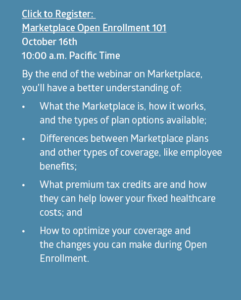
Complete a Health Planning Analysis, at No Extra Cost to Bailard Wealth Management Clients
If you would like to take it a step further, ask your Investment Counselor about completing a Health Planning Analysis. Caribou can provide support in this complex decision process by finding health plan options tailored to your needs and preferences at no extra cost to you.
1 Insurance plans cannot be changed outside of the annual open enrollment period, except for qualifying life events that can trigger unique enrollment opportunities. Changes to your current health status may not align with either of these timeframes, so it’s important you have a plan that covers you, your spouse, and your dependents for any eventuality.
2 Most doctor offices now offer a mobile app where you can look up your past medical history, past and upcoming medical appointments, and current medications in one location. .

How the Corporate Transparency Act Might Impact You
Dave Jones, JD, LLM, CFP® Senior Vice President and Director of Estate Strategy, explains the Corporate Transparency Act, the types of entities impacted but often overlooked, and pragmatic steps for compliance by year-end to avoid penalties.
If the Corporate Transparency Act sounds unfamiliar, you are not alone. It’s a somewhat obscure—but significant—piece of legislation that took effect on January 1, 2024. The law’s purpose is to curb illicit finance, such as money laundering and tax evasion, by requiring corporate entities to identify the individuals who ultimately own or control said entities to the Financial Crimes Enforcement Network (FinCEN). Given the law’s intent, it may be surprising that it could apply to you!
To accomplish its objectives, the Corporate Transparency Act (CTA) applies broadly to domestic and foreign entities, including some you might not expect, such as single-member LLCs and consulting entities. For entities created prior to 2024, the first deadline is the end of this year. As a result, many law firms across the country have spent the last six months notifying their clients about the new law and their clients’ responsibility to report what is called beneficial ownership information to FinCEN. You may have already received a notification from your attorney.
This article provides an overview of the Corporate Transparency Act, highlights some common examples of affected but often overlooked entities, and outlines practical steps for compliance before the end of the year to avoid penalties.
Overview of the Corporate Transparency Act
While there are certain exceptions—such as for larger companies and regulated entities—corporations, limited liability companies (LLCs), limited liability partnerships (LLPS), and other entities created by filing a document with a secretary of state or any similar office in the United States, are required to report beneficial ownership information to FinCEN.
Information Required to Report
Fortunately, beneficial ownership information is relatively easy information to locate and report to FinCEN. It includes the following for each beneficial owner:
- Full legal name;
- Birthdate;
- Residential or business address; and
- Unique identifying number (such as via a passport or driver’s license)
 Deadline
Reporting deadlines depend on when the entity was created.
For entities created before January 1, 2024—the most common scenario—there is a one-year grace period. For those entities, the beneficial ownership information report (BOIR) must be filed to FinCEN by January 1, 2025.
For entities created between January 1, 2024 and December 31, 2024, the BOIR must be filed within 90 days of receiving public or actual notice of their formation, whichever is earlier. For entities formed on or after January 1, 2025, the BOIR must be filed within 30 days of formation.
Hefty Penalties for Non-Compliance
Importantly, it should be noted that there are penalties for non-compliance, which include $500 per day and criminal penalties, including fines up to $10,000 and imprisonment for up to two years.
Common Examples of Overlooked Entities
Many of our clients have business entities that fall under the CTA’s reporting requirements that could easily be overlooked. Here are some common examples.
- Single-Member LLCs: Many clients use single-member LLCs to hold real estate or operate businesses. These entities, while disregarded for federal income tax purposes, are not disregarded for CTA purposes. They generally need to comply with the CTA by reporting the beneficial owner.
- Corporations for Consulting Services: Clients who operate consulting businesses often use corporations to manage their operations. These entities may need to report the ownership details of the individual, or individuals, who control or own significant shares of the business.
- Holding Companies: Certain holding companies used to manage family assets or investments may also fall under the CTA. The beneficial owners, often family members, of such holding companies are required to be disclosed.
Less Than Six Months Left for Compliance: Three Steps to Take
With the compliance deadline less than six months away, we encourage you to take the time this summer to complete your reporting. Follow these steps to ensure you meet the CTA requirements:
- Assessment of Entities: A good place to start is to list all of your business entities, and then determine which ones fall under the CTA reporting requirements. If you need assistance assessing whether the CTA applies to an entity, we recommend you contact your attorney or another trusted advisor who helped you create the entity. Note that larger companies or those already subject to significant regulatory oversight will likely be exempt from CTA reporting requirements.
- Gather Beneficial Ownership Information: For each entity that must report, identify all beneficial owners. A beneficial owner is anyone who owns or controls at least 25% of the entity or has significant control over its operations. Collect the beneficial ownership information for each beneficial owner of the entity.If ownership is held through a trust, the following individuals are deemed to be beneficial owners: the settlor with revocation rights, a sole beneficiry of the trust’s income and principal, a beneficiary with rights to withdraw most of the trust’s assets, the trustee, and any individual with authority to dispose of trust assets. Other individuals, like distribution or investment advisers, trust protectors, or beneficiaries of multi-beneficiary trusts, may also need to be reported based on specific circumstances.
- Submission Process: Once you’ve obtained all of the relevant information, prepare the BOIR using the standardized forms provided by FinCEN on their website. Double-check details to avoid mistakes. You can submit the report to FinCEN through their secure online portal, and save a copy of the confirmation of your submission with your related records.
 Reporting to FinCEN will be an ongoing process. It’s important to update FinCEN as ownership or control of an entity changes over time. This can happen in a number of ways, such as when an owner dies or an interest in an entity is gifted or sold to a family member. We recommend reviewing the FinCEN reporting requirements as estate planning or other events impact a reporting entity, and to generally review the reporting requirements on a regular basis.
A Note About Corporate Transparency Act Scams
As the deadline for compliance nears, scams related to the CTA may become more prevalent. Scammers often exploit the urgency and complexity of new regulations to defraud businesses and individuals. To protect yourself, first be cautious of unsolicited communications about the CTA. Legitimate information and notices will come from your trusted advisors and recognized government agencies like FinCEN. They can provide accurate guidance and help you avoid fraudulent schemes. And, as always, verify the source before responding to requests for information or payments, and ensure that sensitive information is only shared through secure channels.
Next Steps
The Corporate Transparency Act is a significant change in reporting for those who own or control business entities. We encourage you to take steps to comply with the CTA in the next few months if you have not already done so. Make sure to not overlook some of the entities that are not as obvious, such as single-member LLCs, and work with your attorney and other trusted advisors to answer questions. By taking proactive steps, you can ensure compliance with the CTA.


Economic Brief: Tyranny of the Few
Jon Manchester, CFA, CFP® (Senior Vice President, Chief Strategist – Wealth Management, and Portfolio Manager – Sustainable, Responsible and Impact Investing) charismatically threads how high food prices and the AI boomlet have produced a “K-shaped” economy and stock market, creating the opposite impact on two populations.
Value Ingesting
Civility, alas, has its limits. This is perhaps nowhere more evident than in the cesspools of politics and social media, both playgrounds for the civility-challenged. The discourse devolution predates the pandemic, of course, but stressors have emerged in Covid’s shadow. Some clearly fall in the life-or-death category, while others are decidedly less consequential: “Why does Zoom need to update now?” One old and nearly forgotten nemesis, inflation, made an entirely unwelcome return after roughly four decades of dormancy. At its recent peak in mid-2022, the Consumer Price Index (CPI) reached a 9.1% year-over-year (y/y) growth rate. Following rapid improvement over the next 12 months, CPI readings have since settled into the still elevated 3.0% to 3.7% range. This wearying bout with inflation has not been particularly well-received by consumers, nor policymakers. The University of Michigan’s Consumer Sentiment Index plunged to an all-time low of 50 in June 2022, half of its pre-pandemic level. In releasing the survey results at that time, University of Michigan’s Chief Economist Joanne Hsu noted that, “Inflation continued to be of paramount concern to consumers.”1
 While it is obviously a stretch to blame rising prices for the ongoing bear market in civility, they do seem to be a piece of the gloominess puzzle. In the 1970s, economist Arthur Okun created the “Misery Index,” which simply adds together the inflation and unemployment rates. The higher the combined number, the greater the misery felt by citizens. To this point, the U.S. unemployment level has remained rather subdued, at 4% or below since late 2021. To the extent there is misery, it has come via inflation. From a populist perspective, a key source of the inflation angst seems to be elevated food costs. The CPI Food Index crested north of 11% y/y growth in summer 2022 (see chart below), and despite its y/y growth rate decelerating to 2% by May 2024, consumers remain troubled by the unrelenting price hikes.
Although consumer spending has held up in aggregate —Personal Consumption Expenditures (PCE) rose 2.4% y/y, inflation-adjusted in May 2024—companies are sounding cautious, particularly regarding less affluent customers. When Dine Brands Global, the parent company of Applebee’s and IHOP, reported earnings in early May, chief executive John Peyton said that lower-income consumers are, “more aggressively managing their check, finding our value-oriented items.”2
That mentality is very familiar to McDonald’s, long embroiled in the Burger Wars. Chris Kempczinski, CEO of the Golden Arches, noted in late April that its customers were being, “more discriminating with every dollar” they spent. According to the company, the average price of all of its menu items increased 40% over the last five years, matching the rise in the cost of labor, paper, and food.3
In June, McDonald’s announced their “Summer of Value” campaign, including a $5 meal deal. Joe Erlinger, President of McDonald’s USA, acknowledged, “We heard our fans loud and clear—they’re looking for even more great value from us…”4
These are not isolated price rollbacks. Target announced they would cut prices on approximately 5,000 frequently shopped items, and Walgreens said they would slash prices on 1,300 items. Even upscale Whole Foods lowered prices. This has some analysts convinced a “K-shaped” economy persists, in which the higher-income cohort is on an upwards trajectory, while the lower-income segment struggles to absorb higher costs. Per U.S. Department of Agriculture (USDA) data, consumers spent more than 11% of their disposable income on food in 2022, the highest percentage since 1991.5
The tide is now turning, and it has impacted certain pockets of the equity markets. Over the first half of 2024, the Standard & Poor’s 500 (S&P 500) Food, Beverage & Tobacco industry group returned just 0.1% on a price-only basis.6
A more cautious consumer is apparent in other areas as well. The S&P 500 Consumer Durables & Apparel group posted a -14.4% price-only return, dragged down by subpar results from retailers Lululemon and Nike.

On Repeat
In theory, the first two quarters of 2024 should have been challenging for growth stocks. The Federal Reserve (“the Fed”), contrary to expectations, did not reduce its Fed Funds target range. At the outset of the year, holding rates steady was assigned a 0% probability for the June 2024 meeting, according to the CME FedWatch Tool. Instead, the futures market expected 75 basis points of rate cuts by now, which would have taken the upper end of the target range down to 4.75%. In addition, the 10-year U.S. Treasury Note yield rose 52 basis points to 4.40%, although it did ease from an April high of 4.70%. Lacking support from lower rates, the sharply higher valuations for growth stocks could have proved problematic. Investors shrugged off these headwinds, however, and continued to bid up any equities deemed a direct or indirect beneficiary of the artificial intelligence (AI) boomlet.
Within the tech-heavy S&P 500 Index, the song remains the same. After comfortably leading the Index last year, the Technology and Communication Services sectors assumed the same positions over the first half of 2024. Similar to last year, a relatively small group of Tech oligarchs are running the show. Chipmaker Nvidia, the current AI kingpin, saw its stock price soar 149%, accounting for approximately 30% of the S&P 500 Index’s return alone. The market-cap weighted S&P 500’s other five largest stocks (Microsoft, Apple, Amazon, Alphabet, and Meta) contributed another 32%, meaning the top six names generated ~62% of the Index’s total first half of the 2024 return. This is a concentrated market, with a K-shaped element of its own—a widening gap between the haves (Tech/AI) and the have-nots (nearly everything else). The S&P 500 Equal Weighted Index returned just 4.1% price-only over the first half of 2024, far in the rearview mirror compared to the S&P 500’s arguably artificially inflated 14.5% price increase. According to Bloomberg, that is the widest underperformance margin ever for the first six months of the year.7
 One of the most famous Saturday Night Live skits, More Cowbell, aired in April 2000. The actor Christopher Walken played a fictional music producer, directing a band that included actor Will Ferrell on the cowbell. Walken’s character insists the band’s song needs one thing: “I’ve got a fever, and the only prescription is more cowbell!” The market’s fixation on AI feels a bit the same, where the intensifying ring of the AI cowbell drowns out nearly all other sound. It has, however, provided a growth story for the equity markets, and investors continue to funnel capital into the theme. By the end of Q2, the S&P 500 hadn’t experienced a 2% or worse down day in 340 trading sessions, dating back to February 2023. Expected volatility, as measured by the Chicago Board Options Exchange (CBOE) Volatility Index, continued to drift at a low level in the second quarter. The main complaint might be that more stocks aren’t enjoying index-type returns. Equality, admittedly, has never been a strength of the stock market, and probably not a fair aspiration. Yet, with the S&P 600 SmallCap Index down 1.6% price-only year to date, there is a sense that not all engines are firing.
Tea Leaves
In the waning days of the second quarter, the Bureau of Economic Analysis (BEA) reported encouraging inflation data. The core PCE price index, which excludes food and energy prices, increased just 2.6% y/y, its slowest growth rate since March 2021. This may provide some fuel for stocks in the coming months, as traders impatiently await Fed rate cuts. The degree to which this is already reflected in the stock market’s overall valuation remains a concern. The so-called (Warren) Buffett indicator tracks the ratio of the market’s total capitalization to Gross Domestic Product (GDP). As a variation on that, the chart below looks at the S&P 1500 Index’s total capitalization relative to the Corporate Profits After Tax series.8
Over the last 20 years, this ratio has averaged roughly 11x, but reached nearly 16x at the end of Q1 2024—very close to its high for this timeframe.

This suggests stocks, in aggregate, remain richly-priced, but obscures underlying pockets of value. Indeed, it could be time for the long-awaited rotation into lower-valued industry groups. One such area, Banks, returned 15% price-only over the first half of 2024—one of just five S&P 500 industry groups (out of 25 total) to outperform the overall Index. Near quarter-end, the Fed announced a passing grade for all 31 large banks included in their annual “stress test” meant to assess how the banks are likely to perform in a severe recession scenario. The scenario assumed a 10% unemployment rate, a 36% drop in home prices, and a 55% decline in equity prices, among other variables. Despite those challenging conditions, the Fed concluded the 31 banks could absorb approximately $685 billion in losses and continue lending to households and businesses. With more than enough capital to survive adverse economic conditions, the banks can return more capital to shareholders via increased buybacks and dividends. JPMorgan Chase immediately announced their third dividend hike within the past year, a cumulative 25% increase, and said the Board also authorized a new $30 billion share repurchase program.
Savita Subramanian, Bank of America equity and quant strategist, published a piece in mid-June titled, “How do bull markets end?” Her research identified 10 indicators that have typically preceded market peaks, and produced few false positives during bull markets. They include valuation metrics, an inverted yield curve, lofty sentiment readings, tighter lending, and what she categorized as “late cycle hubris” indicators. As of May 2024, only four of the 10 indicators suggested a market peak—compared to an average of seven ahead of prior bull market peaks. Not surprisingly, Subramanian notes there is no single holy grail. As for what to do, she reminds us that remaining invested is generally superior to emotional selling, so trying to sell early or late around market peaks is not advised.

1 “Survey of Consumers,” www.sca.isr.umich.edu, University of Michigan. 6/24/22
2 “Why Companies Are Nervous About the Consumer,” www.nytimes.com, 5/10/24
3 “McDonald’s says $18 Big Mac meal was an ‘exception’ and news reports overstated its price increases,” www.apnews.com, 5/29/24
4 “McDonald’s Kicks Off Summer of Value Across the US,” www.mcdonalds.com, 6/20/24
5 “It’s Been 30 Years Since Food Ate Up This Much of Your Income,” www.wsj.com, 2/21/24
6 Price-only returns do not include dividend income, only the price changes.
7 “Where Stock Market Is Headed After Wild First Half: Five Charts,” www.bloomberg.com, 6/29/24
8 Corporate Profits After Tax (without IVA and CCAdj), www.fred.stlouisfed.org
9 “2024 Federal Reserve Stress Test Results,” www.federalreserve.gov, June 2024
10 “2024 Federal Reserve Stress Test Results,” www.federalreserve.gov, June 2024



The “Blocking and Tackling” of Estate Planning
Dave Jones, JD, LLM, CFP® Senior Vice President and Director of Estate Strategy, dives into how estate planning can be broken down into blocking and tackling— much like football—to create a “winning strategy.”
Legendary football coach Vince Lombardi once said: “Football is two things—blocking and tackling.” Perhaps an oversimplification, but the principle is correct. Winning in football boils down to whether the team does a few, essential things really well. If a team blocks and tackles better than the team they’re playing, they’re likely to win.
At Bailard, we recognize that achieving your estate planning goals often hinges on a few critical aspects of the planning process. These tasks may seem basic and perhaps even tedious, but their importance cannot be overstated. They are:
- Regularly reviewing estate planning documents;
- Funding your revocable trust; and
- Designating beneficiaries for retirement accounts, annuities, and life insurance policies.
In this article, we explore these critical aspects of estate planning to help you accomplish your estate planning objectives.
Why—and How Often—to Regularly Review Estate Planning Documents
Estate planning documents—such as wills, trusts, powers of attorney, and healthcare directives—form the foundation of your estate plan. However, it’s not enough to simply create these documents and then forget about them. Since life is dynamic, circumstances change over time, which may necessitate revisions to your estate planning documents. Like a football game, you cannot necessarily set and forget a “winning” strategy—your approach must be dynamic, adjusted based on your team’s players, changing circumstances, and other factors.
It’s not uncommon for clients’ estate planning documents to be more than 10 or 20 years old—requiring significant updates to address changes in personal circumstances as well as changes in tax and state laws. We generally recommend that estate planning documents be reviewed every two to five years, even if personal circumstances haven’t drastically changed. Outside of this maintenance cadence, some common life events warrant immediate review:
- Marriage or Divorce Within the Family: Changes in marital status can have significant tax and non-tax implications for your estate plan. It’s crucial to update your documents when your marital status—or the marital status of a future beneficiary—changes to reflect current circumstances and intentions regarding the distribution of your assets.
- Birth or Adoption of Children: The arrival of a new child or grandchild often prompts the need to revise your estate plan to ensure that your loved ones are provided for in accordance with your wishes.
- Changes in Financial Status: Significant changes in your financial situation, such as inheritances, business ventures, or liquidity events, may necessitate adjustments to your estate plan to account for new assets or liabilities.
- Relocation to Another State: State laws governing estate planning and probate vary, so if you move to a different state, it’s essential to review and update your estate planning documents to ensure they comply with the laws of your new state of residence.
- Changes in Beneficiaries or Fiduciaries: If your relationships with beneficiaries change or if you wish to add or remove beneficiaries, it’s crucial to update your estate planning documents accordingly. Similarly, it’s also very important to update your documents if you wish to change your fiduciaries (i.e., Executors, Trustees, Guardians, Agents).
Regularly reviewing and updating your estate planning documents in light of these and other significant life events—or every two to five years—helps ensure that your documents accurately reflect your wishes and that your assets are distributed according to your desires.

Creating and Funding Your Revocable Trust
A revocable trust is a valuable estate planning tool that offers numerous benefits, including probate avoidance, privacy, and flexibility in asset distribution. However, simply creating a revocable trust is not sufficient to reap these benefits; you must also fund the trust by transferring title of your assets into it.
By funding your revocable trust, you ensure that the above assets are held and managed according to the terms of the trust, thereby avoiding probate and streamlining the administration of your estate. (Note: In several states, such as California and New York, the probate process can be much more expensive and time-consuming than other states, such as Texas or Montana. You should consult your local counsel to guide you about the probate process in your state and county.) Additionally, a revocable trust provides continuity of asset management in the event of your incapacity, as your designated successor trustee can step in to manage the trust assets on your behalf. Assets that can be transferred to a revocable trust generally include:
- Real Estate: Transfer ownership of your primary residence, vacation homes, rental properties, and other real estate holdings to your revocable trust. Often your attorney will prepare the deed and transfer documents for real estate.
- Financial Assets: Transfer bank accounts, brokerage accounts, and investment accounts to your revocable trust. If you have digital assets (e.g., Bitcoin) in a wallet or held on an exchange (e.g., Coinbase), you should discuss with your attorney the most effective methods of transferring ownership of these assets to your revocable trust. Additionally, any loans that you have made to family or others may be considered a financial asset and titled in your revocable trust.
- Business Interests: If you own a business, consider transferring ownership interests or shares to your revocable trust. For example, S corporation shares or LLC membership interests need to be updated to reflect ownership in your revocable trust.
- Personal Property: Valuable personal property items such as artwork, jewelry, vehicles, and collectibles may also be transferred to your revocable trust.
Designate Beneficiaries of Retirement Accounts, Annuities, and Life Insurance
Beneficiary designations for retirement accounts, annuities, and life insurance policies supersede the instructions outlined in your will or trust. Therefore, it’s essential to review and update these beneficiary designations regularly to ensure they align with your current wishes and intentions, and are coordinated with your overall estate plan. Here are some key considerations:
- Primary and Contingent Beneficiaries: Designate both primary and contingent beneficiaries to ensure that your assets pass according to your wishes, even if your primary beneficiaries predecease you. Doing so will also help these assets avoid probate, which may occur when there is no beneficiary designated to inherit the account.
- Minor Beneficiaries: If you intend to leave assets to beneficiaries under the age of 18, carefully consider establishing a trust or naming a trust as the beneficiary to manage and distribute the assets on behalf of the minors. New laws regulating retirement plans make this a very complex area of the law, so be sure to consult with your attorney before designating a trust as a beneficiary.
- Spousal Beneficiaries: If you are married, your spouse may have certain rights to your retirement accounts and other assets. Consult with your estate planning attorney to ensure that your beneficiary designations comply with applicable laws and maximize the benefits available to your spouse.
- Charitable Beneficiaries: If you wish to support charitable causes, consider naming charitable organizations as beneficiaries of your retirement accounts, annuities, or life insurance policies. Naming a charitable beneficiary can also minimize, or eliminate, any estate and/or income taxes associated with the account or policy.
Play Like a Team
Estate planning, much like football, hinges on mastering the basics—the blocking and tackling, so to speak. But winning still requires communication and playing like a team. For example, sometimes it is more advantageous to make a gift by beneficiary designation than through your will or revocable trust, or vice versa. It is common to remove a charitable beneficiary from the will or revocable trust and instead make the gift from a retirement account for tax reasons.
Regularly reviewing and updating your beneficiary designations ensures that your assets are distributed efficiently and in accordance with your wishes, while also minimizing the potential for unnecessary taxes, disputes, or challenges to your estate plan.
While estate planning may not be the most enticing topic for many (many may argue the same about football), it’s crucial to recognize estate planning’s significance in securing a smooth transition of wealth. By addressing these three “block and tackle” tasks—reviewing documents on a regular basis, funding your revocable trust, and designating beneficiaries—you lay the groundwork for a “winning” estate plan.

How HSAs Can Bring Relief to High Healthcare Costs in Retirement
Lena McQuillen, CFP® Director of Financial Planning, explores the many ways that Health Savings Accounts (HSAs) can be used throughout your life—including in retirement—to help combat the high cost of health care, and what you should consider and know, from tax implications to beneficiary designations.
It’s no secret: health care costs often rank among the most significant expenses in retirement. A single retiree aged 65 in 2023 may need to have saved approximately $157,500—after tax—to cover health care expenses in retirement, according to Fidelity; for a retired couple, this number is doubled, coming in at a staggering $315,000.1
However, these figures will vary based on factors such as location, longevity, overall health, and types of accounts used to cover expenses—including Individual Retirement Arrangements (IRAs), taxable accounts, and Health Savings Accounts (HSAs). In this issue of the 9:05, we explore the pros and cons of HSAs to help combat the high cost of retirement health care expenses.
 What is a Health Savings Account (HSA)?
Health Savings Accounts (HSAs) have emerged as a popular savings vehicle for health care expenses. An HSA is similar to how a 401(k) plan is used to save for retirement, but is specifically designed for health care costs throughout one’s life. An HSA is a medical savings account that you can contribute to and withdraw from for qualified medical expenses—now, prior to retirement, or when retired. It’s also the only savings vehicle available today that offers a triple-tax benefit.
1. Tax-deductible Contributions: Contributions reduce your federal taxable income, regardless of how high your income. (Note: States will vary on deductibility; currently, residents of California cannot deduct HSA contributions on their state income tax returns.) Employers may contribute to the account on your behalf as well.
2. Tax-deferred Growth: Earnings on your contributions have an advantage of growing tax-free. Funds can also be invested in a brokerage account providing 2023additional flexibility in investment options allowing you to manage growth and risk to invest for the long term. The HSA is yours for life even if you leave the company where you opened the HSA.
3. Tax-free Withdrawals: Qualified medical expenses can be withdrawn tax-free at any time after the establishment of the account. Non-qualified expenses can be withdrawn, but will be taxed as income (Note: There is a 20% penalty in addition to income taxes on non-health care or non-IRS-qualified medical expenses if you are under 65 when you take the withdrawal.)
Contributions and High Deductible Plan Eligibility
To contribute to an HSA, you must also be covered by a high-deductible health plan (HDHP) with no other non-HDHP coverage. In 2024, the maximum contribution limit is $4,150 for singles and $8,300 for families, with a catch-up contribution of $1,000 for those age 55 and older. Additionally, you must cease contributing at least six months prior to enrolling in Medicare to avoid penalties.
For the high-deductible health plan itself to qualify, it must have a minimum deductible of $1,600 for singles and $3,200 for families. The maximum out of pocket allowed for an HSA-qualified plan is $8,050 for singles and $16,100 for families.
Who Does and Doesn’t Benefit from HSAs?
Given the high deductible associated with HDHPs, you might wonder if an HSA is right for you. Generally, HSAs are most advantageous for healthy individuals with fewer health care needs. If you anticipate minimal medical expenses in the near term, maximizing the tax-deferred growth of your HSA contributions can provide a valuable reserve for significant future medical costs.
However, if you have a chronic condition, anticipate frequent health care utilization throughout the year, or expect a major health event such as surgery or childbirth, a high deductible plan and HSA may not be the best option. A lower deductible insurance plan may be a more suitable choice, even if it comes with a higher monthly premium.
What are the HSA Withdrawal Rules?
Unlike traditional retirement accounts, HSAs have no minimum age requirement for tax-free qualified withdrawals nor do HSAs have required minimum distributions. Funds can be invested and left to grow, and you can be reimbursed for a qualified medical expense, even if it happened in the past, provided they were not previously reimbursed or taken as an itemized deduction. The expense must also have occurred between the time when the account opened and when you die.
 Why Consider an HSA?
While the annual contribution limits may not seem sizeable, early and strategic saving can result in significant HSA balances over time, especially if you opt to let funds accumulate rather than immediately reimburse qualified medical expenses. This approach means paying for some of your current medical expenses out of pocket, but can lead to a substantial balance in your HSA account by the time you retire. Considering the high costs of health care during retirement, having tax-free funds available through your HSA can alleviate the strain on your other retirement accounts, allowing them to last longer.
Who Can Inherit and Maintain an HSA?
It is important to consider the post-death rules governing HSAs, especially if you anticipate accumulating a substantial balance that may not be fully utilized during your lifetime. This can have significant tax implications, particularly if your beneficiary is someone other than your spouse.
Should your spouse be designated as your HSA beneficiary, they can inherit the account tax-free and integrate it into their own HSA (or create one if they do not have an existing HSA). However, if the beneficiary is someone other than your spouse, the account loses its HSA status, requiring the entire balance to be withdrawn and treated as taxable income to your beneficiary. Consequently, if your beneficiary is already in a high tax bracket, the taxes owed on the inherited funds could substantially erode its value and potentially push them into an even higher tax bracket.
Preparing For Tax-Efficient HSA Utilization
Considering the potential for significant HSA balances upon retirement, it’s essential to plan for tax-efficient utilization and the management of any remaining balance, especially in the event of your passing. Here are some proactive steps to ensure your HSA is used efficiently:
1. Utilize Funds During Your Lifetime: Actively utilize your funds for qualified medical expenses to prevent excessive accumulation, especially for larger medical expenses before or during retirement.
2. Plan For and Take A “Deathbed Drawdown”: Maintain records of unreimbursed and undeducted qualified medical expenses since the establishment of the account. This documentation will enable you to make an immediate and potentially substantial tax-free withdrawal before your passing, known as a deathbed drawdown. This can become challenging without proper documentation as IRS rules will require you to be able to substantiate any reimbursements. Documents you will want to hold onto include: medical expense receipts, tax records, HSA account statements, itemized bills, and other tax forms to prove the expenses were not previously deducted.
3. Assess Tax Implications of a Non-qualified Withdrawal: If you don’t have records to make a “deathbed drawdown,” consider the pros and cons of making a withdrawal anyway. Evaluate whether you or your designated beneficiary are in a lower tax bracket. If you are in the lower tax bracket, it may make sense to take a non-qualified withdrawal and pay taxes at your income tax rate—especially if you are over 65 and can avoid the 20% penalty.
Exploring an HSA and Retirement Planning Options
Planning for health care expenses in retirement is crucial for financial security and peace of mind. HSAs offer valuable benefits and tax advantages for managing these costs, but they require thoughtful consideration and strategic planning. By proactively utilizing your HSA, assessing tax implications, and preparing for the future, you can ensure that your health care needs are met efficiently and that your assets are passed on effectively to your beneficiaries. Your Bailard Investment Counselor can provide personalized insights and help you navigate the complexities of retirement planning with confidence.
1 “Fidelity® Releases 2023 Retiree Health Care Cost Estimate: For the First Time in Nearly a Decade, Retirees See Relief as Estimate Stays Flat Year-Over-Year”, https://newsroom.fidelity.com/pressreleases/fidelity–releases-2023-retiree-health-care-cost-estimate–for-the-first-time-in-nearly-a-decade–re/s/b826bf3a-29dc-477c-ad65-3ede88606d1c, 7/21/2023.
Additional Sources:
“Fidelity® Releases 2023 Retiree Health Care Cost Estimate: For the First Time in Nearly a Decade, Retirees See Relief as Estimate Stays Flat Year-Over-Year,” https://newsroom.fidelity.com/
“How To Quickly (And Tax-Efficiently) Draw Down HSA Assets,” https://www.kitces.com/blog/hsa-tax-benefits-withdrawal-qualified-medical-expenses-irs-records/, 2/15/2023
“5 HSA Rules You Need to Know – Ed Slott and Company, LLC (irahelp.com),” https://irahelp.com/slottreport/5-hsa-rules-you-need-know/, 4/5/2023
‘Tis the Season: Maximizing Gifting Exclusions for Family
Director of Estate Strategy, Dave Jones, JD, LLM, CFP®, explains how to optimize the impact of your year-end family gifting by leveraging tax exclusions for education, medical expenses, and annual giving.
As we move into the final months of the year, now is an excellent time to review your financial situation and consider opportunities to give to family and loved ones. Thoughtful gifting can not only help support those you care about, but also strengthen relationships and assist in achieving important life goals and objectives. This article explores how you can leverage three key tax exclusions to maximize the impact of your generosity: the annual exclusion, the education exclusion, and the medical exclusion.
The Annual Exclusion
It’s also worth noting that gift recipients are not responsible for paying any gift taxes; the responsibility lies with those making the gift (and only when the giver has exhausted their annual exclusion and lifetime exemption and no other exclusion applies).
The Education Exclusion
Another powerful tool is the education exclusion. Federal tax law allows individuals to pay for someone’s tuition directly to an educational institution without triggering gift taxes or reducing your lifetime exemption. This exclusion applies to all levels of education, from elementary to graduate school. As long as the payments are made directly to the school, the exclusion applies. However, keep in mind that only tuition qualifies: expenses like books, uniforms, and room and board do not. There is no limit on the amount that can be excluded under this rule.
The Medical Exclusion
The medical exclusion allows you to pay for someone’s qualified medical expenses without it counting toward your annual exclusion or lifetime exemption, providing a tax-efficient way to assist loved ones with healthcare costs. Payments must be made directly to the healthcare provider or insurance company, and can include medical treatments, surgeries, dental care, and health insurance premiums. As with any tax strategy, individuals should consult with a tax advisor to ensure compliance and proper implementation of this benefit. Like the education exclusion, there’s no limit on the amount you can pay under this rule.
The Annual Exclusion and 529 Plans: A Special Super-Funding Rule
Fortunately, while the education exclusion applies only to tuition, other educational expenses can be covered through contributions to a 529 plan. Qualified expenses generally include room and board, books, supplies, computers and technology, special needs expenses, and even K-12 tuition and apprenticeship programs. A key tax advantage of 529 plans is the ability to “front-load” contributions by using up to five years’ worth of annual exclusion amounts at once. For example, you can contribute $90,000 to a 529 plan in 2024 and spread the gift over five years for tax purposes, provided you make the proper election on a timely filed gift tax return. For married couples, this amount can be doubled to $180,000.
Combine Gift Exclusions for Maximum Impact
With the holiday season on the horizon, it’s the perfect time to consider how strategic gifting can align your generosity with your family’s needs while preserving your wealth. Whether you’re making a direct gift, helping with tuition, or covering medical expenses, these gifting strategies can be tailored to fit a wide range of family situations and financial goals. By working with a tax advisor, you can ensure that your gifts are implemented effectively, maximizing their financial and personal impact—making this season one of lasting significance for those you care about.